
Graduates of the Conducting (Choral, Orchestral, or Wind) program have been successful in gaining admission to doctoral programs across the United States and in securing prominent conducting engagements and teaching positions at the university, public school, and church levels.
Conducting – Choral, Orchestral & Wind
Master of Music
Conducting (Choral, Orchestral, Wind) Master's Degree
This Master of Music degree program is designed to prepare, promote, guide, and encourage students to aspire to the highest artistic and intellectual standards. In addition to studying with a major teacher, Conducting (Band, Choral, Orchestral) students receive the opportunity to work directly with the major performing ensembles in their respective area.
Conducting students benefit from a fully immersive apprenticeship that affords them the opportunity to develop experience and skills in all aspects of the art and profession of conducting.
Careers with a Conducting Master's Degree
Tuition & Financial Aid
-
Graduate Assistantships
A strength of the program is the competitive stipend, benefits, and tuition waiver assistantship package compared with other institutions of similar size and scope.
-
Financial Aid, Scholarships & Funding Sources
To learn more about loans, scholarships and grants, visit Ohio University's Office of Financial Aid & Scholarships.
Explore funding resources obtainable by graduate students at Ohio University at Graduate Student Financial Support.
-
Tuition & Fees
Tuition and fees are assessed based on the number of credit hours of enrollment, Ohio residency and program.
Choose a Conducting Track
Each of the three degree-tracks features a mentorship between the student and the major faculty member, allowing for close interaction and evolving discussion on various aspects of conducting.
-
Choral
School of Music large ensemble offerings include choral groups Ohio University Singers, Choral Union, Opera Theater, The Singing Men of Ohio, and Bella Voce. The Opera Theater presents at least one main stage production each year as well as a recital of opera scenes. Smaller vocal ensembles are often formed from within each choral group.
-
Orchestral
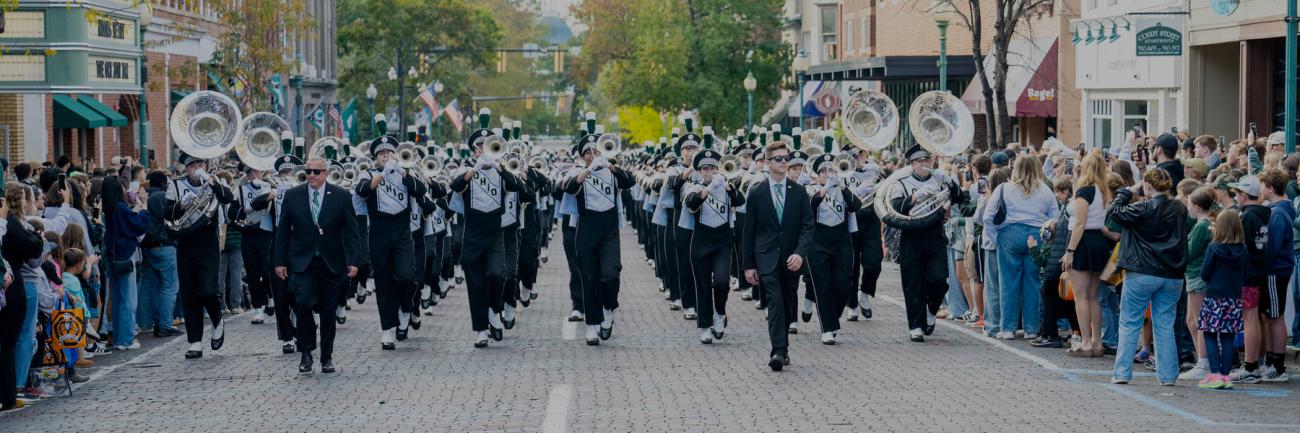
School of Music large ensemble offerings include choral groups, Concert Bands, symphony and campus Orchestras, three symphonic bands, Jazz Ensembles, and the Marching 110. The Opera Theater presents at least one main stage production each year as well as a recital of opera scenes.
-
Wind
In addition to the large performing Concert Bands, Orchestras and the Marching 110, students may choose to participate in small mixed groups including the New Music Ensemble, jazz combos, and various woodwind, brass, and string chamber ensembles. Like-instrumental ensembles include Flute Choir, Clarinet Choir, Saxophone Quartets, and more.
Conducting Master of Music Courses & Curriculum
View Courses & Requirements in the Official Academic Catalog
The curriculum for the Master of Music degree in conducting (choral, orchestral, wind) is in compliance with the National Association of Schools of Music standards. The degree program emphasizes live contextual experiences that enhance the student’s manual/baton technique, non-verbal communication, rehearsal skills, aural differentiation, and musical interpretation. Additional related studies include theory, history, literature/repertoire, score study and analysis, as well as continued study in the candidate’s particular applied area (instrumental or voice).
Recital: Each student accrues conducting time in public performances. The total of these appearances serve as the degree recital. All performances, both on- and off-campus, will be arranged in conjunction with the major professor and must be approved by the conducting faculty. These experiences are the foundation for developing highly qualified, professional conductors of bands, choirs, and orchestras.
Tracks & Mentorship: Each of the three degree-tracks features a mentorship between the student and the major faculty member, allowing for close interaction and evolving discussion on various aspects of conducting. Within the apprenticeship model, the students gain experience in nearly every area of their major conducting faculty’s teaching and administrative responsibilities. Graduate conducting students are assigned a conducting load so that they are always in one, if not multiple, rehearsal cycles between the various ensembles in their area, which grants them the chance to work with a variety of skill levels and to develop a broad range of repertoire.
Throughout the duration of their residency (usually two years), a graduate conducting student will rehearse and perform with the appropriate select ensemble(s) multiple times. The faculty members encourage additional research and discussion in conducting literature, repertoire, organizational psychology, program philosophy, and physical efficiency and health to offer a holistic perspective and preparation in the field.
Admission Requirements
Qualified candidates should submit a face-to-the-camera digital video (DVD, mp4, YouTube video are some of the possible formats) demonstrating 10-20 minutes of their conducting ability in a rehearsal or performance situation. Pending approval by the conducting faculty, prospective students will be invited to campus for an audition/interview.
All auditioning students will:
- Rehearse and conduct a major university ensemble.
- Perform a representative work on their major instrument that demonstrates technical ability and musical competence.
- Demonstrate sight-singing and aural skills.
- Demonstrate keyboard facility.
- Interview with the conducting faculty.
- Meet with the current graduate conducting studio.
English Proficiency Requirement: Please review information about Ohio University's minimum English Language Proficiency requirements for graduate study.
School of Music Graduate Auditions & Admissions
International Students
This program permits full-time enrollment in residence at Ohio University, and an I-20 may be issued based on admission to this program.
Share Your Musical Interests
The School of Music at Ohio University offers a variety of musical ensembles designed to meet the educational and artistic needs of our majors, and also qualified students from other academic disciplines who wish to continue their involvement in music performance.
School of Music large ensemble offerings include choral groups, symphony and campus orchestras, three symphonic bands, two jazz ensembles, and the marching band. The Opera Theater presents at least one main stage production each year as well as a recital of opera scenes.
In addition to the large performing ensembles, students may choose to participate in small mixed groups including the New Music Ensemble, jazz combos, and various woodwind, brass, and string chamber ensembles. Smaller vocal ensembles are often formed from within each choral group. Like-instrumental ensembles such as Flute Choir, Clarinet Choir, Saxophone Quartets, Brass Quintets, Trumpet Ensemble, Trombone Choir, Tuba/Euphonium Ensemble, Percussion Ensemble, and Jazz Percussion Ensemble are also available to interested students.
OHIO's Performing Arts Series
Ohio University's premier concert and performance series, organized by the Division of Student Affairs, and hosted in venues across campus, while primarily staging concerts and events at the Templeton-Blackburn Memorial Auditorium.
The Performing Arts series is home to a wide variety of arts and entertainment, from Grammy-award winning Kenny G and South Africa's Ladysmith Black Mambazo to the Wizard of Oz play and country singer Sara Evans. The Memorial Auditorium and Stuart’s Opera House host some of the University and community’s top shows, acts, and events. We also host a regular film series and an acoustic showcase for movie and music buffs alike.
Our Faculty Expertise
The conducting faculty are very active at the state, regional, national, and international levels as guest conductors and lecturers and have extensive experience in conducting and conducting pedagogy.
-
José Rocha
Recognized as a vibrant cellist and educator, Dr. Rocha has enjoyed a diverse musical career that includes collaborations with Ray Charles, Bobby McFerrin, and many more. An active chamber musician, Rocha has performed recitals throughout Europe and Latin America.
-
Richard Suk
Dr. Suk is director of the Marching Band, known as "the most exciting band in the land." The Marching 110 is known throughout the U.S. as one of the finest show bands, incorporating precision dance routines with its excellent musicianship.
-
William Talley
Dr. Talley is the Director of Bands at Ohio University, where he directs the wind symphony and teaches graduate and undergraduate courses in conducting and wind literature. He is an active arranger and transcriber of music for wind ensembles.
-
Justin McCrary
McCrary, a native of North Carolina, is the current Assistant Director of Bands at Ohio University in Athens, Ohio. Prior to his current appointment, he taught for over 10 years in the public schools of North Carolina.
-
Peter Haley
Dr. Haley serves as Director of Choral Activities and Assistant Professor Music at Ohio University, where he conducts the Ohio University Singers and Singing Men of Ohio and teaches undergraduate and graduate courses in conducting, choral literature, and music education.
-
Daniel Stein
Tenor Daniel Stein, whose voice has been described as “warm and flexible,” has an international career performing opera, concert, and recitals. An Ohio native, he has performed leading roles with many professional opera companies.
-
Contact Us
For additional questions regarding conducting programs, please contact the appropriate band, choral, or orchestral program director:
Dr William Talley
Band
wtalley@ohio.eduDr. Peter Haley
Choral
pahaley@ohio.eduDr. José Rocha
Orchestra
rocha@ohio.edu
Ready to Get Started?
Related Programs
-
Graduate Conducting CertificateThe Graduate Conducting Certificate Program benefits students seeking to teach music in public schools, perform, or study conducting at the graduate level by providing in-depth skill development.
-
Undergraduate Conducting MinorThrough Ohio University's minor in conducting, undergraduate students may further develop their conducting skills so they can become more knowledgeable and marketable in the field.
-
Music Performance and Pedagogy (M.M.)Within the area of Performance, students may elect a Master of Music degree in Performance with an emphasis in pedagogy. The goal of the pedagogy emphasis is to prepare students for college level teaching, public school teaching, as well as to develop and strengthen their own private studios.