
Enrollment, Registration, and Continuing Graduate Student Services
Grad Mass Hours, Transfer Credit, and Limits on State Subsidy for Enrollment
Students with previous graduate coursework may have credit on their transcripts before enrolling in any OHIO courses.
“Grad Mass” hours
For subsidy reporting, students entering OHIO with graduate degrees completed external to Ohio University are credited with a group of transfer hours that reflect the awarded degree. Completed master’s degrees are credited as 34 “grad mass” hours. Completed doctoral degrees (e.g., Ph.D., J.D., M.D., D.P.T.) are recorded as 80 hours. In instances where a terminal degree is a first professional degree (e.g., RN to MSN, Pharm.D.) fulfilling the bachelor’s equivalency requirement, grad mass hours are not recorded. Likewise, if international bachelor’s equivalency is confirmed using a portion of a post-baccalaureate degree (e.g., Indian BA/MA, BS/MS), grad mass hours are not applied for the master’s degree.
The state requires these hours to appear in the student record in order to account for completed degrees in calculating total number of hours remaining that are eligible for state subsidy. They are added to a student’s record once final documents for previously earned non-OHIO graduate degrees are received. Grad Mass hours count toward the hours required for the OHIO degree, but cannot substitute for any particular courses in the degree program or affect GPA calculations.
Transfer credit
Master’s degrees: Students may transfer eligible graduate courses or hours from another institution with approval of the academic program and the college dean. A maximum of 25% of the hours in a master’s degree may come from another institution (or up to 8 hours if the degree only requires 30).
Doctoral degrees: Students may transfer a maximum of 25% of total graded coursework requirements for the degree, subject to eligibility requirements and approval by their individual program and the college dean. Exceptions to this policy may be made by the Dean of the Graduate College upon recommendation of the student’s department chair or graduate program director and the associate dean of the student’s college.
Certificate programs: Certificate programs of 12 hours or fewer can transfer a maximum of one course (up to four credit hours). Certificate programs longer than 12 hours can transfer no more than 25% of the total graded coursework.
Transferable credits must meet the following conditions:
- Earned through a regionally-accredited university or the international equivalent.
- Designated as graduate credit and applicable to a graduate degree at the institution where taken, and taught by members of that institution’s graduate faculty. Letter-graded B or better. Ungraded courses or those carrying a credit/no credit or pass/fail grade scale cannot be transferred.
- Earned in the last five years;.
- Have not been used to satisfy requirements for completion of another conferred degree.
- Credit is not accepted for courses taken by correspondence.
Transfer credit process
The student and the Graduate Director or Graduate Program Chair complete a transfer credit form (available on the Graduate College Forms website). The form is forwarded to the associate dean of the student’s college for approval. The complete/signed form is sent to the Graduate College for processing in the student’s record. Transfer credit cannot be processed unless there is an official copy of the transcript on file with the Graduate College or attached to the transfer credit request.
Petitions for transfer credit are accepted after the start of the first semester of enrollment. Students are encouraged to discuss transfer plans with the academic program during the application process.
Transfer credit forms should be submitted within the first year of enrollment, at the earliest possibility.
Academic programs can waive DARS requirements based on prior academic work without formally requesting transfer credit. If a waived requirement will create a credit shortfall, the difference can be made up with elective courses.
Calculating the five-year limit on eligibility: Five years is the span between the end of the term in which the class was completed and the start of the semester of the beginning of the Ohio University degree program. For example, a course ending in spring term is eligible for transfer until summer semester 2027. It would expire prior to the start of fall semester 2027.
Transferring courses taken after matriculation in an Ohio University graduate program
With consent of the student’s academic program, courses taken at external institutions can be applied to the student’s Ohio degree program, provided they meet all transfer eligibility requirements. Many institutions offer a “Transient Student” status to graduate students in good standing at an external institution.
- Courses taken at institutions outside the United States can be transferred with advance approval from the student’s academic program, provided they meet all transfer eligibility requirements. Refer to the Global Experiences Transfer Credit Approval Process | Ohio University for details.
A Note on credit hour subsidy eligibility
Prior degrees and transferred coursework, as well as hours in the current program, affect whether a student’s hours will result in the university receiving state subsidy. Any graduate student exceeding 172 registered graduate credit hours at the beginning of the semester cannot be included in the university’s subsidy count for the Ohio Department of Higher Education Subsidy report.
- Registered graduate credit hours include Grad Mass and transferred courses as well as OHIO hours.
- Audit hours are not counted toward the 172-hour maximum.
- Students who are in doctoral programs but have not yet accumulated 34 hours are classified as master’s students for subsidy. This can occur with direct entry doctoral programs.
- Credit-hour subsidy eligibility is also determined by type. Different subsidy ranks are used for students in MBA and M.Ed. programs and professional doctoral programs (e.g. D.P.T, Au.D.).
A corollary to all this is that tuition waivers are no longer partially subsidized by state funds when students have accumulated the total number of eligible hours. On the other hand, a full half of per-student state funding is disbursed based on degree completion, so reducing time-to-degree and providing students with adequate resources to complete in a timely manner are both important economic imperatives for graduate programs.
Registration Procedures
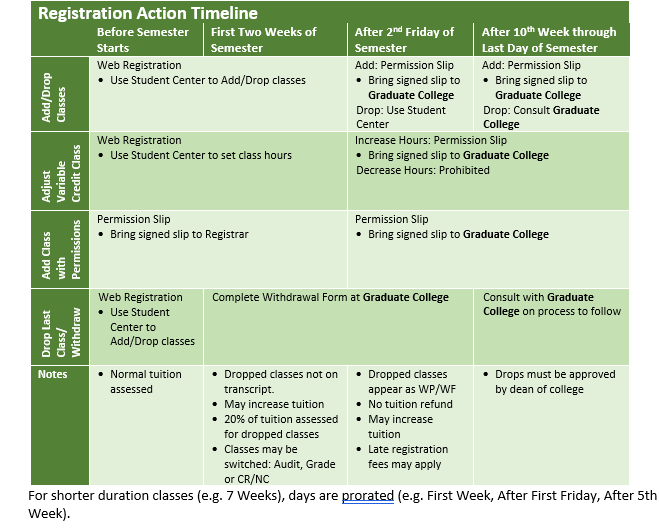
Registration policy and procedural details for students are outlined in the Graduate Catalog, section “Academic Policies & Procedures: Registration Information.” Table 6 provides a timeline of what processes must be followed to register or change registration throughout the term. Additional information for departments is outlined below.
Table 6: Registration Action Timeline
Students are responsible for registration
It is the student’s responsibility to be aware of all registration procedures and deadlines. As students are financially liable for all fees associated with registration, the Registrar’s Office and the Graduate College strongly prefer that students manage their own registration. New graduate students cannot until their admission record is matriculated, they have completed the identity verification process, and their account is term activated.
Matriculation Schedule:
Ohio Online/ECAM programs
Athens/Dublin programs
Please assist students in maintaining accurate registration by taking the following actions:
- Encourage students to use the registration system for all registration activity. If an error message results, have them contact the office noted on that message.
- Encourage students to follow registration procedures outlined in the Schedule of Classes and adhere to posted deadlines.
- Encourage students to review their class schedule. The class schedule is sent via email to the student’s OHIO email account or can be viewed online through their MyOHIO Student Center and the Go OHIO mobile app. Any problems should be reported promptly to allow time for change or petition processes to work.
- Encourage faculty members to compare class rosters with the students in attendance.
- Students and their faculty advisor can access a DARS report online.
Withdraw/Drop deadlines for individual classes are noted for each class in the Course Offerings and also in the student’s portal view of their course schedule (Figure 5). The calendar icon to the left of the course expands to show the deadlines for dropping an individual class and withdrawing from all classes for the semester (Figure 6).
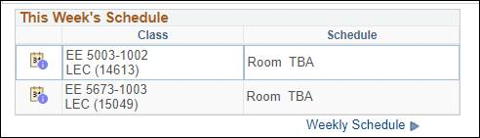
Figure 5: Student Center Course Schedule View
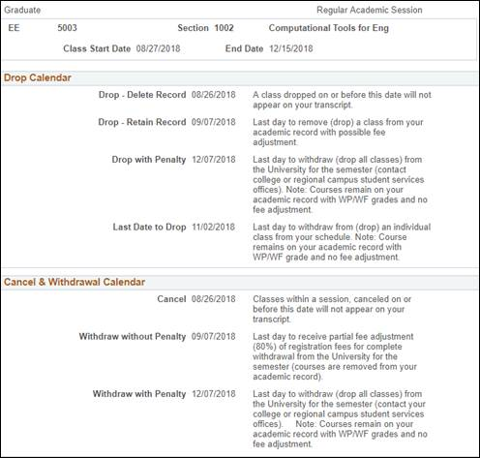
Figure 6: Detail of Course View
Student statuses allowing registration for graduate courses
To register for graduate-level course (5000 and above) a student must hold a valid admission and one of the statuses qualifying for graduate registration (See the Application and Admission section). Special cases:
- Students holding Post-Baccalaureate status (program code ND9951) are eligible to register through a regional campus in any semester but may register for Athens campus courses during summer semester only.
- Undergraduate students seeking to register for graduate courses must either hold Honors status (HTC, Departmental Honors student, OHIO Honors), apply for Senior for Graduate Credit status, or be enrolled in an Accelerated Graduate Pathway. NOTE: Graduate courses taken under Senior for Graduate Credit status or under an AGP will create a Graduate DARS and graduate grade point average. They appear on the transcript as graduate level courses.
- Honors Tutorial College students may take graduate courses either for undergraduate or graduate credit. For a graduate course to count as graduate credit, an HTC student must complete an HTC Undergraduate for Graduate Credit form. If this form is not completed, the course will count in the undergraduate GPA and will not appear on a Graduate DARS.
- Department Honors: Students in a recognized department honors program may take a maximum of three graduate-level courses in their major department during their senior year (i.e., after earning 90 or more hours of credit). Hours earned in these courses will count toward total hours required for graduation and the grades will be calculated into the undergraduate GPA unless a Senior for Graduate Credit form is completed.
- OHIO Honors: Students in the OHIO Honors program may take a maximum of three graduate courses during their junior and senior years (i.e., after earning 60 or more semester hours of undergraduate credit). Hours earned in these courses will count toward total hours required for the undergraduate degree only; the grades will be calculated into the undergraduate GPA. Registration in graduate courses requires written permission from the instructor. Participation in this option is at the discretion of the department or school. Qualified students can be registered by obtaining permission from the Director of OHIO Honors (or designee) and submitting the approval form to the Registrar’s office for processing.
Registration basics
- Students enrolled in the previous semester (or spring for a fall registration) will be active in the succeeding semester.
- Students who have not maintained continuous registration are classified as returning students. A student who has previously attended OHIO as a graduate student and still has valid graduate status can register. If the student is in a program requiring continuous enrollment (CE), the student may need to register for missed CE hours. See Reenrollment below.
- DARS exceptions are handled by the respective academic college/unit that “owns” the program.
- Graduate status ends when the student completes the degree or certificate program, reaches the maximum time limit for a degree or certificate, or completes the maximum number of credits allowed under non-degree admission. In these cases, a new application is required before additional graduate registration is allowed.
Matriculation, missing documents, and registration holds
Following the close of registration each semester, the Graduate College runs a report checking admitted students for registration and application file completion status.
No shows
Admitted students who are not registered by week 5 of their first semester are handled as “No Shows.” These students must request a deferral from and be readmitted before they can register for a subsequent semester.
Missing documents
- Admitted/registered students with missing or incomplete application documents are sent a letter outlining what document(s) are still missing. A registration hold is placed to prevent preregistration for subsequent semesters pending receipt of missing or final documents. As documents are received, the Graduate College updates PeopleSoft. Holds are lifted once all documents have been received.
- When US transcripts are incomplete, the Graduate College requests the student to obtain an official, complete one.
- Official/final transcripts from U.S. institutions are available to students with a properly placed request. Most institutions include transcript request information on their web pages. This is generally a function of the Registrar’s office. Schools that have ceased operation have another institution acting as the record repository.
- Colleges and universities reserve the right to refuse to release official transcripts if the student has failed to meet all obligations to that institution—often something like unpaid library fines. Ohio University honors this action and will not excuse a student from the requirement to provide final/official transcripts due to the inability to get a transcript due to a hold.
- In this case, the Graduate College may opt to place a missing credential hold, which allows registration but does not allow release of an OHIO transcript or a diploma. The student may be asked to provide certification from the previous institution that he/she is actively working to clear up their record and work toward release of the necessary document(s). A credential hold allows continued registration but holds the student accountable for the missing documents.
- When international documents are not yet available, special consideration is given. Some countries take many months to provide students with graduation certificates or diplomas showing conferral of a degree.
- In the event that final documents are not available, the Graduate College will lift the registration hold immediately preceding the next semester (not during pre-registration). The registration hold is replaced following the close of registration.
- If final documents will not be available for some time, the Graduate College may opt to place a missing credential hold, which allows registration but does not allow release of an OHIO transcript or a diploma. This allows continued registration and holds the student accountable for the missing documents.
Incomplete prior degree
When a student fails to complete requisite degree to retain their admission status (e.g. completed bachelor’s degree or completed master’s if admission to Ph.D. program is based on earned master’s), the following processes will be applied.
- In the event a student fails to complete a bachelor’s degree, that student’s status will be changed to undergraduate unless he/she qualifies for early admission as a graduate student. This process is coordinated between Graduate College and the student’s graduate program. The student may qualify for Senior for Graduate Credit. Because initial program acceptance is provisional on completion of the undergraduate degree, this process may occur before the end of the first semester of graduate study (i.e., before the official transcript is finally due) if the Graduate College otherwise confirms that the degree is incomplete.
- In the event a student fails to complete a requisite master’s, the student may be returned to master’s status. In some cases, the student may be allowed to remain in doctoral status pending completion of the master’s degree. In these cases, the Graduate College will request that the program provide to the student written documentation regarding the deadline for completion of all requirements for conferral of the master’s degree, usually not to exceed the duration of the first semester of doctoral standing.
Continuous enrollment
Students in programs subject to the continuous enrollment policy and who are not on an official leave of absence will have a registration hold placed to prevent to prevent reenrollment without registering for required missing CE hours. See Reenrollment below.
Academic probation
Students with a cumulative GPA under 3.0 are placed on academic probation and a registration hold will be applied. For more details about Probation status, see Academic Probation/Dismissal below. Following the end of the semester, the Graduate College reviews students with academic probation holds for current semester grades. Academic probation holds are removed when students have all grades posted and have cleared probation, or when all grades are posted and students have met the agreed-upon requirements for continued enrollment on probation.
Changes in registration
Registration guidelines, procedures and deadlines are published by the Registrar in the Schedule of Classes (https://www.ohio.edu/registrar/academic-calendar). During the registration period, students may register and make any changes to their schedule. Unless there are extenuating circumstances, registration and changes should be completed during the posted registration period.
After the Friday of the second week of the semester (Friday of the first week of a 7-week session), the registration snapshot for reporting to the Ohio Department of Higher Education (ODHE) is taken. Changes made after the Friday of the second week of the semester (Friday of the first week of a 7-week session) have the potential to impact ODHE and subsidy reporting, so we require administrative approval procedures for later changes.
Adding and dropping courses
- Deadlines for course adds, drops, and hour changes:
- Adding a class or changing registration hours or grading option in an existing class can be done online through the second Friday of the semester (Friday of the first week of a 7-week session).
- A permission slip is required to add any course which requires permission or to change the number of hours for an existing course. Students can use the online permission process through their MyOHIO Student Center until the Friday of the second week of the term (Friday of the first week of a 7-week session).
- Adding after the Friday of the second week of the semester (Friday of the first week of a 7-week session) must be done by change order through the Graduate College. Students must bring the permission slip (“green slip”) to the Graduate College. The slips are processed and signed by the Assistant Dean of the Graduate College and then forwarded to the Registrar’s office. This ensures the inclusion of the late adds in the ODHE Subsidy Report.
- Students may use MyOHIO Student Center to drop any class except their last class (see Canceling Registration or Withdrawing from the University below) through the Friday of the 2nd week of the 14-week semester or the Friday of the first week of the 7-week session.
- Dropping courses before the semester begins will remove both hours and possibly fees on the student’s academic record.
- Dropping courses after the beginning of the semester and before the Friday of the second week of the semester (Friday of the first week of a session) may allow fees to be prorated.
- After the end of the second week (first week of a 7-week term) the credit hours for these courses remain part of the student’s permanent record (although the resulting “WP,” “WF,” or “WN” grades do not affect GPA). They are counted both toward minimum registration requirements for graduate appointments and the ODHE Subsidy Report.
- Any drop after the tenth week of the semester must be approved by the dean of the college via the “Petition to Drop a Class after the Tenth Week of a Semester” (“Dean’s Petition,” available online from the Provost’s Office at https://www.ohio.edu/provost/apfap/appeals-tuition.) Approved Dean’s Petitions must be returned to the Graduate College for processing, not forwarded directly to the Registrar’s Office. Poor performance is not usually a viable reason for withdrawing.
- Students wishing to change hours on variable-credit courses must drop and add the course unless the course is the only registered course. If the course is the only registered course, they need to complete a change order at the Graduate College.
Withdrawal
Withdrawal is the complete withdrawal from all courses prior to the day before the last day of classes for the semester in session. Withdrawal is not permitted after the last day of classes.
- Web registration cannot be used to drop the last class on a student’s registration. The student must contact the Graduate College to process a withdrawal.
- Withdrawal between the first day of classes and the Friday of the second week of the semester (Friday of the first week of a session) results in an 80 percent tuition refund and the courses will not be reflected on their transcripts. Graduate tuition scholarships are reversed from the student’s account if a student withdraws from the university before the second week of the semester (Friday of the first week of a session).
- Students who withdraw after the Friday of the second week of the semester (Friday of the first week of a 7-week session) will not receive a refund and will receive a “WP,” “WF,” or “WN” grade in each course. Withdrawal from a semester does not automatically remove a student from the program. Graduate tuition scholarships are NOT reversed from the student account if the withdrawal occurs after the Friday of the second week of the semester (Friday of the first week of a session). If a student is withdrawing from the program, please notify the Graduate College by email (graduate@ohio.edu).
- Students who withdraw when a graduate appointment is in effect receive a prorated stipend based on the work they did up to the point of their withdrawal. Departments need to coordinate this with the Graduate Appointments Administrator in the Graduate College.
- A student who is withdrawn from the university for Medical Reasons cannot be reinstated until the Dean of Students office receives a written clearance from a medical provider. The medical withdrawal and return process are outlined on the Dean of Students webpage, https://www.ohio.edu/student-affairs/dean-of-students/return-withdraw-m…;
Cancellation of registration
Cancellation is dropping all classes before the start of the semester.
- Cancellations result in a full refund of tuition and fees. Cancellations may be done via web registration prior to the first day of classes or through the Graduate College on the first day of the semester.
- For workshops, students must notify the department or campus student services office prior to the date of the workshop of their intent to cancel.
- Departments/Schools should notify the Graduate College if a student does not show up for classes, so that the Graduate College can process a cancellation or a withdrawal.
- Students who notify the Graduate College on the first day of the semester of their intent to cancel their registration are eligible for a cancellation of registration and fees. Students who are withdrawn via department request have the option to submit a petition for a tuition refund.
Tuition and fees when dropping classes, canceling rcegistration, or withdrawing
Students who drop classes, cancel, or withdraw may appeal assessed tuition and fees.
- Ohio University Tuition Refund Policy (12.050) states that students are entitled to a 100% refund of their tuition charges if all classes are dropped (registration canceled) before classes begin.
- Students will receive an 80% refund of charges if all classes are dropped by the Friday of the second week of the semester (Friday of the first week of a session).
- If all classes are dropped after the Friday of the second week of the semester (Friday of the first week of a session) no tuition refund is issued.
- The Tuition Refund Appeal Panel functions to approve exceptions to the policy above.
- The Tuition and Fees Appeal Form is to be used by students if they feel that their circumstances justify an exception to the regular tuition and fees refund policies.
- This form can also be used by the Assistant Deans to present reasons why exceptions should be granted in cases where university procedures or staff members are culpable.
- The completed form, accompanied by appropriate documentation must be delivered to the Graduate College.
- The Review Panel meets every other Tuesday. To ensure consideration of a request it should be turned in by Friday afternoon prior to the Tuesday when the Panel is scheduled to meet.
- An expedited version of the panel review process can be used by the Graduate College for specific late registration adjustments, including :
- changing class sections of the same course after the registration period for the class has ended.
- increasing credits in a flexibly-scheduled course.
- changes that are unique to graduate students, such as changing from research to project hours or changing thesis to dissertation hours.
- Requests for registration changes must be requested and approved by both the student and the instructor of record for the course.
- In the event a class is cancelled by the department, the department needs to work with the Registrar’s Office to ensure any registered students are removed from the cancelled course.
- These changes are initiated through email from the student or department to graduate@ohio.edu
Verification of registration
Enrollment and degree verification are available through the Registrar’s Office, https://www.ohio.edu/registrar/enrollment-and-degree-verification.
Employees registering for graduate courses
Employees must apply for and be admitted to graduate status as a degree, certificate, or non-degree student through the normal application process. To apply the tuition benefit, the employee must complete and submit the benefit forms as outlined on the HR website, https://www.ohio.edu/hr/benefits/educational-benefits/how-apply.
Conflict of interest: Full-time Ohio University faculty and administrators must also complete the Conflict of Interest Review process before registration is permitted. The employee’s supervisor and the admitting department graduate director must both complete the conflict questionnaire. These forms are distributed by the Graduate College after an admission recommendation had been made.
Graduate students taking undergraduate courses
To register for undergraduate courses, graduate students must submit the Graduate Student Seeking Undergraduate Course Registration form to the Graduate College prior to registration. Graduate College Forms | Ohio University. Refer to the Graduate Catalog “Enrollment” section under “Academic Policies and Procedures” for details.
Program Updates & Adding Certificates
Students who need to update their academic record with a new program or add a certificate must complete an “Application for Update of Graduate Academic Program” form, found on the Graduate College Forms page at Graduate College Forms | Ohio University. The completed form is submitted to the Graduate College for processing, and is required for:
- Adding a certificate to an existing graduate record.
- Changing major tracks within the same graduate program.
- Changing a student from Ph.D. to master’s level, or vice versa.
- Adding a master’s degree to an existing direct to Ph.D. program.
Reenrollment
Students who do not maintain continuous registration (with the exception of summer) must request reenrollment in order to register upon return. The reenrollment form is available on the Registrar’s Office page at https://www.ohio.edu/registrar/register.cfm#re-enrolling.
The completed form should be submitted to the Graduate College (not directly to the Registrar’s office) for processing. Students who have exceeded their degree time limit must reapply for admission before they can reenroll.
Students in Ph.D., Ed.D., or MFA programs are required to enroll for at least 0.5 credit hours in two semesters of each academic year to comply with the continuous enrollment policy (unless on an official leave of absence). Students who do not meet this requirement must register for missed continuous enrollment hours in the first semester that they reenroll (up to a total of 2 missed semesters or 1 credit hour). These hours are in addition to any fixed-credit courses and to the current semester’s continuous enrollment hours requirement. For more details, see the Graduate Catalog “Enrollment” section under “Academic Policies and Procedures.”
Name Change Requests and Preferred Name/Pronoun
Students wishing to change their legal names in OHIO records should contact the Registrar’s Office. Students can update their own preferred names/pronouns through the MyOHIO Student Center. Information about both legal name changes and preferred names/pronouns are available at https://www.ohio.edu/registrar/personal-info.
Fee Assessment Information
See the Graduate Catalog section “Fees, Insurance, and Residency for Tuition Purposes” for policy and rate details. Student registration fees are assessed based on level of student, not level of class (graduate students who take undergraduate classes are billed at the graduate rate). Students taking classes with Athens campus call numbers are assessed Athens campus fees, regardless of where the course is taught.
Students taking only undergraduate classes can apply for temporary change of level to undergraduate status through undergraduate admissions. They cannot take graduate courses while holding undergraduate status. Students must then apply for a change of level back to graduate status through the Graduate College to register for graduate courses in subsequent semesters.
Technical fees are not linked to which courses a student enrolls in.
- Students are assessed technical fees (College Tech Fees) for all open programs on their PeopleSoft record.
- The only way to remove a technical fee is to withdraw from a program. To do this a student must notify the Graduate College within the first two weeks of the semester. However, students requesting to drop a program must reapply and be readmitted if they wish to pursue a dropped program in the future. In addition, the academic program retains the ability to apply credits earned prior to dropping a program toward a readmission. Students will be readmitted under the catalog in effect at the time of readmission. Credit for previously earned courses may not be given if course work is more than six years old.
Leave of Absence
Students may declare an official leave of absence for up to one year during graduate study, during which time they are understood to be neither substantially working on degree requirements nor using any university resources (including faculty time). For purposes of continuous enrollment requirements, only one leave of absence may be declared. The form for declaring a leave of absence is found at Leave of Absence Form. The full policy is outlined in the Graduate Catalog “Academic Policies and Procedures.”
Time Limits for Degrees and Readmission
Generally speaking, students admitted to master’s degrees requiring fewer than 40 hours generally have six years to finish the degree, while research doctoral degrees and master’s programs requiring 40 or more hours have seven years. Specific programs may have more stringent time-to-degree requirements, however.
Under exceptional circumstances, the dean of the academic college may permit an extension of the time limit, through the next consecutive semester only (including summer). When the time limit is not extended, or when a student does not complete the degree during the semester of extension, the student must reapply to the program in order to continue or receive the degree. The graduate committee of the program and the dean of the college must review the readmission application, and the currency of coursework and research should be evaluated to see if any must be retaken. Readmission requires specifying the conditions in writing, including the amount of time permitted for completion, with a copy of the terms forwarded to the Graduate College.
Academic Probation/Dismissal
Graduate students are expected to maintain a minimum cumulative GPA of 3.0. Conferral of any degree or certificate requires a cumulative GPA of 3.0, and the GPA cannot be “rounded up” to achieve a 3.0. No course with a grade below C (2.0) may be used to satisfy any graduate degree or certificate requirement. Unlike undergraduate retakes, repeating or retaking a graduate-level course will not remove or replace a grade from a previous attempt. The Probation policy is outlined in the Graduate Catalog in the “Standards of Work” section under “Academic Policies and Procedures.”
Students on probation have an account hold preventing registration for future terms. The hold is in place until all current term grades are reported and reviewed. If the cumulative GPA is 3.0 or higher, the hold and probationary status are removed. Students who fail to clear probation but are allowed additional terms of registration will continue to have registration holds in place so that their status can be reviewed before further registration is allowed.
The Graduate College maintains probationary status within PeopleSoft. Departments are responsible for advising students on probation about the steps necessary to return to good status. Please forward copies of correspondence to students regarding probation or academic suspension or dismissal to the Graduate College for inclusion in the student's file.
Graduation and Commencement Ceremony
Degree conferral is not automatic. Students must apply through the Registrar’s Office to initiate the degree conferral review (https://www.ohio.edu/registrar/graduation).
Doctoral students wishing to participate in the commencement ceremony for hooding must register with the Graduate College using the Doctoral Commencement & Hooding Registration form.
Each doctoral graduate must be accompanied for hooding by a faculty escort who holds an appropriate terminal degree and Ohio University faculty status. Students are limited to one escort except in the case of students in interdisciplinary degrees who have two declared co-chairs of the dissertation committee. Requests for escorts who are not current OHIO faculty must be cleared through the Dean’s Office of the student’s academic college, with notification to the Assistant Dean of the Graduate College.
Eligibility for Commencement ceremony: doctoral student
Doctoral degrees are conferred just prior to the commencement ceremony. Students must have a conferred degree in order to participate in the ceremony. This means that, under normal circumstances, all program requirements have been met, and, if a dissertation is required, it has received Final Clearance through the TAD process by the deadline for that semester. (See Thesis and Dissertation Services for details.)
Exceptions to this rule may be approved in very limited cases when students fail to meet the requisite deadlines for graduation due to extenuating circumstances. To be considered for an exception, the following must obtain:
- The student must successfully defend their dissertation and file a final version of the document by the Friday prior to Graduate Commencement Ceremonies.
- Exception requests must explain the extenuating circumstances and be submitted by the dissertation advisor to the program’s graduate chair/director, who then submits it to the associate dean of the student’s academic college. If the associate dean supports the request, they forward it to the Graduate College Dean (copied to the Graduate College Assistant Dean) for a final decision. The associate dean’s endorsement must confirm that the student is on track to meet all requirements for the degree no later than the end of the subsequent semester.
- Exception endorsements from the academic college must be received by the Graduate College (copied to the Assistant Dean) no later than 5 p.m. Friday, the week prior to commencement ceremonies.
Students granted an exception will not have their name in the commencement program and will not receive their degree until all requirements are completed and degree conferral is complete. The student must reapply to have the degree conferred by completing the graduation process through the Registrar’s Office.
Eligibility for Commencement ceremony: master’s students
Master’s students have the same rules for participation in Commencement as undergraduates. For the spring ceremony, students must apply for graduation by the spring deadline and either complete their requirements by the end of spring or indicate that they will complete requirements in summer. For the fall ceremony, students must have completed requirements in the summer or file an application for fall graduation and complete the requirements that semester.
Custom regalia
Ohio University offers custom OHIO regalia through Oak Hall Cap & Gown. Custom OHIO regalia is available for doctoral and master’s degrees. Ordering information can be obtained directly from Oak Hall, https://oakhalli.com/product/special-regalia/