
Application and Admission
The Application System
All graduate applications go through the graduate instance of Slate, the university CRM for recruitment and applications. The Graduate College builds application forms for each program individually, allowing for considerable customization within our brand standard. Programs using a Common Application System (CAS) for their disciplines have varying methods of entering applicant information into Slate. For more information, contact the Graduate College Director of E-Systems.
Customizing Application Information and Requirements
The online application has space to provide program-specific information, which is visible to the applicant when they select that program code. All document requirements to complete an application will be drawn from the Graduate Catalog. For assistance, please contact the Director of E-Systems.
Updating Application Admission Terms
Applications in Slate will be open for terms listed in the Graduate Catalog as possible terms of entry.
Applying
Who can apply to graduate programs or take graduate courses?
To register for graduate-level courses, students must generally apply and be admitted with graduate status. In most cases, this requires an earned U.S. bachelor’s degree or equivalent by the time of registration. Current undergraduates meeting particular requirements, however, may take a limited number of graduate courses for graduate credit while remaining in undergraduate status or (in the case of honors students) take graduate courses for undergraduate credit.
Please see the Graduate Catalog section “Application and Admission,” Special Admission Status Types below, and Minimum university requirements below for more information.
Where is the application?
The online applications are found at this webpage. If you wish to link to the application from your program website, please do so via the Graduate College application page so that applicants are aware of relevant university policies and requirements.
When do applicants need a new application?
Each application is good for one program and one term of application.
Deferral/change of admission term
Students who need to defer an application to a subsequent term or who wish to change their term of admission must submit an application for the new term. There is a $10 processing fee for submitting a change of session application (rather than a new application fee).
- Domestic students who have been admitted may (with the permission of the program) defer their admission term using an application “cloned” from the existing application by the Graduate College. The Graduate College will perform this service when the program does not need to reconsider the application for admission in the next available semester. The student must still submit the cloned application and pay the $10 fee, unless the program chooses to pay for the deferral through an application fee waiver.
- International students who have been admitted will need to submit a new application.
- Applicants who have not been admitted will need to initiate their own reapplication in Slate. Instructions for changing application or admission terms are found at https://www.ohio.edu/graduate/apply/change-application
Change of program
A separate application is required for each degree program, except for designated dual-degree programs (e.g. MBA/MSA). Students in certain direct-admit doctoral programs may also be able add the associated master’s degree plan without submitting an application.
Sometimes a student wishes to change program codes within the same umbrella program. This may not require a new Slate application. For example, students who wish to change an application for the same program offered in a different delivery mode (e.g., campus-based to online) or wish to change a specialization or track within the same degree program (e.g., Social Work to Social Work-Advanced Standing) can request support from the admitting department who may in turn send that request to the Graduate College. The Graduate College will determine the feasibility of a change of program request made by an applicant.
Readmission after Expiration of Time Limit
A student who fails to complete a degree within the maximum time allowed by university policy may apply for readmission to the program. Readmission is at the discretion of the program. See Time Limits for Degrees and Readmission in Section 8.
Application fees and waivers
Application fees vary by admission type and are slightly higher for international applicants. Subsequent applications and changes to existing applications are generally less expensive. Fees can be found by clicking on the appropriate application type from the application page.
Programs interested in offering application fee waivers can request a waiver code through the Graduate College. Programs must provide an account number to be charged each time the waiver code is used. Contact the Director of E-Systems to set up an application fee waiver code.
The Graduate College offers a waiver to the application fee for degree-seeking applicants who are participants in the Ronald E. McNair program. The process for requesting a waiver is outlined at this webpage.
Application Deadlines
To allow for admissions consideration, Graduate College processing, and possible visa issues, the Graduate College recommends these application deadlines as the absolute minimum for degree seeking applicants:
Table 1: Recommended Final Application Deadlines
| Applicant Type | Fall | Spring | Summer |
|---|---|---|---|
| U.S. Citizens/Permanent Residents, international applicants who do not require a student visa | 8/1 | 12/1 | 4/1 |
| International Applicants who require a student visa | 3/15 | 9/15 | 12/1 |
The Graduate College does not, however, automatically defer or deny domestic applications received after these dates. It also allows applications to be available for submission unless the program has set periods in which they should be closed. (The Graduate College does require minimum times to process final admissions after programs recommend admission; please see below under Admission Policies and Procedures for admissions deadlines.)
Departments and schools must thus set their own deadlines for applications and/or limit the period in which applications are accepted. Please list your deadlines in the Graduate Catalog and on your web page. Slate can only enforce deadlines for application by closing the application for that term. Prior to opening applications for admission to a given term, programs will be asked to verify the date for closing the application. To request changes to the term open/close dates after that census, or to briefly open reopen availability of a specific term for a late applicant, please contact the Graduate College Director of E-Systems.
How Applications are Processed
Applications require not only that the student complete, submit, and pay for an application, but also some manual processing at the Graduate College before they are marked Complete and before a recommendation of admission can be made by the program. These steps are necessary to ensure that an applicant is admissible.
For more detailed information about transcripts and other application materials, see the following two sections.
Getting the necessary documents to the Graduate College and the program
Preferred method: via the Slate application
Most information from the application in Slate automatically load to PeopleSoft and admitted student materials such as transcripts will load to OnBase, our document management system. If this process fails, the Graduate College staff will match orphaned data and files to the correct application. PeopleSoft and OnBase, in turn, send information and materials back to the Slate system. To ensure that applications are complete, accessible to all reviewers, and preserved, students should be instructed to submit their materials through the Slate application. However, if any changes in student application information is received by the department/school directly, it should be sent to the Graduate College so that PeopleSoft is updated.
Work-arounds and fall-backs
Documents not uploaded with the original application are collected in person or as a last resort, via direct mail.
If electronic or paper letters of recommendation are received at the Graduate College separately from the online application portal, they are uploaded and made available in Slate.
Checklists and To Do items
Prior to admission the online application portal carries a To Do list that displays a checklist for documents not yet received. Department application reviewers can see this list in the Checklist Items section of the student record in Slate Reader. Checklist items are posted if any documents or test scores required in the application are missing.
When the required materials have been submitted and the associated checklist items are complete, the application becomes reviewable by the department.
Departments have the ability waive certain checklist items in Slate Reader. Letters of recommendation may be waived in the Reader, but it may take up to one business day until the checklist item is updated to reflect the waiver request.
When can the application be reviewed for admission?
Applicants must pay the application fee or provide a valid waiver code before a submitted application writes from Slate to PeopleSoft. Only after that step is the application viewable by program faculty.
Students can work on an application over a period of time before submission and payment. Students are encouraged to upload copies of official transcripts and supporting materials with the application, and these materials are available for review after application submission/fee payment.
An application becomes reviewable for admission in Slate Reader when 1) All materials required by the program are received or waived 2) a baccalaureate transcript has been received and verified as a U.S. bachelor’s equivalent, or a transcript/evidence of baccalaureate progress has been received and reviewed; 3) any Felony or Disciplinary Review issues have been addressed; and (for non-native speakers of English) 4) English proficiency requirements for admission are shown to be met. Applications that do not yet meet these three criteria are shown in Slate Reader as Incomplete.
Official transcripts are only required if a department recommends an applicant for admission. Departments that require official transcripts for application review must notify the Graduate College so that this information is incorporated into application instructions provided with the application. See Transcripts for Admission for further information.
How does the felony review process work?
Applicants are asked to disclose whether or not they have been suspended/dismissed from an institution; whether they are eligible to return to all prior institutions; and if they have been charged with or are under indictment for a felony or were charged with or under indictment for an act committed as a juvenile that would be a felony if committed by an adult. Legal Affairs reviews applications that answer any of these questions in the affirmative to determine if the applicant is admissible according to university standards. Students are also asked about disciplinary actions at previous institutions. If the student received some disciplinary penalty but were permitted to continue at the institution, the Graduate College usually clears the application to proceed to admission review.
Transcripts For Admission
With the exception of students in particular Ohio University programs, all students admitted to graduate status must demonstrate they have earned a U.S. bachelor’s or equivalent degree prior to beginning their graduate degree program. (Students who have not completed their bachelor’s degree at the time of application must demonstrate that they are on track to have a conferred bachelor’s degree prior to the beginning of the graduate degree program.) Students must also submit the following beyond the bachelor’s:
- An official transcript from each institution where a bachelor’s degree has been or will be granted.
- An official transcript from any institution attended after completing a bachelor’s degree, or from which any graduate coursework was attempted, regardless of whether or not a degree has been or is being completed.
- An official transcript from any college or university attended within the past four years from which credit was or is currently being completed.
For application purposes, unofficial transcripts are acceptable. Accepted students must, however, provide official transcripts.
What is an official transcript?—U.S. or Canadian
To be official, transcripts must be received in an envelope sealed by the issuing institution or through a direct electronic transcript delivery service. Transcripts opened prior to receipt are not considered official and the student will be asked to re-submit. If an official transcript is opened at the academic program, please attach the original envelope to the transcript, indicate the transcript was opened at the department, and forward the official transcript to the Graduate College. A domestic diploma is not evidence of degree completion or a substitute for an official transcript.
For information about official international transcripts other than those from Canada, please see International Applicants: Special Admissions Procedures.
What is an unofficial transcript?—U.S. or Canadian
Official transcripts are not generally free and securing them can create delays. For that reason, unofficial transcripts are acceptable for reviewing applications and recommending admission. Similarly, incomplete transcripts may be submitted for students who are still completing a prior degree program at the time of application.
An unofficial transcript is one issued by the degree-granting institution (usually the Registrar’s office) that includes an institutional verification such as signature or stamp of approval but that does not meet all the criteria of an official transcript. In other words, it is a scan or copy of an official transcript that is in the possession of the student. Lists of courses not officially issued by the Registrar or equivalent are categorized as “DARS” in the application.
When is the official transcript due?
A final/official transcript showing the degree and date earned should be submitted prior to initial registration as a graduate student. Students graduating after the admission decision must submit an in-progress/official transcript and a letter from their college confirming whether or not they have completed all degree requirements, and whether the degree is expected to be conferred.
It is the student’s responsibility to see that final, official transcripts are on file at the Graduate College no later than the end of the first term of enrollment. If transcripts are not received by the middle of the first term, a registration hold is placed on the student’s account preventing pre-registration for the subsequent term. Failure to produce final transcripts may result in suspension or dismissal from a program. In addition, if it comes to the attention of the Graduate College after the start of classes that the bachelor’s degree is not complete, the student will need to switch to undergraduate status. Students admitted to doctoral-level study in programs that require completion of a master’s degree must present a final, official transcript prior to enrollment or within the first semester of enrollment to retain doctoral status.
Credential checks
The Graduate College reserves the right to conduct credential authenticity checks of academic documents. Copies of a transcript may be returned to the issuing institution for confirmation that they match the documents held at the institution. Transcript verification is also requested if it appears that:
- Documents have been altered
- Certification stamps are overly blurry or appear irregular
- Signatures do not appear to be valid
Unmatched transcripts
Transcripts received at the Graduate College without an application are retained for one year. If no matching application is received within the year, the transcript is destroyed.
Test Scores
Only test scores reported to Ohio University from the testing service are official. GRE scores are valid for five years. TOEFL/IELTS scores are valid for two years. These time limits are from the start of the application term and not the date of the application.
Other Admission Documents
Most paper documents received at the Graduate College are scanned and uploaded to Slate and saved to OnBase. Any document that cannot be scanned (e.g., books, non-paper items) will be sent in original form to the academic program. All materials for which the Graduate College staff cannot determine an appropriate department/school are kept in a pending file for one year. If no matching application is identified after a year, they are destroyed.
Fraudulent Application Documents
If the Graduate College discovers that transcripts, letters of recommendation, or other documents submitted by an applicant are forged or misattributed, they will be labelled in Slate as an Irregular Document and in OnBase as “Fraudulent Documents.” If reviewers at the program level suspect or confirm that a document is not what it claims to be, please pass that information to the Graduate College so that the documentation can be flagged. Under most circumstances, the Graduate College will not cancel the application based on misleading documents without consulting the program. Application reviewers who notice that an applicant has been denied or had an application withdrawn previously might be wise to check for fraudulent documents in those earlier applications.
Minimum University Requirements
The university sets no minimum GPA or GRE score requirement for admission. Requirements for English Language Proficiency are detailed in a later section. Programs may set minimum requirements for these as well as other relevant academic or professional criteria.
NOTE: If your program curriculum requires student participation in organizations that require a background check, include this information in your application and catalog information.
Admission Policies and Procedures
Recommending admission
Departments set their own procedures for reviewing applicants, but they must process those decisions in Slate . Unless a student is Reviewable and an admission recommendation can be made there, it is possible that the student does not meet minimum university admission criteria.
Departments do not admit students. Admission is recommended by the department and finalized by the Graduate College.
All admissions decisions are subject to the condition that the student have completed a bachelor’s degree before beginning the graduate program. Departments may impose additional academic conditions on admission by recommending Conditional Admission, but only for students who do not require a student visa in order to attend the university.
When recommending admission for international students, it is extremely important to note any financial awards that will be offered: that information will facilitate the issuance of an I-20. This information will also be used to create an offer letter on the fly that can be reviewed by the recommender prior to sending it to the student via their application portal.
Denying, waitlisting, and withdrawing
If you will not be offering admission to an applicant, you should deny, waitlist, or withdraw the applicant as soon as possible in Slate Reader.
When you deny an applicant, there is a 24-hour delay before the decision is recorded in PeopleSoft and then the application status updates to “cancelled” and an official email is sent to that applicant. If you select deny by accident, the Graduate College can withdraw that action in Slate Reader during the 24-hour wait period and no action is recorded in PeopleSoft. If you wish to rescind the denial more than 24 hours later, contact the Graduate College and we can return the application to “application” status so that you can recommend admission.
NOTE: Please do not send applicants department-specific denial letters or emails unless you are providing specific details about how the applicant can strengthen future applications.
If you believe the candidate is acceptable but have admitted a full cohort, you can use Slate Reader to set the student’s status to waitlist or withdraw. Waitlist triggers an email notification to the student alerting them of their application status.
You must admit, deny, or withdraw the applicant prior to the start of the admit term. If you withdraw an application (whether waitlisted or not) because no slot became available, use the Withdrawal for Admit Term Closed option.
NOTE: If you have recorded an admission offer in Slate Reader and the student contacts you directly and declines the offer, please use Slate Reader to withdraw that application—or, if the withdrawal option is no longer available, notify the Graduate College of the student’s decision. Recording the student’s withdrawal will remove that student’s name from Orientation and other beginning-of-program emails.
Conditional admission
- Students with some academic deficiency in their entry requirements may be approved by the department for conditional admission. The admitting department will specify the conditions—usually a number of hours with grade point average or completion of some prerequisite—that must be met in order to clear the student for unconditional admission.
NOTE: Departments have the responsibility to monitor conditionally admitted students and to notify them and the Graduate College when the students meet or fail to meet the conditions.
- Students admitted conditionally are not eligible for graduate appointments until their admission status changes to unconditional.
- The Graduate College monitors student GPA and will notify the department and academic college if a student GPA is below 3.0 after semester grades are posted.
International students cannot obtain a visa based on conditional admission. For guidelines on admission for students without adequate English language proficiency for graduate study, see English Language Study Provisional (EP) Admission below.
Finalizing an admission recommendation
Graduate College staff are notified of pending admissions in Slate. Staff will verify eligibility (a final/official transcript for the bachelor’s degree must be on file), and then a formal letter of admission is sent by the Graduate College to the student confirming:
- the degree program,
- entry term,
- admission status (see Admissions Status immediately below), and
- any documents required to complete the admission file.
Admissions status
Final
Student application file is complete and there are no special conditions to be met after matriculation (i.e., admission is neither conditional nor provisional).
Conditional
See Conditional Admission above.
Provisional
Students are admitted provisionally when they are missing some application documents, pending completion of a previous degree, or if some part of the application is incomplete.
- Students are asked to submit final, official documents before the end of their initial semester of registration. If documents are not received, a hold is placed on the student’s account, preventing pre‐registration for the following semester.
- The provisional status is removed once all documents are received.
- Holds placed for missing documents are not lifted for pre-registration. In the event a missing document is not yet available to a student, registration depends on which documents are missing. The Graduate College may request permission slips to register, or the hold may be modified to a transcript/diploma hold.
NOTE: Students who are unable to submit a final transcript showing the degree conferred by the start of their initial term of enrollment must submit an Enrollment Verification Letter from their college or university, verifying completion of degree requirements and indicating the expected date of degree conferral. This letter must be received by the Graduate College by the first day of the student’s term of admission.
Department letters to students
Although official, binding letters of admission will come from the Graduate College, it is good practice to notify applicants of your decision to admit them. This is especially true given that official letters will go out only after admission is finalized and do not carry information about funding offers.
Starting in Fall 2026, all admission recommendations made by departments in Slate Reader will also create an offer letter in Slate that the admitted student will receive in their applicant portal. This letter will precede the formal letter of admission and will include graduate appointment details when applicable. This letter can be used to demonstrate funding amounts when seeking an I-20 as it relays the funding offer and estimated expenses.
Departmental letters notifying applicants of the departmental admissions recommendation and a funding offer (if applicable) must do the following:
- Note that admission is being recommended.
- If student is being offered an appointment or other aid, spell out the amount and type of aid, and for how long it is being offered. Good practice also includes disclosing whether the student is likely to spend time in the program without an appointment or with a lower level of support.
- Spell out what expenses the student will bear.
- Indicate what the student needs to do to remain eligible for any appointment offered.
- For international students, include information about English proficiency.
- For all students offered funding, do not require acceptance prior to April 15, per the CGS Resolution Regarding Graduate Scholars, Fellows, Trainees, and Assistants https://cgsnet.org/resources/for-current-prospective-graduate-students/april-15-resolution/.
- Include the University’s Mission and Vision Statements and the Statement of Commitment as required by state law.
Pending applications will be closed… but may come back
The Graduate College administratively closes all applications for a given term that are still in application status as of the fifth (5th) week of the term for applicants in the U.S. Applications for those who need to go through the visa process will be closed at least six (6) weeks before the start of the term. Applicants are notified that they have the option to defer their application to a subsequent term. If you would rather that these students not reapply using the same application, please deny them prior to this time.
International Applicants: Special Admissions Procedures
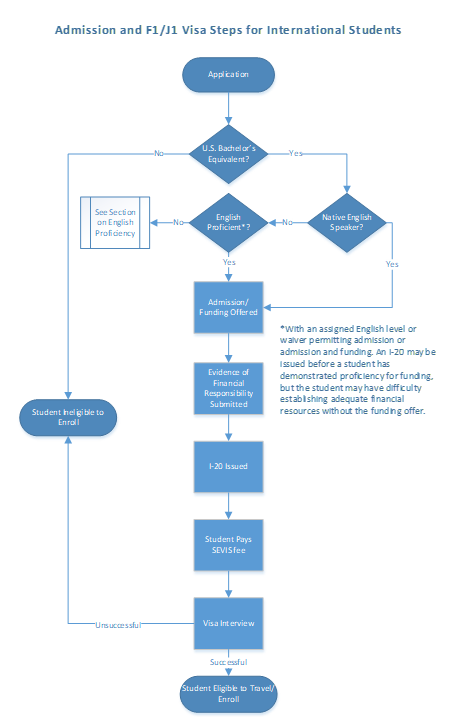
International students need an I-20 or DS-2019 (Certificate of Eligibility for Nonimmigrant Student Status or Exchange Visitor Status, respectively) before they can be issued student visas to study in the U.S. The Graduate College works individually with each international admit who is not currently studying in the U.S. to issue an I-20. This process is shown in Figure 1.
DS-2019 Forms for J (exchange) visas are issued by the Office of International Student and Faculty Services. These are subject to many of the same legal requirements, including financial information, as the I-20s issued for students who enroll for the purpose of completing a graduate program at OHIO.
What is an official transcript?—international (not Canadian)
Original copies of transcripts, mark sheets, degree certificates, and diplomas issued by the awarding institution are preferred. However, many international institutions issue only one official copy of the transcript, which becomes the student’s sole copy.
Many institutions will provide students with certified or “attested” copies of academic documents, which are copies of the original that have been signed and stamped by the Registrar of the issuing university or the Principal of the university-affiliated college. These documents should arrive at the Graduate College in envelopes sealed and issued by the issuing university. Alternately, the student may choose to have documents evaluated by a National Association of Credential Evaluation Services (NACES) member. Official documents may also be attested by an EducationUSA office (in which case they must include the cover letter).
Academic documents must be submitted in both the original language and an English translation. Only translations by the degree-issuing university, a NACES organization, the Ministry of Education, or EducationUSA are acceptable, unless otherwise noted. Country-specific details can be found on the Graduate College website at https://www.ohio.edu/graduate/prospective-international-students/international-credential-requirements-country.
Students may also opt to pay for CertiFile credential verification from within the application. This third-party service uses NACES-approved evaluators and allows the student to use the same credential evaluation for multiple academic and employment applications. It also saves considerable time in Graduate College application processing.
English proficiency
The Graduate Catalog requires a demonstration of proficiency through an official TOEFL or IELTS score before an offer of admission to an academic program can be made and an I‐20 for study in that program can be processed. Non-native English speakers must also establish proficiency in English before they are eligible to receive a graduate appointment, and the offer of a graduate appointment may affect the student’s ability to receive an I-20.
Applicants without demonstrated English proficiency may be admitted as English Provisional and initially placed into the Ohio Program of Intensive English (OPIE). This and other exceptions are noted in the section on English Language Proficiency.
All students with a TA appointment must also demonstrate spoken English proficiency. Non-native speakers must establish this through approved testing. Programs are responsible for verifying the spoken proficiency of native speakers. For more information, see the sections on English Language Proficiency and Graduate Student Appointments.
Affidavit of Support/Financial Responsibility
International applicants must submit evidence of financial responsibility—either funding from the university, cash in the bank, or some combination—because student visa holders generally cannot hold off-campus employment. International students must certify funds totaling the amount listed for the applicable academic year. For amounts, see https://www.ohio.edu/graduate/prospective-students/tuition. Please note that the amounts are for a 9-month academic year.
Once a student is admitted:
- The Affidavit of Support is evaluated
- If it is found to be satisfactory, an I-20 or DS-2019 is sent to the student permitting the student to apply for a visa (F and J visas respectively).
The Graduate College requires verification of financial support from the department/school, since any financial aid provided by Ohio University may be used as partial/full evidence of financial responsibility for the Affidavit of Support. Funding amounts entered into Slate Reader are used for this purpose. Failure to notify the Graduate College of a departmental financial support offer can delay the admission process for international graduate students.
Figure 1: Admissions and Visa Steps for International Students
How do students get their I-20s?
The Graduate College by default emails all I-20s from Sunapsis. Students may also request that documents to be mailed to a friend or a relative who resides in the U.S. so they can express mail these documents to the student. Anyone picking up an I-20 at the Graduate College must provide photo ID. If the student is using an option other than airmail or eShip Global, this information should be noted by the student on the Financial Support form.
The Next Steps: The Student Exchange Visitor Information System (SEVIS) and Changes in student status
All international student visa documents are issued through SEVIS. All students issued an I‐20 or DS2019 are required to pay a SEVIS fee (currently approx. $160) directly to the Student Exchange and Visitor Program (SEVP) prior to presenting the I‐20 or DS‐2019 at a visa interview.
The University is required to confirm a student’s arrival and registration within 45 days of the start of the academic term. The student is thus required to check-in with International Student and Faculty Services. International students are also required to maintain current address information. The address update form is on the Registrar’s webpage (https://sis.ohio.edu/student); note that only students have access to this page.
Changes/addition to degree program or degree level (e.g. master’s to doctoral level) require a new I‐20 or DS-2019. Students must work with International Student and Faculty Services Office to acquire this.
New International Student Fee
To assist in providing services, ISSS charges each new international student a one-time fee of $150.
Timeline for international application, admission, and visa
Once all application documents are submitted, the timeline for international admissions looks like this:
- Credential check: 7–10 days, but expedited at the request of the department. If the student pays for the CertiFile option when applying, this step is much less time-consuming.
- Application review by program: variable time.
- Request for English proficiency waiver: if needed, 3–5 business days to finalize.
- Recommendation for admission and finalization of admission by Graduate College: 3–5 business days.
- Student compiles financial documents for I-20: variable time.
- Financial documents reviewed in Graduate College and I-20 processed: 5–10 business days.
- I-20 emailed directly to the email address provided on the application.
- Student pays SEVIS fee and schedules interview: up to 2 months (may be as short as 30 days for Europe).
- If successful, student arranges travel: allow 1 week.
- TOTAL TIME (without departmental deliberations): 2–4 months.
Special Admission Status Types
Students not pursuing a graduate degree program may enroll in graduate classes with one of a number of other admission types. If you need more information than is included here, these types and associated policies are fully detailed in the Graduate Catalog section “Application, Admission, and Adding Degrees: Admission Categories.”
Transient student
A student working on a graduate degree at another university can apply to take classes intended for transfer as a transient student.
- The student should complete a Transient application form (through the normal application portal) and pay the appropriate application fee.
- Rather than submitting transcripts, the applicant must complete a Certificate of Good Standing from his or her dean (in place of transcripts), confirming that they are enrolled in a graduate program and are in good standing. Contact the Director of Communications and Professional Development for access to this form.
- Admission for transient students is good for one semester only.
Non‐degree student (non-certificate)
An applicant interested in taking courses without intending to complete a degree or certificate may qualify to study as a non-degree student.
- “Non‐degree” admission has a 12-credit hour or six-year limit and does not constitute admission to a degree program. Renewal after the credit-hour or time limit requires a new application and application fee.
- Non‐degree applicants need to identify an area of study on their application. Review and admission to the non-degree program are made by the graduate chair of the corresponding degree program. For example, ND1234 applicants would be admitted by the chair responsible for MA1234.
- Students applying for non‐degree status need to provide an official transcript showing completion of a bachelor’s degree or higher. Departments have the option to require or waive additional application materials (e.g. letters of recommendation, personal statements, resumes, etc.).
- Credit earned in non‐degree status cannot normally be applied toward a graduate degree at Ohio University.
- Non-degree students are generally not eligible for financial aid. If you have questions, please refer to the office of Financial Aid.
Certificate
A certificate student is one working toward a standalone graduate certificate in a non-degree status.
- To be admitted to certificate status, students must apply through the certificate application. Once admitted, students may only enroll in graduate courses that are part of their certificate programs.
- A certificate student who wishes to be considered for admission to a degree program must submit a degree-seeking application.
- Graduate status ceases upon completion of requirements for the certificate, dismissal from the certificate program, or reaching the certificate completion time limit of six years.
- Most certificates cannot be supported by financial aid.
Dual/second master’s degree
Students already enrolled in a master’s program may apply to a second master’s degree program by completing a regular application form and paying the appropriate application fee. The Graduate Catalog section on “Application and Admission” details the process and policy. In general:
- Up to 10 semester hours of graduate credit (maximum three courses) may be applied toward both degrees.
- To complete admission to a second degree program, a student must complete the dual degree form https://www.ohio.edu/graduate/forms and submit the completed form to the Graduate College. This does not apply to students applying to the joint MBA/MSA program.
Post‐baccalaureate
A qualified applicant interested in taking postgraduate workshops may be admitted as a post-baccalaureate student. Students in this status are admitted for summer sessions only on the Athens campus or for any semester on one of the regional campuses.
- The program appears as “ND9951” in PeopleSoft. Admission is automatic to any student who holds an earned bachelor’s degree and no transcripts are required.
- Post‐baccalaureate status is granted for six years, or for 12 credit hours (whichever comes first). This status is renewable every six years.
Senior for Graduate Credit
Undergraduate students with an overall GPA of at least 2.5 and within six credit hours of completing the requirements for the bachelor’s degree may apply to become a senior for graduate credit. Permission to take such courses does not constitute admission to a graduate degree program.
- A student who is admitted as Senior for Graduate Credit pays undergraduate fees and is not eligible for a graduate assistantship or scholarship support.
- Well-qualified seniors at another university who have six or fewer credits to complete the bachelor’s degree are eligible to apply as well.
Early admission to a graduate degree program
A well-qualified senior may qualify for early admission. Eligibility requirements include 1) a GPA of at least 3.5 and 2) completion of all undergraduate requirements except the total credit hour requirement at the time of entry into the graduate program. This means that all major and general education requirements have been met. (The second requirement does not apply to HTC students.)
- Graduate courses taken under early admission status can be used to satisfy both graduate degree requirements and undergraduate total credit‐hour requirements.
- The student must submit both a regular Graduate Admission Application to the Graduate College and a completed Application for Graduate Study Early Admission (found on the Graduate College website at https://www.ohio.edu/graduate/forms).
- A student admitted through Early Admission is eligible for graduate student assistantships and scholarship support but not for undergraduate financial assistance.
- HTC students seeking early admission must complete the Honors Tutorial College Combined Degree Form and may also need to submit the Honors Tutorial College Undergraduate Application for Graduate Study, both of which are located at https://www.ohio.edu/graduate/forms.
Accelerated Graduate Pathways
Accelerated Graduate Pathways (AGPs) allow well-qualified students to begin work on a graduate credential prior to the completion of their undergraduate degree. AGPs must be approved by UCC and each has its own criteria for eligibility. In some cases, the AGP allows students to apply up to 9 hours of graduate credit to undergraduate degree requirements. For full policy details, please see the section Accelerated Graduate Pathways in the “Application and Admissions” section of the Graduate Catalog.
The following are important things to know about how AGPs work for students:
- Undergraduate students taking graduate courses for graduate credit alongside undergraduate courses will need to register for graduate courses in one enrollment center transaction under their AGP plan and for undergraduate courses in a separate enrollment center transaction under their undergraduate plan.
- Students should never preregister for semesters after they complete their bachelor’s degrees under their AGP program. They must complete the [APPLICATION THING] for the graduate program and be matriculated into the program prior to registering for post-baccalaureate graduate courses.
OHIO Honors
Students in the OHIO Honors program may take a maximum of three graduate courses during their junior and senior years (i.e., after earning 60 or more semester hours of undergraduate credit). Hours earned in these courses will count toward total hours required for the undergraduate degree only; the grades will be calculated into the undergraduate GPA and cannot count as graduate coursework. Registration in graduate courses requires written permission from the instructor.
Participation in this option is at the discretion of the department or school. Qualified students can be registered by obtaining permission from the Director of OHIO Honors or his or her designee and submitting the approval form to the Registrar’s Office for processing.
Departmental Honors
Students in a recognized departmental honors program may take a maximum of three graduate courses in their major department during their senior year (i.e., after earning 90 or more hours of credit). Hours earned in these courses will count toward total hours required for the undergraduate degree only and the grades will be calculated into the undergraduate GPA; they cannot be counted as graduate coursework. Registration in graduate courses requires written permission from the instructor.
Participation in this option is at the discretion of the department or school. Students process this special registration by obtaining permission from the departmental honors coordinator and submitting the approval form to the Registrar’s Office for processing.
Biomedical Engineering Undergraduate Affiliate
An Ohio University student who holds Undergraduate Affiliate status in the Biomedical Engineering program can take a select group of graduate courses by applying for BME Undergraduate for Graduate Credit.
English Language Study Provisional (EP) Admission
Non-native speakers of English who do not qualify for testing exemption and who have either no official, valid English language testing scores or who have scores below the cut-off for admission may apply concurrently for admission to OPIE and request future admission to a graduate degree-seeking program.
NOTE: Without exception, applicants with a TOEFL iBT score below 61 iBT or an IELTS score below 5.5 (or equivalent) are not eligible for graduate admission nor for registration in graduate level courses concurrent with admission to OPIE.
EP Admission decisions by the academic program and the Graduate College will be made on the basis of the student’s previous preparation and qualifications for graduate study. If the EP student is not able to meet English language proficiency within the original terms of EP admission as specified below, EP Admission to the academic program will be administratively withdrawn by the Graduate College.
EP-specific guidelines and procedures:
- Applicants must apply concurrently for admission to the Ohio Program of Intensive English (OPIE) as well as for admission to an Ohio University graduate degree program.
- The academic department will determine if the applicant has the appropriate background (except for English language proficiency) for EP Provisional Admission. The Graduate College will determine if the applicant meets the university minimum for prior degree credentials and GPA.
- If the applicant is deemed admissible, the department will assign a minimum required TOEFL score and set a future term of entry up to 24 months beyond the initial term of entry to OPIE. Any department considering EP admission should also consult the section When a Student Does Not Demonstrate English Proficiency, below.
- The Graduate College will provide an EP Provisional Admission letter for entry to the graduate program following 12 or 24 months in OPIE.
- The initial immigration documents will be issued for English language instruction.
- When the student arrives on campus, he/she will take OPIE placement examinations and be placed in the appropriate English classes.
- EP Students will take the on-campus English language proficiency test at the conclusion of each semester.
- If an EP student achieves the required minimum TOEFL score for unconditional admission as stated in the original letter of EP Provisional Admission in less than the designated period, the student may ask the academic department to change the term of admission to full-time graduate academic study to the term following release.
- If an EP student fails to achieve the required minimum TOEFL score as stated in the original letter of EP Provisional Admission and fails to meet the University minimum by the end of 24 months (or fewer if stipulated by the program), the EP Provisional Admission will be administratively withdrawn. Individual departments/programs may not waive the assigned minimum required TOEFL score.
How to Monitor Applications and Admissions
By logging into the Slate Reader, program administrators can check to see which (and how many) applications are in certain admissions statuses, including Awaiting Submission, Awaiting Payment, Admitted, Denied, and Waitlisted. As admissions cycles close for each term, departments should be sure to check for any remaining Reviewable applications and either recommend admission, deny, or withdraw them.
Use OBI
For a more comprehensive snapshot, the OBI reporting system provides a dashboard and several ad hoc reports to assist departments/schools in monitoring applications and admission status. The applications listed as Application (APPL) require additional department action (admission, denial, or waitlist). Students listed as DEIN have accepted an offer of admission. (Note: international students may accept an offer of admission even if they are ineligible for an I-20 and therefore will not matriculate.)
How to Read OBI and PeopleSoft: Application Status Decision Codes (Status/Reason)
Applicants are coded based on the both the admission decision from the department and document requirements. You may encounter these codes in reports or in PeopleSoft.
Basic Admission Codes
- ADMT/FINL—Final, full admission to graduate study. All required documents have been received and no academic conditions are in place.
- DENY/DEPT—The applicant has been denied admission to the graduate program.
- WAPP/varies—Application has been withdrawn by student. Codes: STUD (student request), SCOS (change of session), NSHO (Applicant not heard from).
- WADM—Application has been withdrawn administratively.
- DEFR—Applicant is being admitted as an undergraduate English Provisional, with a timeframe to achieve English Proficiency. Applicant remains in applicant status.
- DEFR/ENPR—Applicant is admitted to OPIE for up to 2 years of undergraduate study.
- DEFR/ENG1—Applicant is admitted to OPIE for up to 1 year of undergraduate study.
Conditional Codes
- COND/varies—Applicant has been conditionally admitted. Conditions for admission may be document-based (missing documents to complete admission), academic-based, or some combination of the two.
- COND/CPRO—Applicant is missing academic documents. Once missing academic documents are provided, applicant will be given ADMT/FINL status.
- COND/ACEL—(For international students who require a student visa.) Applicant is missing financial documents, and possibly other academic documents. Until financial documents are provided, an I-20 cannot be issued. Once all documents are provided, applicant will be given ADMT/FINL status.
- COND/CACA—Applicant is admitted academic conditional.
- COND/PCAC—Applicant is missing academic documents. Once all documents are received, applicant will become COND/CACA.
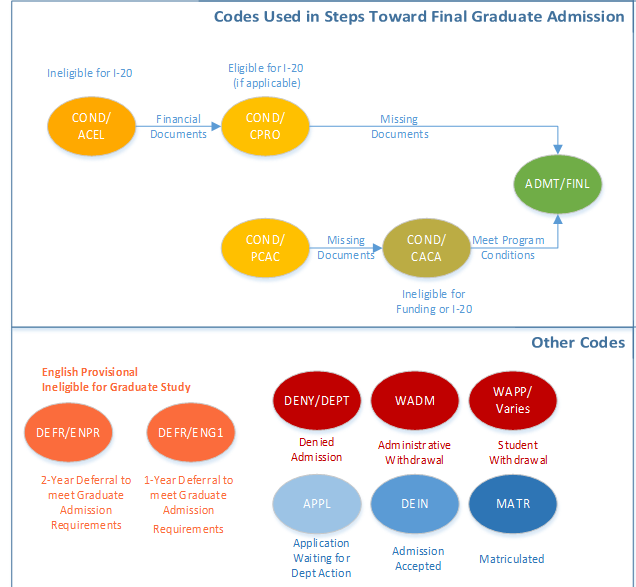
Figure 2: Admission Codes in PeopleSoft