
Spring Awakening
Spring Awakening
Book and Lyrics by Steven Sater
Music by Duncan Sheik
Based on the play by Frank Wedekind
Directed by Alan Patrick Kenny
Choreographed by Kellen Stancil
Music Direction by Brent Frederick
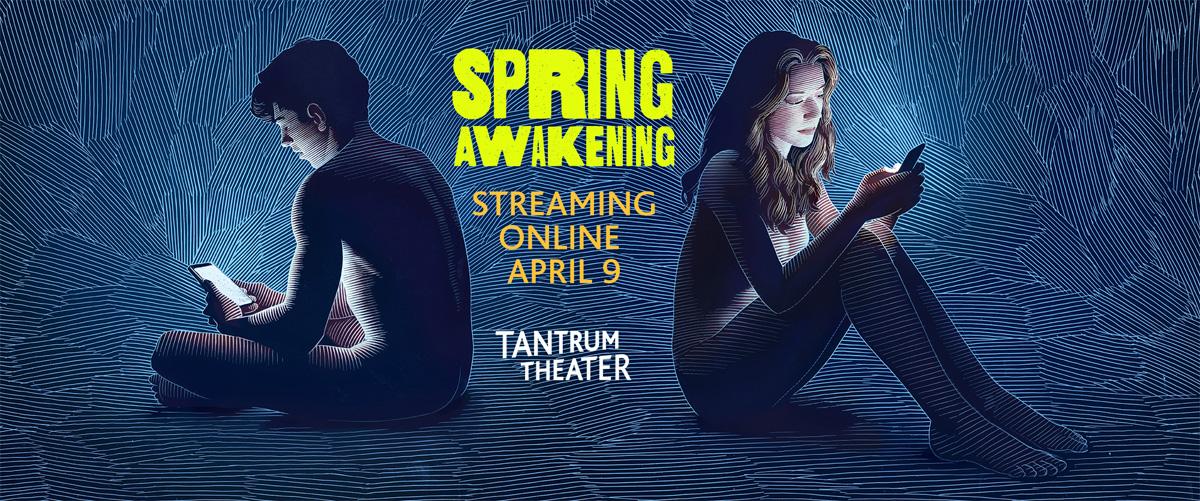
Spring Awakening is an angsty pop-punk musical about the explorations & trials of adolescent life in 19th century Germany. The eponymous adaption of the groundbreaking play follows a group of teens trying to navigate sexual discovery in an ultra-conservative, sexually repressed world. Tantrum’s production juxtaposes scenes of an 1891 Germany with songs representing a 2021 reality: hybrid vignettes of theater, film & social media. These interludes express powerful inner-landscapes–tumultuous, shared moments of anguish and yearning. The result is a remarkable and celebratory journey, one that uplifts the power and necessity of youthful rebellion, self-acceptance & discovery.
Program for Spring Awakening
CONTENT ADVISORY
Sexual content, Sexual abuse, Sexual assault, Violence, Self-harm, Suicide, Eating Disorders, Body image, Body dysmorphia
A NOTE FROM THE DRAMATURG
Echoes of Purple Summers
When Spring Awakening opened on Broadway in 2006, it shook the musical theater establishment. The show was an innovative and form-bending exploration of adolescence, and its overtly sexual subject matter was presented with an unapologetic, youthful exuberance. Adapting the play of the same name by German playwright Franz Wedekind, Duncan Sheik and Steven Sater infused a 19th-century drama with a pop-punk score. They transformed Wedekind’s “Children’s Tragedy” into something fresh and equally potent.
Wedekind wrote Spring Awakening in reaction to the conservative and pious bourgeois morality of 19th-century Germany, where basic human needs were condemned as libidinous and bestial. Spring Awakening’s scathing critique of that society was as brutal as the cane wielded by its viscous schoolmasters. The play foregrounds young pubescents discovering masturbation and sexual desires, their adults refusing to educate them or give any guidance: sexual education is inherently immoral. Wedekind’s characters receive instead an often-impenetrable classical education, and they understand their own bodies less than they do Virgil’s Latin or Plato’s Greek. The play’s themes of homosexuality, sexual assault, and abortion infuriated the German public, and censors frequently banned the play. Spring Awakening did not premiere until 1906, some 15 years after its initial composition and publication. Even when it was allowed to be performed, many of the play’s most controversial scenes were cut: demonstrating the exact ignorance and hypocrisy that Wedekind sought to expose.
Sheik and Sater set their Spring Awakening in a province of Imperial Germany, and the adaptation deliberately resembles the dialogue and episodic structure of Wedekind’s original work. This choice transforms the musical’s songs into a clever device. In many Western musicals, songs drive the plot forward or grant emotional resolution, and the actors sing to each other or sing their internal dialogue. In Spring Awakening, the songs are instead turned to the audience in the form of direct address, and they serve as an outward expression of the character’s internal states—a nod to the Expressionist roots of Wedekind’s play. Music provides a direct window into the characters’ feelings of angst and yearning: a yearning for knowledge, physical contact, and understanding. In his note to the libretto, Sater remarks that the songs offer “breaks'' from the “confines” of the character’s 19th-century world. During Sater’s self-described “mini alt-rock concerts,” school children transform into heart throbs, a simultaneous performance of past, present, and the utopic plane of the teen idol.
Exploding out of scenes of stifling bourgeois moralism, the concerts provide a playful breath for the characters’ personal expressions. They also close the distance between Melchior Gabor and Holden Caulfield in Catcher in the Rye, or Wendla Bergmann and Kat Hernandez of HBO’s Euphoria. There is a reason we remain transfixed by this story. We have all been through the pain and beauty that is the transition from child to adult, the “wonder of purple summer.” Prevented from contrasting our supposedly enlightened era to that of Wedekind’s Germany, we are left to wonder: Are our parents and educators today prepared to help teens in their rapidly changing, tech-heavy world? Are we really more comfortable with our own sexualities than Moritz Stiefel is?
By Tyler Everett Adams
DIRECTOR'S NOTE
On the surface, it might appear that a cautionary tale about 19th century German children and the dangers of omitting proper sex education would have very little relevance to today’s technologically driven world, where all of that information is available instantly and in graphic detail.
However, look more broadly at the core themes of Wedekind’s play and Sheik and Sater’s musical: isolation, fear of the unknown, disinformation, distrust of leadership, hypocrisy derived from systems of oppression… I could think of no better way to describe the last year in America.
Twenty years ago, I was working to complete my first year of undergraduate study, and as I reflect back on that period in my life, I remember just how hard it was to navigate the transition to college and adulthood while gaining strikingly new freedoms and responsibilities.
When I observe the experiences of my students over this tumultuous year, I’m deeply moved by the magnitude of additional challenges they have faced. From all of the restraints brought upon by the pandemic to the sheer reality of living in the digital social media age, every aspect of their transition to college has been moderated by screens and devices, Zoom calls and group chats, masks and restrictions, pictures and emojis, distance and isolation. While keeping us digitally connected, they also reduce our humanity and block true connection.
Negotiating these liminal spaces has always been tough for young people - finding and claiming your identity and values, finding your community and friend circle, while simultaneously identifying and pursuing your passions and goals, has never been a smooth or simple process. But I can only imagine what it’s like to do it through an app.
Our meditation on the trials of youth in our SPRING AWAKENING carves out space for both of these narratives - in the scenes, Sater’s redux of Wedekind’s German kids and their “children’s tragedy,” and through the songs, the stories of our students navigating their own challenges during this unprecedented year.
Athens, Ohio is not only home to Ohio University, the oldest university in the state founded in 1804, but also to The Ridges, formerly the Athens Lunatic Asylum which operated from 1874-1993. Featuring High Victorian Gothic architecture and a sprawling hilltop property overlooking the university campus, one could easily picture Wedekind’s characters living and learning on these grounds.
Indeed, as we dance and sing in their auditorium and hillsides and cemeteries, we feel the spirits of the former inhabitants and sing their songs of struggle and angst, joy and salvation. Just as we tell the story of Wendla, Melchior and Moritz then, we also acknowledge that history is doomed to repeat itself again and again, and to encourage change now, we must first bear witness.
Alan Patrick Kenny
Spring 2021
CAST
(in alphabetical order)
Fräulein Großebüstenhalter, Father Kaulbach, Frau Bessell ... BURGESS BYRD*
Reinhold ... CHRISTOPHER DUCLOS
Ulbrecht ... HOLDEN EVANS
Otto ... DANIEL CAGLE
Ernst ... RHYS CARR
Ilse ... LOZZA COLE
Wendla ... MEGAN COLLINA
Fräulein Knuppeldick, Schmidt ... SHELLEY DELANEY*
Herr Neumann, Herr Stiefel ... DANIEL C. DENNIS*
Doctor Von Brausepulver, Herr Knochenbruch ... KEN EARLY*
Herr Gabor, Herr Rilow, Herr Sonnenstich ... BRIAN DAVID EVANS*
Dieter ... FORREST HAASL
Hanschen ... SEAN MCGLYNN
Frau Bergman, Frau Gabor ... KELLY MENGELKOCH*
Georg ... NATHAN NAPOLI
Rupert ... TIMOTHY OH
Melchior ... TOMMY PAGE
Thea ... SARAH RILEY
Martha ... TAYLOR ROBERTS
Anna ... GENEVIÈVE SHAFTEL
Moritz ... ROBBY YOHO
Ensemble ... CAROLINE DONATO, CHRISTOPHER DUCLOS, HOLDEN EVANS, FORREST HAASL, ADRIANA HOLST, LAUREN JANOSCHKA, JULIA KUZMICH, BRADLEY NOLAN, TIMOTHY OH, ANNA RAMBO, OLIVER RUNYON, MOLLY TUCKER

UNDERSTUDIES
For Wendla: CAROLINE DONATO; for Ilse: ADRIANA HOLST; for Thea: MOLLY TUCKER; for Martha: LAUREN JANOSCHKA; for Anna: JULIA KUZMICH; for Otto: FORREST HAASL; for Hanschen: TIM OH; for Ernst: CHRISTOPHER DUCLOS; for Georg: BRADLEY NOLAN; for Moritz: OLIVER RUNYON; for Melchior: HOLDEN EVANS.
SWING
ANNA RAMBO
DANCE CAPTAIN
JULIA KUZMICH

Tantrum Theater is made possible in part by state tax dollars allocated by the Ohio Legislature to the Ohio Arts Council (OAC). The OAC is a state agency that funds and supports quality arts experiences to strengthen Ohio communities culturally, educationally, and economically.