
Riding the wind with picoballoons
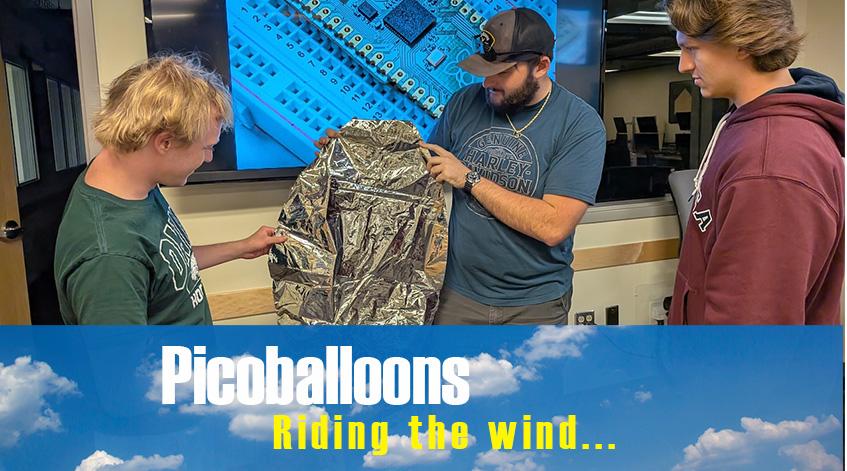
October 7, 2026
Riding the winds: Students Build a Picoballoon for Studies
This semester I’ve been part of a team of five students building something small enough to fit in the palm of your hand: a picoballoon. This project is an independent study class, and what makes it special is that we are the ones guiding it: we chose the design, researched how the hardware and software fit together, sourced the parts and planned the launch ourselves. Our team is a mix of third- and fourth-year students, Aydin Pope, Ethan Fiedtkou, Declan Herbert, Wyatt Williams and me. The class, ITS 4930 Special Studies, and its project is under the guidance of Dr. Julio Aráuz, faculty at the McClure School.
What is a picoballoon?
A picoballoon is a tiny, solar-powered radio tracker carried aloft by a helium-filled party balloon, typically a Mylar balloon about three feet across. The payload weighs only 12 to 30 grams. The balloon is only partially filled so the helium has room to expand as it climbs to around 12,000 meters (roughly 40,000 feet), high enough to float above most storms. From there it simply drifts with the wind. Well-built flights stay up for weeks or even months, and many have circled the Earth; one recent flight stayed aloft for more than 68 days and completed nearly four laps of the globe. Along the way, the tracker reports its position using WSPR (Weak Signal Propagation Reporter), an amateur-radio protocol whose faint signals are picked up by a worldwide network of volunteer receiving stations and posted online, with no satellites involved.
We are building our project based on the guidelines published in an IEEE Spectrum article back in January, 2026. You can find a link to the article below.
Sourcing the parts
Following the Traquito design, we ordered the Jetpack daughterboard, manufactured and assembled, The main pieces are:
- Raspberry Pi Pico: the small microcontroller that runs the flight software.
- Jetpack board: a GPS receiver for position and precise timing, plus a clock-generator chip that produces the radio signal.
- Solar cells: ultralight panels that power the tracker in daylight. There are no batteries, since they would freeze at stratospheric temperatures that can drop to around –51 °C.
Antenna and balloon: a thin wire antenna and a Mylar party balloon.
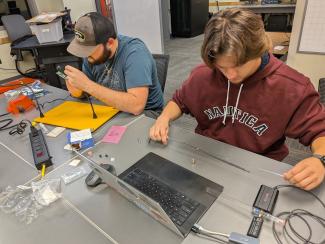
Ethan Fiedtkou, ITS Cybersecurity major, works with a low end upconverter to feed the received signal to a portable software defined radio. 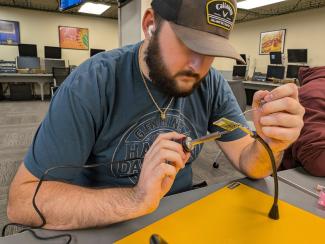
Declan Herbert, ITS Cybersecurity major, works on soldering parts to the picoballoon transmitter board.
What our team has accomplished so far
- Aydin Pope (Senior) helped with the design, part selection, part acquisition and programming. He also directed some research to select alternate parts, as some of those included in the original Traquito design were not in stock.
- Ethan Fiedtkou (Junior) helped with hardware selection and developing our ground station. He is currently testing a low cost upconverter with some of the high-end spectrum analyzers in our labs.
- Declan Herbert (Senior) researched the hardware components, how they work together, and whether external parts were compatible with the software. Declan spent quite a bit of time working on soldering pads and preparing the super light antennas for the board. Another, McClure School faculty member, Prof. Brandon Saunders helped him refine his soldering skills and he is quite an expert now.
- Wyatt Williams (Junior) researched the software, including WSPR, working at the bit level to understand how a picoballoon packs its data into each transmission. He worked extensively with AI infrastructure to develop a visualization of the transmission chain required by WSPR, from preparing the data to be sent, channel coding, interleaving and autocorrelation sequence (for detecting the signal with very low SNR).
- Tyler Nevels (Senior) researched software and helped present the research and aided in documentation and writing. I also helped with Wyatt’s work on the transmission chain visualization.
Flying legally
The FAA's rules for unmanned free balloons (14 CFR Part 101, §101.1(a)(4)) only apply to balloons whose single payload package weighs more than 6 pounds, or more than 4 pounds with a weight-to-size ratio above 3 ounces per square inch on its smallest surface (or multiple packages totaling more than 12 pounds). At a few dozen grams, our payload is far below these limits, so no FAA waiver or permission is needed to launch it. Transmitting on the WSPR bands does require an FCC amateur-radio license, which we will be getting ahold of.
What's next
The Department of Chemistry is helping us with helium: grade 5, which is 99.999% pure. We are also coordinating with Ohio University's airport on a launch in mid to late November. This is only the first update, we will keep reporting here as we get closer to launch, sharing our progress on testing, the ground station and launch day itself. Once the balloon is up I’m sure we will have more to share later on.
References
- D. Schneider, "Explore the Stratosphere With a DIY Pico Balloon," IEEE Spectrum, Jan. 31, 2026 (February 2026 print issue). https://spectrum.ieee.org/explore-stratosphere-diy-pico-balloon
- Traquito – WSPR Pico Balloons, Jetpack WSPR Tracker. https://traquito.github.io/
- Federal Aviation Administration, 14 CFR Part 101, §101.1 Applicability. https://www.ecfr.gov/current/title-14/chapter-I/subchapter-F/part-101
The McClure School of Emerging Communication Technologies strives to offer the best academic programs in the IT (Information Technology), cybersecurity, the game development and the Virtual Reality/Augmented Reality (VR/AR) industries. Our programs and certificates cover numerous aspects of the rapidly changing industries of information networking, cybersecurity operations, data privacy, game development, digital animation and the academic side of esports.