
About the Avionics Engineering Center
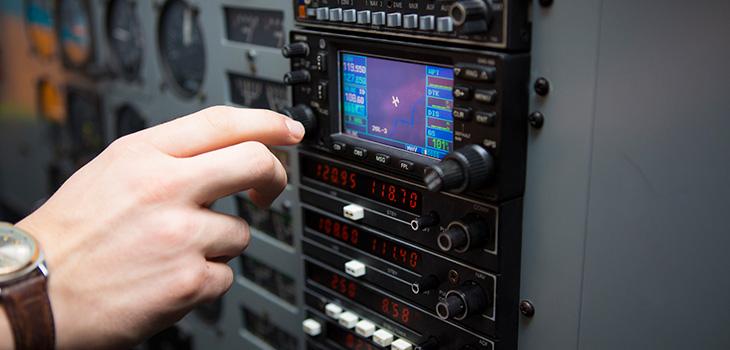
Established in 1963, the Avionics Engineering Center pioneered the combination of technical research and solution development in the areas of electronic navigation, communication, and surveillance systems related to air transportation. The center conducts ongoing research for the Federal Aviation Administration, public and private air transportation facilities and manufacturers, and various state and federal agencies.
Our researchers and administrative employees support the research, design and testing of technology for use in navigation, landing and warning systems for civilian and military aircraft to ensure safe operation with other aircraft and in undesirable conditions. We create for good by keeping our national airspace safe and by advancing the development of autonomous vehicles that can be used in civilian applications like crop inspection and search-and-rescue operations.
The largest research center at Ohio University, the Avionics Engineering Center supports the academic mission of the School of Electrical Engineering and Computer Science (EECS), and many of our faculty and staff teach EECS courses and advise graduate students. A student at the Russ College has the unique opportunity to pursue studies at the premier avionics research institute in the country. (See a list of the unique avionics-related courses offered.)
The unique mix of graduate-level courses and research-centered around aviation has enabled Ohio University EECS graduates receiving the prestigious RTCA William E. Jackson Award 19 times. The RTCA William E. Jackson Award is presented to an outstanding graduate student in the field of aviation electronics and telecommunications. This award is a memorial to William E. Jackson, a pioneer in the development and implementation of the nation’s air traffic control system and an enthusiastic supporter of student engineers.
If you’re already working in the aeronautical or aerospace industries, the Russ College also offers an online Master of Science in Electrical Engineering with an optional specialization in Electronic Navigation Systems built on the expertise of our many faculty researchers at the Avionics Engineering Center. For more information, contact Interim Director Michael DiBenedetto at dibenede@ohio.edu.
Mission
Our mission at the Avionics Engineering Center is to improve the safety and reliability of air transportation by developing technology for navigation, guidance, communication, control, and surveillance. We also provide premier education and training opportunities to future avionics professionals who will advance the frontiers of aviation electronics. Through our affiliation with the School of Electrical Engineering and Computer Science in the Fritz J. and Dolores H. Russ College of Engineering and Technology, both undergraduate and graduate students have the opportunity to see their coursework come to life outside the classroom under the guidance of our expert faculty, research engineers and technologists.
History
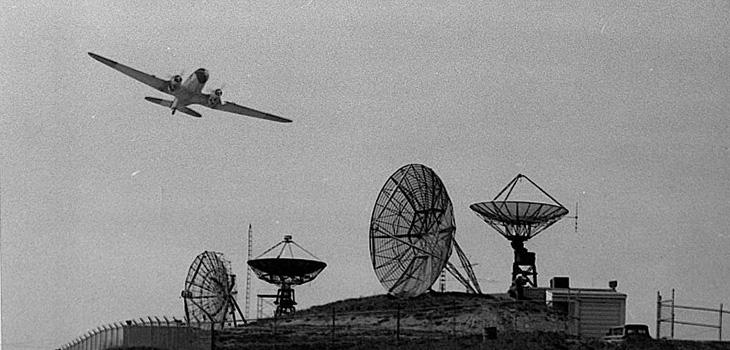
The Ohio University Avionics Engineering Center specializes in the research, development, and evaluation of electronic navigation, communication, and surveillance systems.
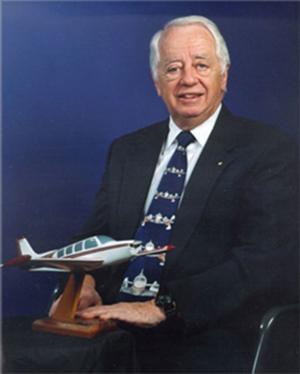
Established in 1963 by the late Richard McFarland, the center was created to support a unique combination of theoreticians, subject matter experts and technical specialists who could address navigational issues encountered in air transportation and supply immediate, practical solutions. Originally housed in a collection of buildings atop Radar Hill on the south end of campus (now part of The Ridges complex), the center was formed as the Avionics Research Group within Ohio University’s Department of Electrical Engineering. In 2004, the center relocated much of its research and training operations to the Richard H. McFarland Avionics Building, featuring 12,000 square feet of office, laboratory, and conference space on the grounds of the Ohio University Airport about 10 miles south of the Athens campus.
The last 50 years of Dr. McFarland’s legacy have yielded remarkable results. Current research projects, including enhanced operations in low visibility conditions, Local Area Augmentation Systems, and Automatic Dependent Surveillance - Broadcast, create for good by sustaining and improving safety, navigation and communication in air transportation.
Avionics and CNS Related Courses at Ohio University
The Avionics Engineering Center is a research unit of the Ohio University School of Electrical Engineering and Computer Science (EECS). As such, the majority of the undergraduate and graduate students working with the AEC are majoring in Electrical Engineering. Students receive a thorough theoretical grounding through the numerous courses offered in navigation systems, including the following.
EE 4403/5403 – Antenna and Microwave Theory: Fundamental concepts and definitions for radiating systems including parameters, current distributions, matching, polarization and their effect on antenna performance. Transmission links, linear wire, loop, aperture, and array antennas discussed.
EE 5853/6863 – Electronic Navigation Systems I & II: Principles and theory of operation of electronic navigation systems with emphasis on avionics; aircraft instrumentation, VOR, DME, inertial navigation, Loran, ILS, MLS, GPS, air traffic control, surveillance radar, data busses, flight testing.
EE 601 – Electromagnetic Wave Propagation for Electronic Navigation Systems: Electromagnetic principles and propagation of radio waves over the earth surface and through the atmosphere. Topics include groundwaves, skywaves, troposphere and ionosphere effects, Total Electron Content, group and phase velocity, incident fields, reflection coefficients, Brewster angle, diffraction, scattering, Fresnel zone, and signal multipath.
EE 6023 – Radar Systems: This course covers the theory of operation of radar systems. Topics include the radar equation, radar cross-sections, radar altimeter, Air Traffic Control radar, Doppler radar, weather radar, synthetic aperture radar, Mode A/C/S.
EE 6033/6043 – Inertial Navigation Systems I & II: Principles of operation of inertial navigation systems. Topics include rigid body kinematics, observation equations, attitude update, earth rate and transport rate, position and velocity updates, sensor technologies, error characterization and modeling.
EE 6053 – Satellite-Based Navigation Systems: Theoretical development of spread-spectrum ranging and positioning with space-based transmitters. Particular emphasis on GPS. Orbital parameters (almanac and ephemeris), link budget, signal structure, receiver architecture, measurements and error sources. Absolute and relative positioning methodologies.
EE 6133 – High Accuracy Satellite Navigation Systems: Theoretical development of correction and measurement based differential satellite navigation technologies, with emphasis on advanced error mitigation techniques and error analysis. High accuracy code and carrier phase processing emphasized with presentation on carrier-phase ambiguity resolution techniques.
EE 6063 – Integrated Navigation Systems: Theoretical development of positioning and navigation with multiple sensors; optimal navigation solutions; the Kalman Filter as an integration tool; fault detection and isolation.
EE 6073 – Navigation Receiver Design: Theoretical development of receiver design with emphasis on spread spectrum ranging; low-noise amplifiers; radio frequency processing; down conversion and intermediate frequency processing; in-phase and quadrature components; analog-to-digital conversion; signal acquisition, tracking and measurement formation.
EE 6083 – Aviation Standards, Software Design and Certification: Overview of aviation standards including Federal Aviation Regulations, Technical Standard Orders, Advisory Circulars, RTCA documents and ARINC standards. Software design using military and civilian standards, IEEE software standards, software life cycle processes, program design language, documentation, testing, independent test verification, case studies.
EE 6900 – Special Topics in Electrical Engineering - GNSS Antennas: The fundamentals of antennas for GNSS antennas are covered including topic on radiation characteristics, beamwidth, bandwidth, impedance, matching losses and characterization. Various antenna types used in GNSSs are covered including linear, helix, microstrip patch, and array antennas. Antenna radome, ground plane, and siting effects are discussed, as well as, antenna design/simulation and measurement techniques.
EE 6900 – Special Topics in Electrical Engineering - Satellite Communications: This course covers the fundamental of satellite communications including topic on orbital mechanics, satellites subsystems, satellite antennas and their coverage regions (global, regional, spot beams), satellite link design, modulation, multiplexing, and multiple access techniques, error control coding-overview, propagation effects in satellite links, VSAT (Very Small Aperture Terminal) systems, Direct Broadcast Satellite (DBS) TV and radio system.
Ohio University Winners of the William E. Jackson Award
2022 – Dr. Timothy Needham, Ohio University, Gravity Modeling in High-Integrity GNSS-Aided Inertial Navigation Systems
2021 – Andrew Videmsek, Russ College of Engineering and Technology of Ohio University, Aircraft Based GPS Augmentation Using an On-Board RADAR Altimeter for Precision Approach and Landing of Unmanned Aircraft Systems
2018 – Pengfei (Phil) Duan, Ohio University, Predictive Alerting for Improved Aircraft State Awareness
2017 – Adam Naab-Levy, Ohio University, Enhanced Distance Measuring Equipment Data Broadcast Design, Analysis, Implementation, and Flight-Test Validation
2014 - Dr. Kuangmin Li, Ohio University, Enhanced Distance Measuring Equipment Carrier Phase
2007 – Dr. Sanjeev Gunawardena, Ohio University, Development of a Transform- Domain Instrumentation Global Positioning System Receiver for Signal Quality and Anomalous Event Monitoring
2006 – Dr. Jacob L. Campbell, Ohio University, Application of Airborne Laser Scanner to Aerial Navigation
2002 – Dr. Andrey A. Soloviev, Ohio University, Investigation into Performance Enhancement of Integrated Global Positioning/Inertial Navigation Systems by Frequency Domain Implementation of Inertial Computational Procedures
2000 - Dr. Robert A. Gray, Ohio University, Inflight Detection of Errors for Enhanced Aircraft Flight Safety and Vertical Accuracy Improvement Using Digital Terrain Elevation Data with an Inertial Navigation System, Global Positioning System and Radar Altimeter
1998 - Dr. Chris G. Bartone, Ohio University, Ranging Airport Pseudolite for Local Area Augmentation Using the Global Positioning System
1997 - Dr. Dennis Akos, Ohio University, A Software Radio Approach to Global Navigation Satellite System Receiver Design
1994 - Dr. David Diggle, Ohio University, Satellite-Based Positioning Systems for Flight Reference and Aircraft Autoland Operations
1992 - Michael S. Braasch, Ohio University, On the Characterization of Multipath Errors in Satellite-Based Precision Approach and Landing Systems
1989 - Frank van Graas, Ohio University, Hybrid GPS/Loran-C: A Next Generation of Sole Means Air Navigation
1988 - Sally A. Mathias, Ohio University, Development of Siting Criteria for the Collocation of the Microwave Landing System (MLS) and the Approach Lighting System (ALS)
1987 - Sanjaya Sharma, Ohio University, Error Sources Affecting Differential or Ground Monitored Operation of the Navstar Global Positioning System
1983 - Fujiko Oguri, Ohio University, Area Navigation Implementation for a MicrocomputerBased Loran-C Receiver
1982 - Joseph P. Fischer, Ohio University, A Microcomputer-Based Position Updating System for General Aviation Utilizing Loran-C
1981 - Kent A. Chamberlin, Ohio University, Investigation and Development of VHF Ground-Air Propagation Computer Modeling including the Attenuating Effects of Forested Areas for Within Line-of-Sight-Propagation Paths