
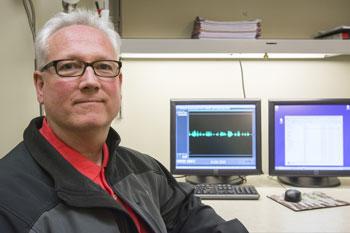
Jim Montgomery Spotlight
CSP professor owes career to girl next door
Little did James Montgomery, CHSP professor of communication and speech disorders, know that a childhood memory would help to shape his career.
"I was raised next door to a family of ten kids," he said. "I played with some of the boys my age, but they had a sister three or four years younger than I was, and she was profoundly deaf."
Over the years, Jim watched as each summer the parents hired speech and hearing professionals to work with the girl, and within five years, he saw her move from having no language at all to learning sign language, lip-reading, and-most surprising of all-speaking.
"I was just fascinated that this girl went from literally zero language to becoming pretty much a total communicator in about five years," he said. "She went on to Gallaudet, then Marquette University and became an editor at the Milwaukee Sentinel Journal."
Like many students, Jim as an undergraduate had no specific career in mind. "I was a communications major-broadcasting/theater-nothing related to what I do now," he said. "But I also double-majored in experimental psychology. I was a lab rat guy."
So when he was accepted to graduate school in hearing and speech sciences, Jim's experience in communications and laboratory research suddenly converged.
"But it was remembering that girl that got me interested in studying language and cognition in graduate school. I kept thinking 'How does someone go from no language at all to becoming a total language user? How does the brain work to do that?'"
Jim still pursues these questions by teaching classes and continuing to conduct research. In 2011, he and several colleagues received a five-year, $2.4 million grant from the National Institute on Deafness and Other Communication Disorders to study the relationship between cognitive measures (such as memory, attention span,processing, retrieval, etc.) and specific language impairment (SLI) in children ages 7-12.
"The grant allowed us to purchase a mobile testing lab that we could take to area schools and even to individual homes," he said. "We knew that being able to travel to the kids rather than having them come to us would result in a broader sampling in this rural area."
The researchers are now beginning to analyze the data they have collected over the past four years.
"Our preliminary data seem to confirm our predictions that cognitive processes may have an impact on language processing. Right now we are finding that children with SLI are doing poorly across the board on all cognitive measures."
The results of this grant project, according to Jim, will lead to additional research.
"The real issue is that there doesn't seem to be any effective therapies for treating children with SLI," he said. "So our next stage of research will be to conduct more in-depth studies of comprehension-how children understand what they hear-and try to create more successful treatment interventions based on those studies."
Those interventions may well make a critical difference in the future of some child-perhaps the one struggling with SLI, or perhaps the one next door, watching and remembering.