
GenAI in Teaching and Learning
GenAI in Teaching and Learning
In June 2026, the Center for Teaching, Learning, and Assessment launched version 3.0 of its GenAI in Teaching and Learning Institute based on three years of attention to the evolution of AI and its impact on instruction and a March 2026 comprehensive survey of faculty perceptions and use of AI in teaching and learning.
This course, which leads to a faculty development certification, supports Ohio University instructors and staff to thoughtfully integrate generative AI into their teaching, course design and assessment practices while maintaining academic integrity and pedagogical rigor.
Instructors explore how to use AI as an instructional strategy, a tool to promote personalized learning and as course content (teaching about AI ethics in a discipline, for example) — all while helping students develop critical AI literacy.
This certification supports OHIO's Dynamic Strategy to amplify teaching excellence (Learn Pillar, Strategy 1, Action 3) and promotes learner-centered AI-enhanced educational experiences that prepare students to encounter ever-evolving AI contexts in work and life.
GenAI in Teaching and Learning Certification Outcomes
By completing the GenAI in Teaching and Learning certification, participants will be able to:
- Consider the relevance and application of the eight principles associated with the CTLA GenAI in Teaching and Learning position statement.
- Apply OHIO's four-domain literacy framework as they design instruction to leverage or mitigate AI.
- Establish their own course and/or assignment AI policies.
- Create AI-enhanced learning experiences using instructional strategy, personalized support and/or content pathways.
- Articulate clear course policies on AI that 1) align with their teaching philosophy and learning outcomes; and 2) communicate pedagogical rationale and choices to students.
- Design assessment plans using SoTL principles to evaluate AI's impact on student learning.
- Teach students critical, ethical AI use including critical prompting, bias recognition and appropriate citation.
These skills will not only elevate teaching but may also be documented in promotion or retention reports, showcasing dedication to innovative pedagogy and student success.
Certification Requirements
Part 1 of the Instructional Redesign Portfolio includes:
- Challenge Statement - Identification of the pedagogical challenge the participant aims to address with AI integration.
- Policy Statement - Articulation of the course’s AI policy, ensuring alignment with pedagogical goals and ethical considerations.
- (Re)Design/Deliverable - Development of a concrete (re)vision that integrates AI into a course.
- Assessment Plan - Development of a doable strategy to measure the effectiveness of the AI-enhanced redesign.
Part 2 of the Instructional Redesign Portfolio is submitted after the enhancements are launched in a course and includes:
- Description of the Strategy Implementation -- A thorough description of how the AI-ehancement was implemented and challenges or changes to the original plan.
- Assessment Data -- A summary of assessment data (student surveys; de-identified assignment performance, etc.).
- Reflection on the GenAI in Teaching and Learning Pathway -- An opportunity to analyze practice, identify strengths and weaknesses and further improve teaching effectiveness.
About the Course
GenAI in Teaching and Learning comprises six modules.
Module 1: AI Landscape
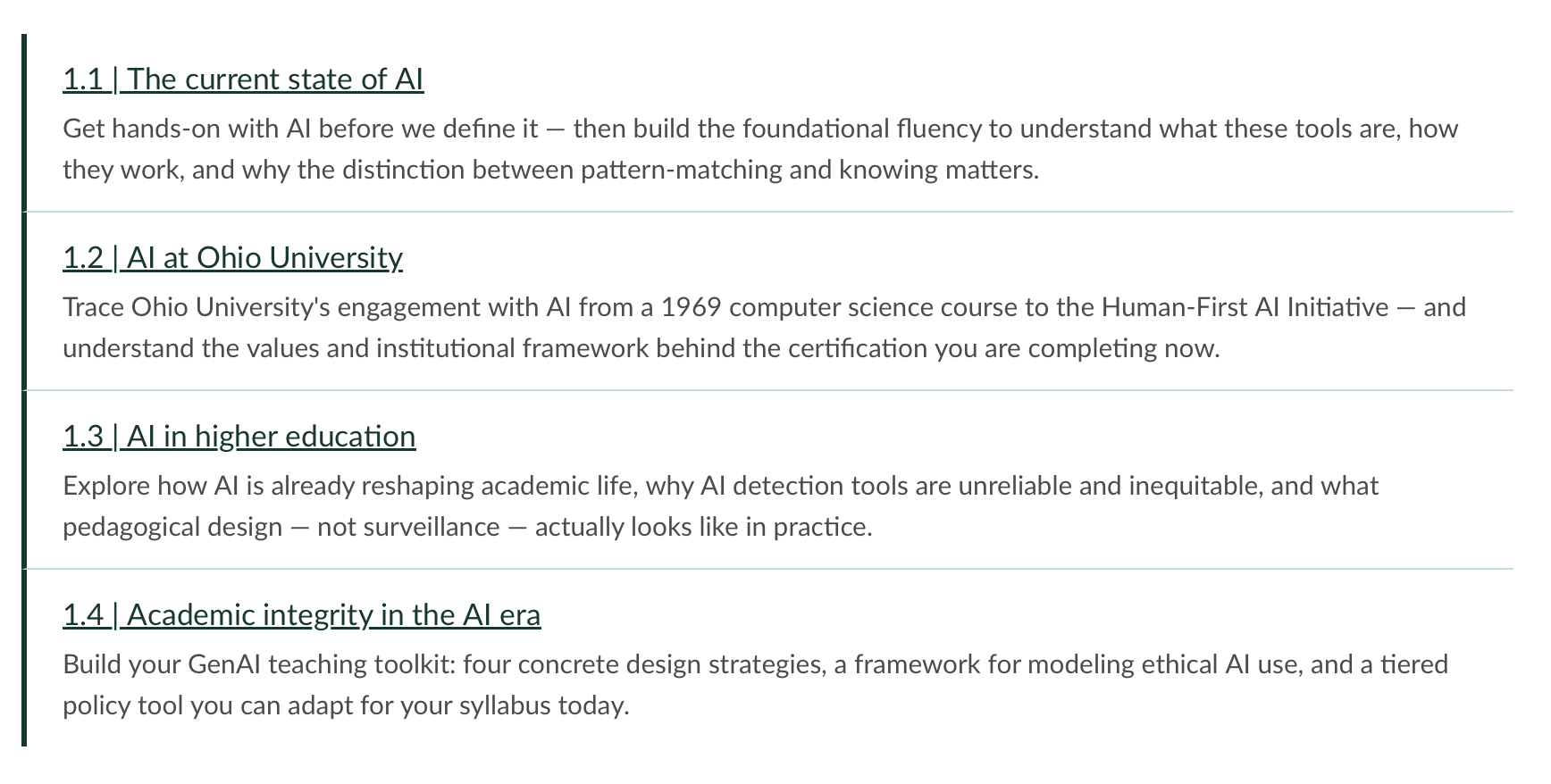
This module covers the AI Landscape generally, then focuses on AI in Higher Education, AI initiatives at Ohio University and Academic Integrity in the AI Era.
Module 2: AI Literacy Framework
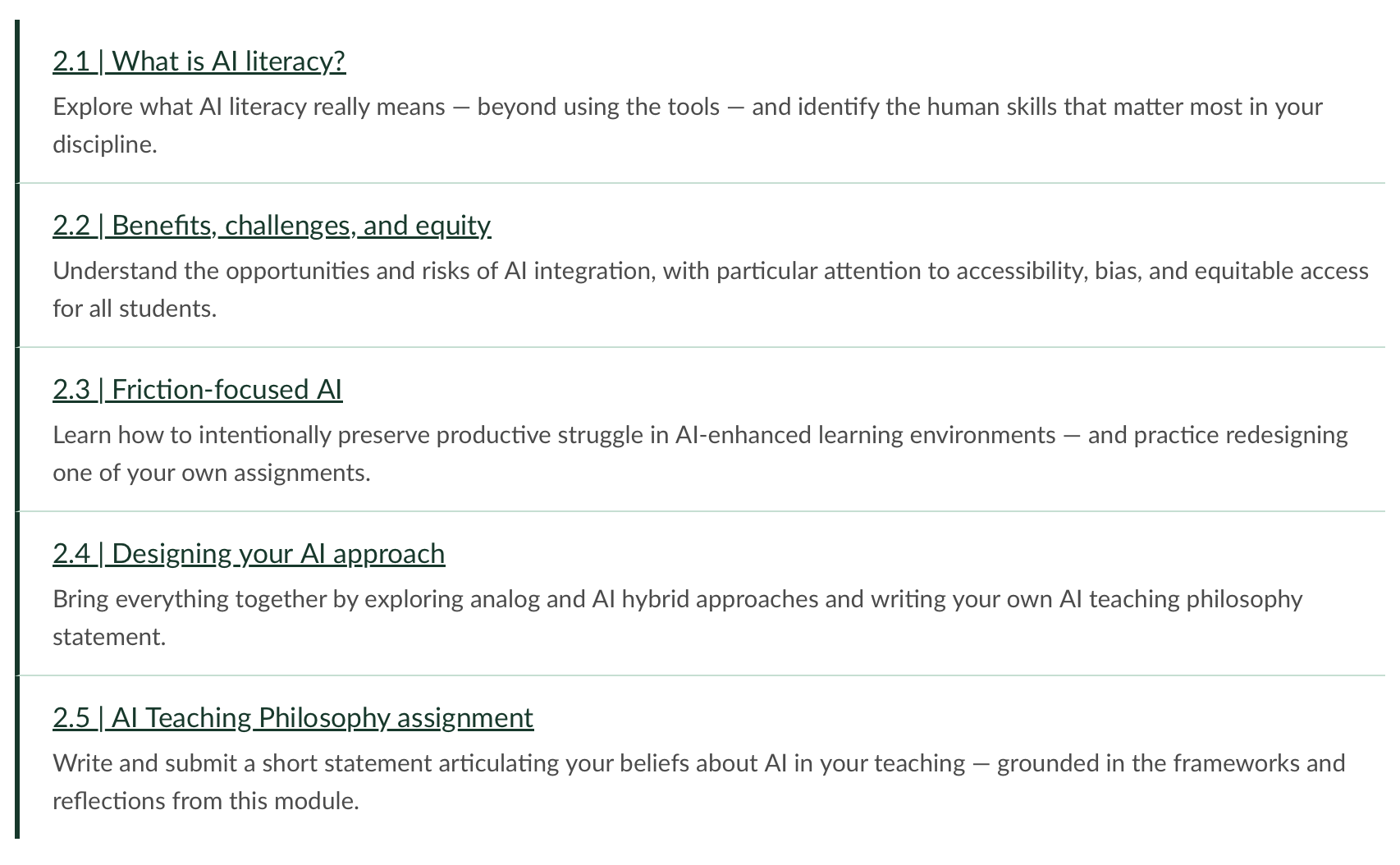
This module explores OHIO's AI Literacy Framework and introduces strategies for thoughtfully integrating, limiting, or resisting AI use depending on the learning goals of a course or assignment. Rather than viewing AI as either a threat or a solution, this module encourages participants to make intentional pedagogical decisions that preserve meaningful learning, creativity and human connection.
Module 3: AI as an Instructional Strategy
AI isn't just changing how students learn, it's also transforming how we design courses, support learners, and make teaching more efficient. This module explores practical applications of AI in instructional strategy, from generating learning outcomes to creating interactive class activities. By the end of this module, participants understand how to use AI as a strategic tool that amplifies pedagogical expertise while maintaining the human elements that make teaching meaningful.
Module 4: AI for Personalized Learning Support
AI's greatest potential in education lies in its ability to personalize learning at scale — adapting to individual student needs, providing 24/7 support, and freeing instructors up to focus on high-impact teaching moments. This module explores how to curate quality content efficiently, evaluate AI tutoring platforms thoughtfully, leverage analytics to support struggling students and scale personalized mentoring. By the end, participants understand how to use AI to make personalized learning accessible without sacrificing the human relationships that make education transformative.
Module 5: AI as Course Content
While modules 3 and 4 provided strategies for teaching with AI, this module explores the foundational concepts and practices for teaching about AI. Participants design hands-on AI projects, develop critical AI literacy skills, explore emerging trends and challenges shaping the field and learn discipline-specific approaches for STEM contexts. By the end of this module, participants have a clear framework for making informed decisions about integrating AI into their course materials and assignments.
Module 6: Implementation and Assessment
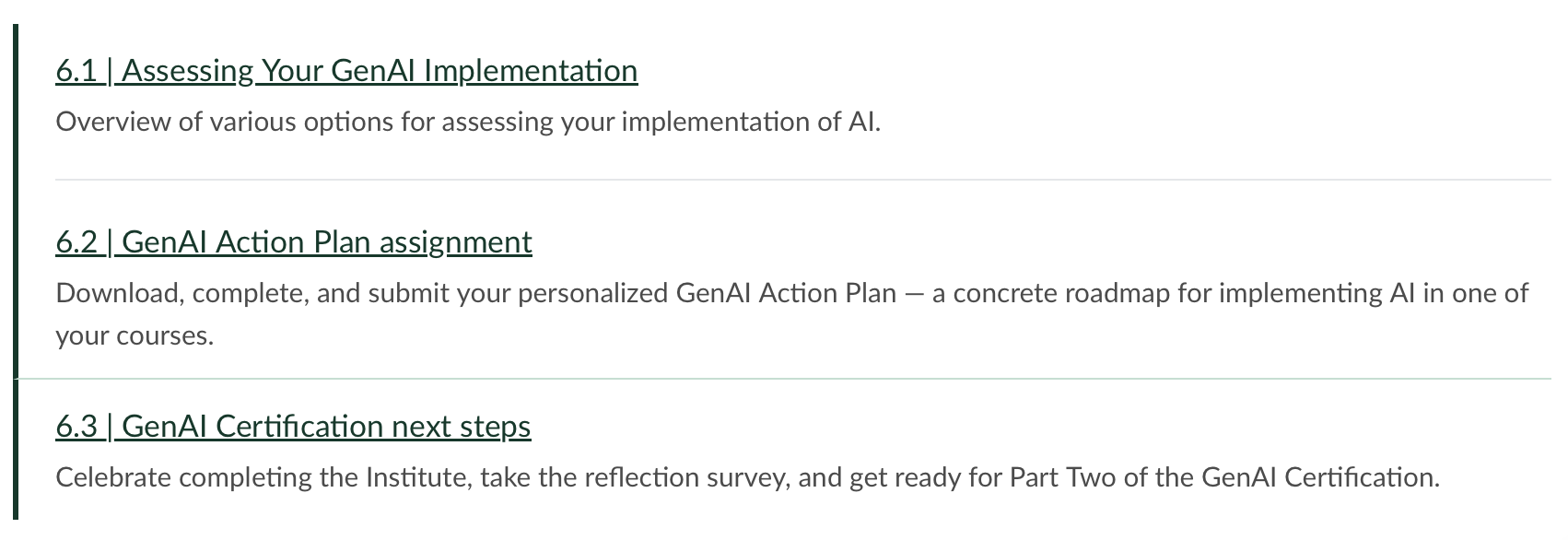
This module is where learning becomes action. This module has three components: an overview of assessment strategies, support and direction to develop a GenAI Action Plan, and a brief reflection survey before participants move into Part Two of the certification.