
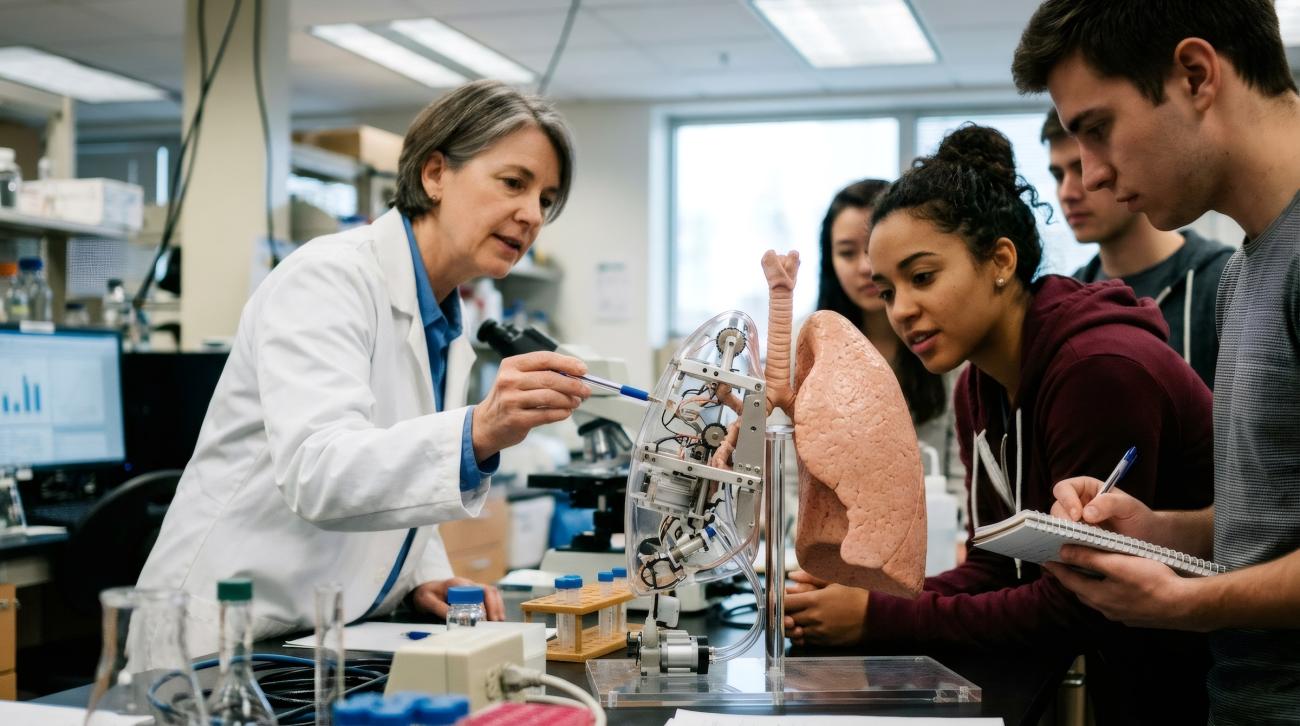
Faculty As Mentors
Mentorship is often expected, but not formally taught, supported or recognized in faculty roles. The Faculty as Mentors Certification recognizes the central role of faculty mentorship in fostering student success and advancing Ohio University’s Dynamic Strategy. Faculty mentors guide students’ intellectual growth, professional development, and personal resilience. This certification develops, supports, and rewards faculty who embed mentoring practices into their teaching, advising, and scholarly engagement.
Content for this scaled experience was developed by OHIO's 2026-27 Mid-American Conference Advancing Leadership Development Program fellows and faculty pedagogical experts focusing on mentorship. They created the course to elevate research on and disciplinary distinction of faculty mentorship and include:
- Maryam Ahmed, professor and chair, Biological Sciences
- Rebecca Dingus, professor, Marketing
- Katie Hartman, Vice Provost for Faculty Development
- Chao-Yang Lee, professor, Hearing, Speech & Language Sciences
- Dwan Robinson, professor, Educational Studies
- Amy Taylor-Bianco, professor, Management
- Jay Wilhelm, associate professor, Mechanical Engineering
Faculty as Mentor Goals
- Making learning pathways transparent. Strengthening clarity in teaching, learning, and assessment demonstrates the connections between courses, academic programs, career contexts and the workplace, and students’ intellectual and professional growth.
- Building habits of mind. Helping students practice metacognition, resilience, and adaptability establishes their skills for navigating challenges inside and outside the classroom now and in the future.
- Designing integrative experiences. Embedding experiences that link disciplinary knowledge with exploration of interdisciplinary perspectives provides opportunities to consider ethical questions, as well as those related to citizenship.
- Mentoring as teaching. Positioning faculty as mentors increases their ability to foster curiosity, critical reflection, and holistic student development within and beyond the classroom.
- Fostering dialogue and feedback. Encouraging authentic, formative feedback from students and peers deepens faculty and student engagement and strengthens our community of learners.
Certification Requirements
- Knowledge Acquisition – a set of asynchronous learning modules delivered through Canvas.
- Implementation – application of learning in new, redesigned, or existing courses.
- Assessment – formal evaluation of pedagogical design and delivery.
- Reflection – instructors’ self-report on implementation effectiveness and next steps.
Faculty will be eligible for the first $500 of their stipend after completing the first two components and for the second $500 after completing the final two components.
This teaching certification is designed as a self-paced, open-entry, open-exit offering.
Getting started with the certification
The Center for Teaching, Learning, and Assessment has opened pre-registration for the certification course. Faculty who complete the form will automatically be added to the Canvas course, which will appear on their Canvas dashboard.
Upon completion of the course, faculty will be able to:
- Articulate the role of mentorship in supporting student learning and development.
- Implement equity-minded mentoring practices in courses and programs.
- Create integrative assignments or experiences connecting coursework, careers and citizenship.
- Foster student metacognition, resilience and adaptability.
- Evaluate and reflect on the effectiveness of mentoring practices.
About the Canvas course
The Canvas course includes research-based frameworks, instructional exemplars from OHIO, digital case studies and multimedia resources and activities. It comprises the following modules.
| Mentoring as Teaching |
|
| Learning Pathway Transparency |
|
| Habits of Mind Formation |
|
| Integrative Experience Design |
|
| Dialogue and Feedback |
|
| Mentorship in Context |
|
About the assessment and reflection components
During the assessment component of the certification, faculty collect data as part of their implementation.
The reflection component involves faculty completing and submitting a self-reflection focused on their own learning and experiences with the certification, as well as next steps for integrating mentoring into their teaching.
Additional details regarding these components are available in the course.
Faculty as Mentors design team
The Faculty as Mentors certification is the result of a collaboration among several units providing faculty development, including the CTLA and the Office of Information Technology, among others. Design team members include:
- Wendy Adams, associate director for assessment, CTLA
- Chelsea Freeman, instructional technologist II, OIT
- Todd Whited, instructional technologist II, OIT