Image

If you’ve been on social media or the internet in the past year, you’ve likely encountered “AI slop.” Three AI-focused OHIO faculty experts define and explain the phenomenon across their different disciplines.
Alex Semancik | May 20, 2026
Share:
A cat playing the violin, the Roman Colosseum turned into a water park, humanoid pasta—if you’ve been on social media or the internet in the past year, you’ve likely encountered “AI slop.” Digital content is often characterized as AI slop when it is of low quality, low effort, high volume and, of course, created by artificial intelligence.
The term has risen to prominence recently thanks to the widespread availability of generative artificial intelligence (GenAI). In fact, slop has become so prevalent that it was Merriam-Webster’s 2025 word of the year.
Generally, AI slop is seen as "digital clutter.” Content that prioritizes speed and quantity over substance and quality. Whether it manifests through social media, art, book or search results, AI slop is also often unwelcome and unwanted.
“We define slop as ‘digital content of low quality that is produced usually in quantity by means of artificial intelligence,’” the editors of Merriam-Webster said. “The flood of slop in 2025 included absurd videos, off-kilter advertising images, cheesy propaganda, fake news that looks pretty real, junky AI-written books… and lots of talking cats. People found it annoying, and people ate it up.”
As the folks at Merriam-Webster colorfully illustrated, AI and especially GenAI can be quite divisive. The growing amount of AI slop on our browsers and feeds has further polarized skeptics and demonstrated what some view as AI at its worst, but at the end of the day GenAI is merely a tool—a reflection of the humans who use it.
Co-Director of Ohio University’s Human-First AI Initiative Paul Shovlin, Ph.D., said it best, “AI is what we make of it.”

Shovlin is an assistant professor of AI and Digital Rhetoric at OHIO and a 2025-2026 AI Faculty Fellow. He says that AI literacy is extremely important in terms of educating people about the harms of AI slop, and helping them formulate more holistic, informed understandings of artificial intelligence in general.
“…if [people] are worried about the environmental impact of AI, but also consider AI a potentially useful tool, it means that they develop some guidelines for using it wisely, since it has a substantial carbon footprint,” said Shovlin. “Many people distill ethical use of AI down to two positions, you either use it or you don't, but knowing more about it can provide more nuanced behaviors that support what you believe in.”

Experts across disciplines agree that as soon as artificial intelligence and large language model (LLM) platforms were released to the public, people were using them to create slop. For Assistant Professor of Computer Science Chad Mourning, Ph.D., the defining feature of AI slop is the low amount of effort it takes to produce. Mourning regularly uses artificial intelligence in his work and integrates it into his curriculum; from his perspective he’s found that the word “slop” can at times transcend AI.
“I would say ease-of-use is the defining characteristic of slop,” said Mourning. “But even before generative AI became ubiquitous, there were a lot of, for instance, subreddits where the top rule was ‘no low-effort posts.’ You see the same accusations of ‘slop’ for Chipotle bowls because they are so easy to assemble.”

Jennifer Garrette Lisy, Ph.D. largely sees eye to eye with Mourning on defining AI slop. Lisy is a 2025-2026 AI Faculty Fellow and assistant professor of elementary education at Ohio University Zanesville. She agrees low effort and quick creation are key elements of AI slop and also sees parallels between AI slop and older mediums like gossip columns and reality TV.
“As an AI Faculty Fellow, I have had the pleasure of supporting faculty and student use of AI for the past two years,” said Lisy. “I think that AI slop is a giant dive into low quality content that doesn’t say anything or add to the larger conversation. With tools like SORA AI, which has already become defunct, anyone could make engaging AI videos that drew people in. When it was still running, people could spend hours watching AI videos of squirrels playing chess or cats in space.”
Shovlin sees slop as an aspect of media, rather than technology. Like Lisy, Shovlin sees some historical trends related to media that could be interesting to think about aligned against AI, however, he also notes that generating and distributing AI slop content has a much lower barrier to entry than past mediums.
“Yes, there are maligned subgenres within other media—people have used words like trash or trashy to describe certain subgenres in fiction like romance. Comic books have been associated with children and childishness, although those judgements are not fair,” Shovlin said. “One aspect here that's different is that we are now using participatory social media platforms. With romance fiction or reality TV someone else, an author with a publishing house, or a producer with a channel, are serving us those forms of media. With the rise of social media platforms and new technologies like smartphones and AI, the barrier to entry is much lower. The result is a deluge of cheap, disposable content.”

If AI slop is ‘digital content of low quality that is produced usually in quantity by means of artificial intelligence,’ then responsible generative artificial intelligence usage is productive, thoughtful, task-oriented and human-centered. Lisy, Mourning and Shovlin all believe that the benefits of responsible GenAI use ultimately outweigh the harm of AI slop. However attentive, mindful human intervention is ultimately required to reap those benefits in the first place.
“Slop is ‘what can I make with this,’ more useful implementations are specific and task-oriented: ‘what can I do with this that I need to do,’” said Shovlin. “If a person is going to understand the advantages, they need to experiment with it in terms of their daily work. This can take some time, because it's not only what can AI do it's also how can I work with this tool to get the outcome I'm hoping for.”

Shovlin adds that people who are new to GenAI may actually need to “play” with it first, creating content that could be categorized as “slop,” before figuring out affordances, limitations and moving onto more effective use. He says this is a typical aspect of human psychology with learning to use any new tool. Once people become more familiar with GenAI as a tool they must make a conscious decision on whether they will use it responsibly.
“AI slop is generated to drive clicks and spread quickly. The goal is not to educate or inform; it is to create clickable content,” said Lisy. “Ethical generative AI use requires the human in the loop to engage with the AI to develop text, images, etc. Then, critically examine the content to determine if it is valid and reliable. Some users determine the most effective ways to use these tools for work and school, while others find ways to profit from them with little effort.”
Lisy also encourages her students, as well as any GenAI users to ask themselves if the information they’re using is valid and if the content they’re creating serves their intended purposes.

“The best uses of AI will be in tandem with human creators,” said Mourning. “Digital creators are rightly concerned about many aspects of how AIs were trained, and the future of their livelihoods, but the best products will be someone using AI like they used Photoshop.”
According to Mourning, GenAI can also serve a purpose in valuable scientific research. During his work with atmospheric visibility prediction, he utilizes GenAI data augmentation to compensate for underrepresented data. For example, if there are a lack of days with low visibility to train his program, Mourning said GenAI is great for creating new samples.
Mourning is also a firm believer that the advantages of GenAI outweigh the “slopification” that most people are exposed to.
“People will never see how it’s being used in the background to cure cancer or stop planes from crashing. They’ll see how it’s being used on their screen,” he said. “As a computer scientist by trade, I can tell you firsthand that I am multiple times more productive than I used to be thanks to GenAI programming tools, but most people will just see videos of cats playing the violin.”

Ohio University’s Center for Teaching, Learning and Assessment (CTLA) serves as a central destination for all things artificial intelligence. CTLA supports OHIO’s commitment to student transformation through the learning experience and serves as a hub connecting University-wide resources, information and support related to teaching, learning and assessment, and AI is no exception.
Ohio University sets itself apart by its acknowledgement and support of faculty to share their expertise across the university. OHIO’s AI Faculty Fellows include faculty across the University and it’s the regional campuses from the sciences, arts, English, and education. The faculty fellows design AI-related professional development for faculty to support their students’ use of AI, design course materials, chatbots and more.
OHIO’s CTLA also has a position statement regarding the use of GenAI.
CTLA supports the principled implementation and integration of Generative Artificial Intelligence in higher education when and where it promotes:
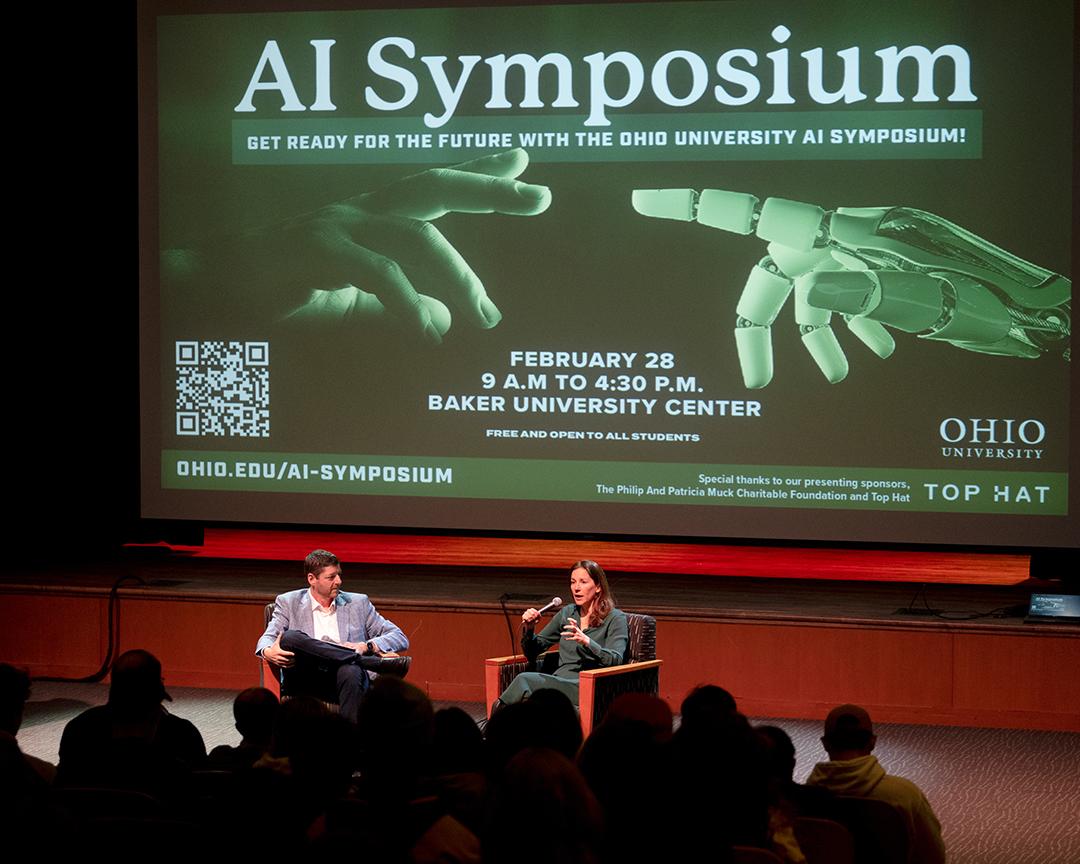
“CTLA's position statement rearticulates its mission to support student learning and faculty teaching,” said Shovlin. “We believe AI is not going to go away and that people's agency, power or control over their lives, is connected to their ability to understand and negotiate this new technology. “
Lisy said that something that truly sets Ohio University apart in this space is the acknowledgement that there is not one AI policy that works across all courses.
“A valid use of GenAI in one field may be considered plagiarism in another,” she explained. “By having transparent policies and continuing open conversations about the ethical use of GenAI, we support our students' use of AI. To be prepared for their future careers, our students need to understand the appropriate GenAI uses in their fields.”
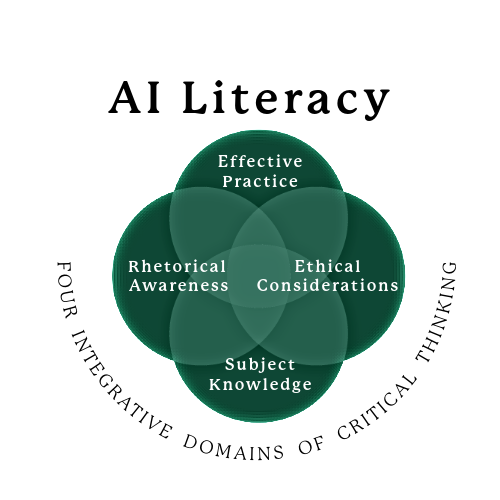
Mourning is not officially an AI faculty fellow but says he agrees with everything in CTLA’s position statement, particularly that AI is here to stay.
“Students will be at a disadvantage, in the classroom and workplace, if they completely abstain from using it,” Mourning said. “Also, I agree that educators need to update their approaches.”
Mourning himself is working to update his own department’s approach.
“The School of Electrical Engineering and Computer Science recently submitted a course request to teach an ‘AI 1000’ course to cover AI literacy and ethical use for any major and are currently gauging interest outside of Russ College,” he said.