
Emeriti Park at Sunrise
Hazing Prevention

Hazing Prevention


Report Hazing

Hazing is not tolerated at Ohio University. Not within our sororities and fraternities, our athletic teams, sports clubs, registered student organizations, the band or anywhere else.

For hazing to stop, it must be reported. All reported incidents of hazing will be investigated, and all individuals involved in hazing activities are subject to both criminal and/or university judicial proceedings.

If you have witnessed or have knowledge of a possible hazing incident, report the incident immediately to Community Standards at 740-593-2629 and/or contact the police. Hazing activity can also be reported through the Community Standards Incident Report. Reports may be made anonymously, although the University may be limited in responding to anonymous reports.

Hazing can be physically and emotionally harmful. There are available resources if you need support or medical attention as a result of hazing activities.

State of Ohio law requires that all members of the university community report hazing. Failure to report hazing could result in criminal charges up to a 1st degree misdemeanor. 

Report a Hazing IncidentHazingPrevention.org

Not Ready to Report?

Ohio University provides multiple methods for students, family members, faculty, staff, and community members to report hazing. If you see or hear something that concerns you, Ohio law requires that you report that concern or incident to support the health, safety, and well-being of students.

If you are not sure what to report and/or want to learn more about what happens after a hazing report is received, contact the Office of Community Standards & Student Responsibility at 740.593.2629 or communitystandards@ohio.edu to schedule a time to speak with a staff member. 

Our Commitment to Hazing Prevention

Ohio University's core values of character, community, citizenship, civility and commitment define who we are as a University community. We will continue to emphasize our core values as we serve our students, and we will do everything we can to keep our students safe.

We are here to help our students learn and grow so that they become responsible community members and leaders. We will never waver in that commitment.

Our obligation is to the safety and security of our students, We are committed to working with our student organizations to help ensure that they are engaging in behavior and practice that are in alignment with University policies and core values.

Collin's Law Report: Biannual SB126 Anti-Hazing Report

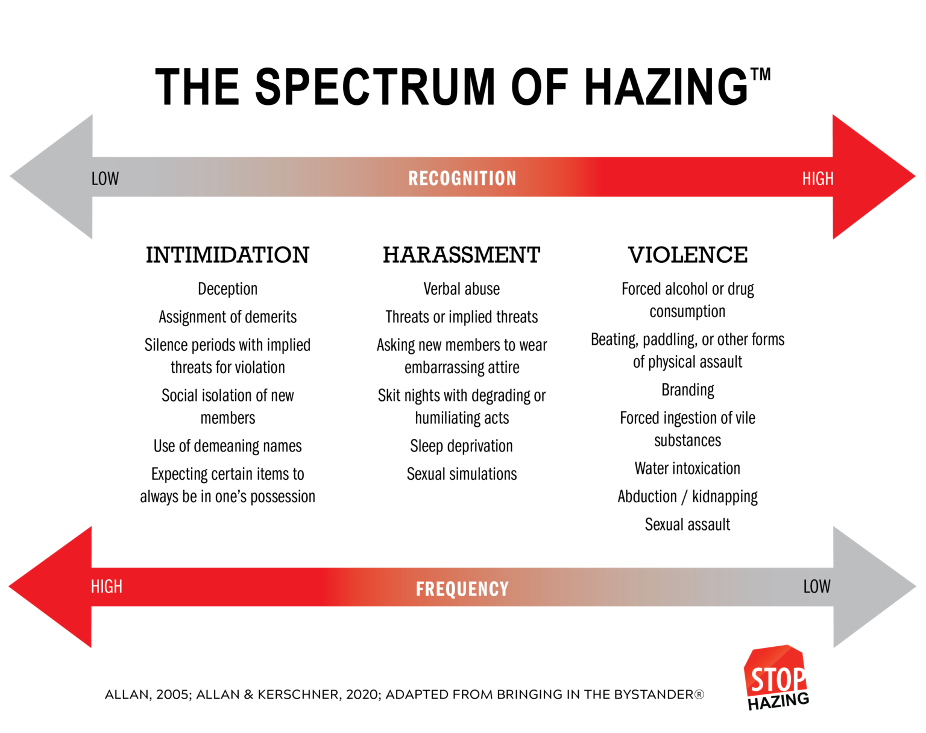
Diagram illustrating that hazing behaviors are more common when they are less easily recognized as hazing, and less common when they are more easily recognized.
Figure 1. Hazing often exists on a continuum. Behaviors that are less easily recognized as hazing tend to occur more frequently, while behaviors that are more readily recognized as hazing tend to occur less frequently.

Is it Hazing?

If the answer to any of the following questions is “yes” the activity is likely hazing:

  • Would I feel comfortable with family, media, or university officials observing this activity?
  • Are senior or existing members declining to participate alongside new members?
  • Does the activity pose risk of emotional or physical harm?
  • Have I been told to keep the activity a secret?
  • Am I being asked to do anything illegal or against university policy?
  • Does this activity conflict with my personal values or the organization’s values?
What is considered hazing?

Hazing is:

  1. Any action or situation which recklessly, intentionally, or knowingly endangers the mental, emotional, or physical health or safety of a student for the purpose of initiation or admission into, or affiliation with, any student organization or group regardless of the person's consent or willingness to participate.
  2. Brutality of a physical nature including but not limited to paddling, whipping, beating, striking, electronic shocking, branding, placing of a harmful substance on someone's body, forced calisthenics, exposure to the elements or other similar activity.
  3. Causing, coercing, or otherwise inducing consumption, including but not limited to any food, alcoholic beverage, liquid, drug, or any other substance that subjects the student to an unreasonable risk of harm.
  4. Causing, coercing, or otherwise inducing acts intended to cause mental stress, including but not limited to sleep deprivation, transportation or abandonment, confinement to a small space, forced exclusion from social contact, forced conduct which could result in embarrassment, any forced activity that is designed to shame or humiliate, or any action of harassment (as defined in the "Student Code of Conduct").
  5. Any activity that places another person in reasonable fear of bodily harm through the use of threatening words or conduct.
  6. Any activity against another person, including a criminal violation of local, state, or federal law.
  7. Coerced activities, including but not limited to violation of local, state, or federal laws, violation of university policies, rules, or regulations, and personal servitude.
    • Personal servitude is defined as activities that are performed for the personal benefit of individual members and may include, but are not limited to driving, cooking, cleaning, serving meals, running errands, picking up laundry, and purchasing items on another's behalf.
  8. Acts of sexual harassment and other sexual misconduct as defined by Ohio university policy 03.004, including without limitation causing, coercing, or otherwise inducing another person to perform sexual acts.
Is hazing against the law in Ohio?

Yes, hazing is against Ohio law. You can review of copy of Ohio Senate Bill 126 here.

What can happen to me or my student organization if we have/are found responsible for hazing?

Students and student organizations found responsible for hazing are subject to the full range of sanctions set forth in the Student Code of Conduct, including suspension and expulsion from Ohio University.  Additionally, student organizations may lose recognition/registration or face permanent expulsion from Ohio University.

Is hazing only a problem for fraternities and sororities?

Hazing is not a problem exclusive to fraternities and sororities and takes place across all types of groups. There have been incidents of hazing at universities with varsity athletic teams, club sports, intramural teams, religious groups, honor societies, ROTC, student organizations, and marching bands.

Does it matter if the person being hazed consents to participating in the hazing activity?

Under Ohio law and Ohio University policy, an individual's consent to the conduct in question is not a defense to a charge of hazing. In hazing situations, such a “choice” is typically offset by the peer pressure and power dynamics that exist when individuals are seeking to gain membership into an organization.

Parents and Family Members

Partners in Hazing Prevention

To prevent hazing, we need the entire Bobcat community to come together in our efforts, and that includes our parents, family members, and other supporters. Parents and family members are key partners to stop hazing. Parents often see and hear things from their students that raise concerns about safety and well-being. There are several things you can do to prepare yourself to prevent hazing and respond when you suspect it is occurring.

  • Educate yourself what constitutes hazing  
  • Be aware of the warning signs that hazing might be happening 
  • Know which questions to ask to learn what really is happening in the student organization   
  • Learn about a student organization conduct history  
  • Know how to report 

Reporting

If your student shares incidents of hazing with you but asks you not to share, you may feel conflicted. Know that by reporting, you may stop dangerous behaviors from escalating. 

  • You can make a report along with your student so that information is shared and they feel supported through the process
  • Reach out to our Community Standards and Student Responsibly team to talk about approaches to encourage your student(s) to come forward on their own or with you.
  • Anyone can submit a report anonymously but our ability to take action may be limited

Possible Warning Signs That Hazing May Be Occurring:

  • Being required to walk in groups to class, the dining hall, or other locations
  • Being required to carry certain items at all times
  • Unexplained loss of voice
  • Performing personal tasks or errands for other members
  • Sleep deprivation or chronic fatigue
  • Being away from home for extended periods without explanation
  • Physical exhaustion
  • Noticeable changes in personality, mood, or emotional well-being
  • Withdrawal from normal activities, friends, or family
  • Decreased communication with family or friends
  • Avoidance of people outside the organization
  • Unexplained bruises, injuries, or signs of pain when moving or sitting

Signs of a Positive Student Organization Environment

  • New members are treated with dignity and respect from the beginning.
  • Expectations for joining are clearly communicated and apply fairly to everyone.
  • Members can decline activities without fear of punishment, exclusion, or embarrassment.
  • Traditions and activities are designed to educate, develop skills, and build community, not to test loyalty or commitment.
  • Leadership development occurs through mentoring, training, and meaningful involvement.
  • New members learn about the organization's history, values, and mission through positive experiences.
  • Activities are designed to include rather than separate or subordinate new members.

For Students

Hazing Prevention mandatory online courses are launched in early August. Once the courses are launched, you will receive email communication from Vector Solutions regarding how to access your course.

Each course must be completed within 30 days of receiving the assignment.

You may also access the course through the Vector Solutions Dashboard and following the steps below.

  1. Open Vector Dashboard link
  2. Log in using your Ohio University email (Catmail)
  3. Click on “My Assignments”
  4. Click on Hazing Prevention and complete the module

Hazing Prevention Task Force

The Hazing Prevention Task Force includes a broad range of campus stakeholders who meet regularly to collectively examine hazing, asses the proactive strategies and approaches OHIO currently engages in to prevent hazing, including ways to strengthen our approach. The broad goals of the task force include:

  • Examine campus, state, and national trends and consider educational strategies to positively impact trends 
  • Consider and recommend proactive approaches to engage students in hazing prevention on campus 
  • Recommend ways to strengthen OHIO’s approach to hazing prevention 
  • Annually provide report on outcomes of the task force to the broader community

Co-Chairs:

Scott Bye, PhD, Interim Dean of Students

Dane Bennett, M.Ed. Interim Assistant Dean of Students & Director, Community Standards and Student Responsibly

Members:

  • Hali Burleson, Senior Project Manager & Planner, JED Campus & Well-Being
  • Amy Dean, MSA, Deputy Athletic Director
  • Robert Foehl, Associate Professor of Instruction
  • Alex Gebers, Assistant Director, Competitive Sports & Community Programming
  • Nyla Gilbert, Student Representative, Health Promotion
  • Andrew Powers, Chief of Police, Ohio University Police Department
  • Allie Stevens, student representative, Health Promotion
  • Tony Gregory, Director for Student Organizations and Campus Programming
  • Timothy Gronert, Student Representative, Interfraternity Council 
  • Maleah Jones, Student Representative, Marching 110
  • Lexi Kepling, Student Representative, College Panhellenic Council 
  • Collins Simat Ketere, Student Representative, International Student Union
  • Kathy Fahl, MSW, Interim Vice President for Student Affairs
  • Carly Leatherwood, Chief of Staff to the President, Office of the President
  • Ryan Mahaffey, Student Representative, Club Sports
  • Bose Maposa, Director of Operations, Office of the Provost
  • Barb Nalazek, Deputy General Counsel, Legal Affairs
  • Dan Pittman, Senior Director of Communications, UCM
  • Sydney Stephan, Director, Sorority and Fraternity Life
  • Richard Suk, Director, Marching 110 

OHIO's Policy Against Hazing

Ohio University seeks to promote a safe environment where students may participate in activities and organizations without compromising their health, safety, or welfare. It is therefore the University's policy that hazing is prohibited.

Prevention of hazing is the responsibility of every member of the University community. Each organization, as well as each individual, must accept the personal obligation to uphold the basic community values of citizenship, civility, character, community, and commitment. It is the university's belief that true human development will best occur in an atmosphere that promotes social and ethical responsibility.

Under this policy every member of our University community has an obligation to report and act on information regarding hazing. If no action is taken, Under this policy Ohio University employees have an obligation to report information regarding hazing.  All allegations of hazing will be fully investigated, and any organization and/or individuals within an organization found responsible of hazing may face disciplinary action up to and/or including expulsion from the University and criminal charges. OHIO's policy against hazing

  • The university-wide policy related to hazing prevention and reporting can be found here.
  • In addition to the university-wide policy on hazing and reporting, hazing is also prohibited as a specific violation of the Student Code of Conduct Part D, Section 8.
  • All student organizations (including recognized social fraternities and sororities) are required to re-register annually to access campus services. As a part of this re-registration process, specific officers of each organization (President, Vice President, Secretary, and Treasurer) are required to agree to terms and conditions including upholding the Student Code of Conduct, a non-discrimination expectation, a non-hazing expectation, financial accountability, and defining the role of an advisor.

Programs & Staff Support

  • THRIVE is OHIO’s student-focused well-being initiative that provides services, events and programs that show genuine care for our students and encourages making connections across the University community and individualizing and prioritizing well-being actions.
  • Through its Make Respect Visible initiative, OHIO is showcasing its commitment to cultivating relationships, communities and environments, both productively and respectfully, in pursuit of its mission, vision and values.
  • Every chapter participates in the Pawprint Accreditation Program which assesses chapters on 8 different areas including chapter operations, health and safety, academics, recruitment, new member education, and more. Chapters are required to submit their new member education programs for review and have monthly chapter coaching sessions with a member of OSFL staff to talk about creating inclusive and safe new member processes.
  • The University provides opportunities for students and student organization members to access risk management, bystander intervention training, and alcohol and other drug intervention trainings from a harm-reduction modality and a socio-ecological approach. View the list of programs, including specifically a hazing program.
  • In spring of 2021 the students and the university worked together to add an additional FTE to Sorority and Fraternity Life, bringing the total full time FTE to 2.0
  • Every fraternity and sorority are required to attend monthly PAWs for Cause Educational Programs that addresses issues of hazing prevention, alcohol awareness, sexual assault prevention, issues of mattering and belonging, mental health awareness and more.
  • Student organizations participate in annual Hazing Prevention Programs each September for National Hazing Prevention Week.
  • All students and staff are required to complete the hazing prevention module training offered by Ohio University. Additionally, all Friends of OHIO (including chapter advisors and IHQ staff), are required to complete their own version of the module training.