Image
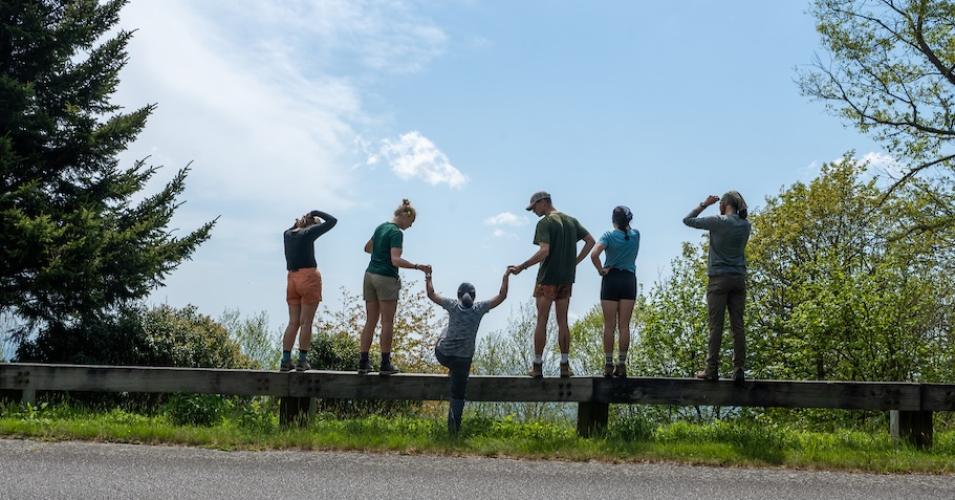
Ohio University faculty and staff representing every OHIO campus are creating new opportunities for students to connect classroom learning with hands-on experience with the help of Experiential Learning Stewardship Grants.
Each semester, the Office of Experiential Learning invites proposals from faculty and staff who are either expanding or enhancing an already existing student experiences or are offering an altogether new experiential learning opportunity.
Previous awards have supported experiences, both domestic and international, ranging from cave mapping and student-produced publications to theater productions and applied learning in exercise physiology, speech-language pathology, and social and public health.
The current award cycle is now open and closes on Oct. 12 at 11:59 pm.
In Spring 2026, the Office of Experiential Learning awarded funding to 11 faculty- and staff-led projects. Six of the projects were at Regional Higher Education campuses and five were on the Athens campus. The projects represent a range of disciplines and experiential learning approaches, including community engagement, research, internships and global learning.
While the projects vary considerably by discipline and approach, they share some common goals: giving students meaningful opportunities to apply academic knowledge in authentic contexts, learning through practice and reflection, engaging with community leaders and businesses, and developing skills they’ll carry into their future academic, professional and civic lives.
“These faculty are doing what so many of our faculty do – they’re just really good teachers – and they recognize that students need opportunities to experience real work alongside academic preparation. These experiential learning opportunities are essential for students to gain practice translating content knowledge into professional contexts," said Michelle O’Malley, executive director of the Office of Experiential Learning.
The following examples feature several projects developed and overseen by the faculty and staff awardees from the past couple of years.
Faculty/staff lead: Adonis Durado, Associate Professor, School of Visual Communication, Scripps College of Communication
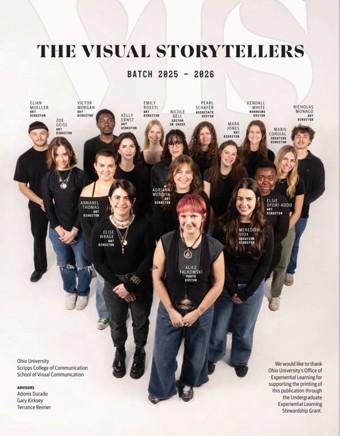
Students in the School of Visual Communication in the Scripps College of Communication gained hands-on professional experience in editorial design, visual storytelling, photography, writing, branding, and publication production through the creation of VIS Magazine, a student-driven publication supported by the Experiential Learning Stewardship Award.
Students interviewed subjects, wrote and edited stories, designed layouts, produced visual assets, managed deadlines, prepared files for print production, and distributed print and digital editions. Throughout the semester, they worked as an editorial team through multiple rounds of critique, revision and refinement.
Through the project, the students experienced a professional publishing workflow while still in an academic setting.
The project strengthened students’ skills in communication, problem-solving, storytelling, visual hierarchy, typography and project management, while also building their understanding of ethical storytelling, audience engagement and the responsibilities of producing work for a public audience. The finished magazine also provides students with portfolio-quality work they can use when applying for internships, graduate programs and employment.
Students reported increased confidence in their creative and professional abilities after seeing their work published in both print and digital formats. Many also developed a stronger understanding of collaborative publishing workflows and the importance of revision, communication, accountability and teamwork in professional creative practice.
The quality of the students’ work also received national and international recognition.
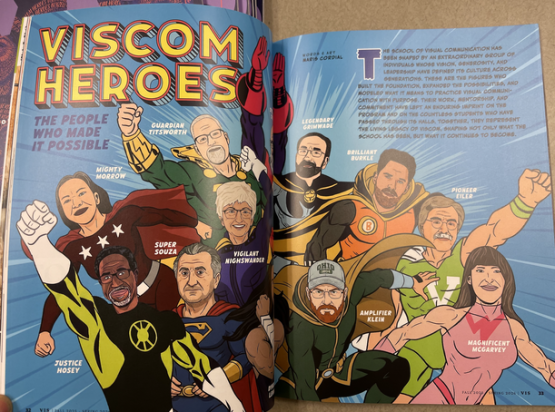
VIS Magazine's entire issue won first prize in the Association for Education in Journalism and Mass Communication (AEJMC) Magazine Division’s Student Magazine Design category, providing national recognition for the publication’s editorial and visual design. The magazine also earned six awards from the Society for News Design competition, including three Bronze Medals and three Awards of Excellence. Together, these honors recognize the strength of the students’ editorial design and visual storytelling and demonstrate what can result when students have opportunities to apply their academic learning to ambitious, professionally relevant projects.
Another outcome was the expanded reach through the digital edition. The online format increased accessibility for alumni, prospective students, parents and external audiences.
Faculty/staff lead: Dr. Christi Camper Moore, Associate Professor of Dance and the head and graduate chair of the Arts Administration program, Chaddock + Morrow College of Fine Arts
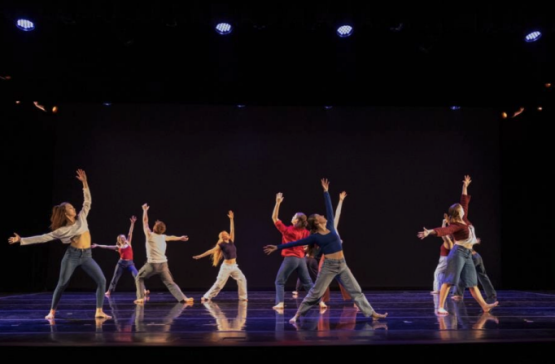
First-year students in the School of Dance in the Chaddock + Morrow College of Fine Arts had the opportunity to learn and create alongside Urban Bush Women (UBW), the groundbreaking Brooklyn-based Black women-led theatrical dance company and social activism ensemble.
Supported by an Experiential Learning Stewardship Grant, the project brought UBW artists to OHIO for a series of workshops that engaged students in movement, creative research and collaborative practice. All first-year dance students participated, ultimately contributing to the creation and performance of a new dance work.
Working directly with professional artists allowed students to experience how artistic practice can intersect with community, identity and social engagement while developing their own skills as emerging dance professionals.
“Working with [Urban Bush Women] was incredibly inspiring,” said one student in a written reflection on the program. “They looked at dance as not just movement, but a way to communicate important topics to others. They incorporated our own voices into the piece seamlessly, which makes it vital for us to share this piece with the greater dance community. When the piece was finished, I felt an astounding sense of pride and accomplishment for creating something that had so much weight to it.”
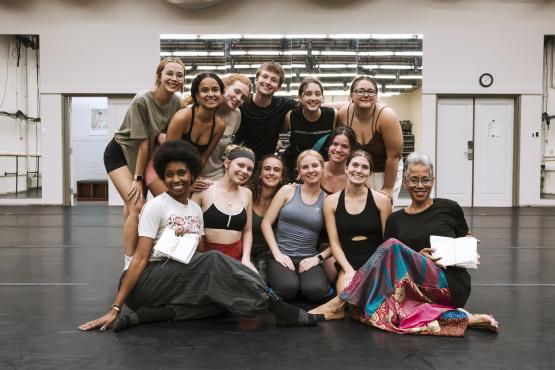
Christi Camper Moore, associate professor of dance and the head and graduate chair of the Arts Administration program, said the project provided an important learning experience for the students.
“The whole intention of the First Year Performance Guarantee is to immediately root our first-year dance majors in a sense of place through creative making and having a guaranteed opportunity to perform…and so we really think thoughtfully about the kind of national guest artists we bring in that really nurture community and build confidence and collaboration within this new group of students,” Camper Moore said.
Faculty/staff lead: Larry Hayman, Director of Legal Engagement and Pre-Law Program, Center for Law, Justice and Culture, College of Arts and Sciences
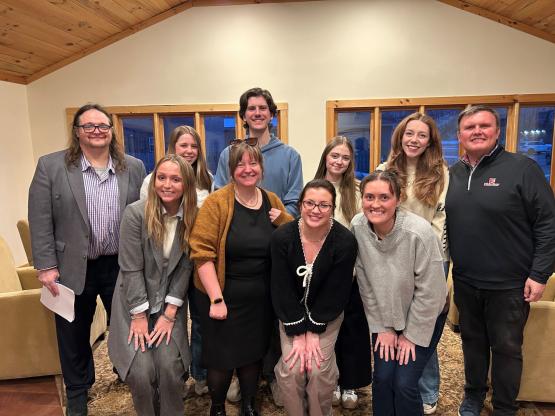
Students in Ohio University’s Center for Law, Justice and Culture (CLJC) gained experience applying legal research and problem-solving skills to complex issues affecting people locally and around the world through the International Justice Lab and Rural Justice Lab.
The International Justice Lab began in fall 2025 through a partnership among the CLJC, OHIO alumnus David Crane, BGS ’72, MA ’73, and the Global Accountability Network (GAN), a nonprofit organization Crane founded to pursue justice for communities affected by atrocity crimes.
Students began with an intensive seven-week course taught by Crane covering international law and human rights violations before joining teams working on four international accountability initiatives: the Pacific Rim Accountability Project, Syrian Accountability Project, Ukrainian Accountability Project and Caribbean Accountability Project. Students also collaborated with faculty and law students from other institutions, giving them experience working within larger professional and scholarly networks.
“The labs matter because they bridge theory and practice in ways that are both rigorous and thoughtful,” Larry Hayman, director of legal engagement and pre-law programs in the CLJC, said. “They prepare students to be able to engage in complex justice issues with humility, skill and accountability while delivering real value to the communities that they serve beyond the university.”
Closer to home, students participating in the Rural Justice Lab worked with Athens County residents living below 200 percent of the federal poverty level who were navigating civil legal matters. The experience allowed students to develop practical skills while contributing to an important community resource.
“It takes people like us students … everybody else who's participating in this project, to do the research so that way, these atrocities don't go down as a blip in the radar,” junior Loren Breslin said. “They are important. People were hurt greatly, and their stories deserve to be told.”
Together, the two labs demonstrate how experiential learning can connect academic study with consequential real-world issues—whether those issues are unfolding in southeastern Ohio or across the globe.
Faculty leads: Joe Crowley, Assistant Professor of Instruction, Recreation, Sport Pedagogy and Consumer Sciences, Patton College of Education, Dr. Greg Springer, Professor, Earth and Environmental Geosciences, College of Arts and Sciences
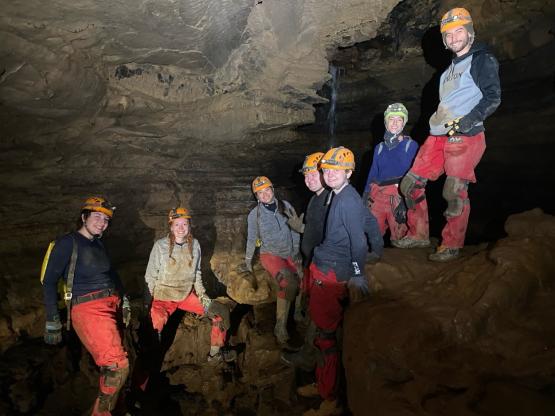
For students in geological sciences, outdoor recreation and a variety of other majors, experiential learning doesn’t just scratch the surface; it has taken them beneath it, literally.
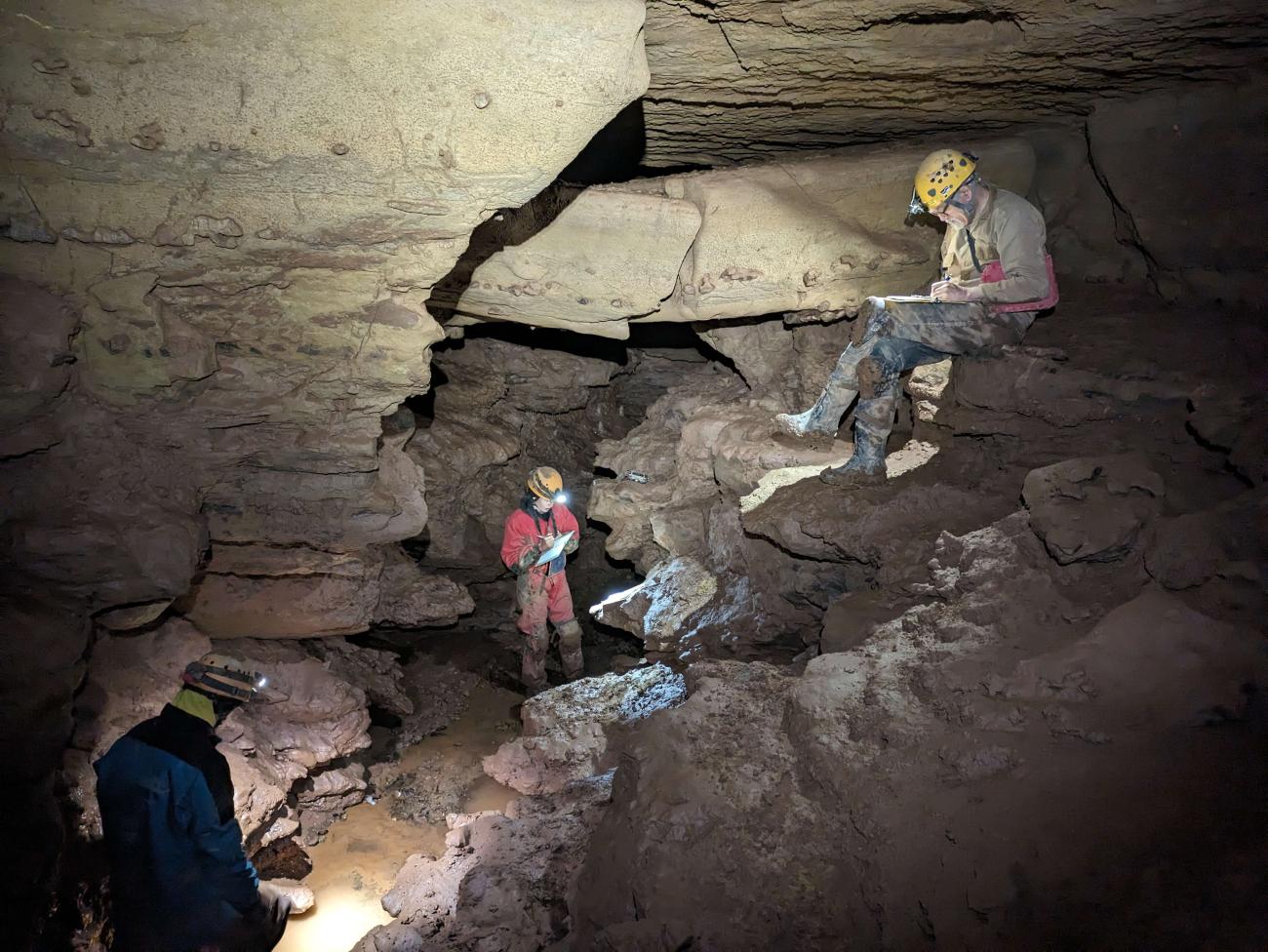
Through an Experiential Learning Stewardship Grant-supported cave mapping project, OHIO students traveled to caves including Boar Hole Cave and Bone Norman Cave in West Virginia to conduct surveying and explore cave geology. More than 120 students have participated in supported caving experiences to date.
Before entering the caves, students learn about basic cave surveying and mapping, geological features and Leave No Trace practices in the classroom. In the field, they put that knowledge into practice by conducting survey work using sketchbooks and specialized lasers to map passages and observe fragile geologic formations firsthand.
The experience moves beyond recreational “sport caving” by introducing students to the scientific methods used to survey, document and understand dynamic cave environments. It also asks students to navigate unfamiliar and potentially uncomfortable physical spaces, solve problems collaboratively and apply classroom knowledge under real-world conditions. Student work helps contribute to the development of professional cave maps and chart potential changes over time.
For OHIO student Hannah Patton, the experience also became a lesson in navigating perceived risks and moving beyond her comfort zone.
“Before the trip, I was quite nervous about everything: the dark, the crickets, the tight spaces, all of it. After heading down the first portion of Bone Norman Cave, I began to feel much more comfortable, and I found myself having the most fun when experiencing all of the things I was afraid of the most,” Patton said.
Patton said the experience taught her that “stepping out of my comfort zone is hard but so incredibly worth it.”
The project illustrates a central purpose of experiential learning at OHIO: creating opportunities for students to put disciplinary knowledge into practice while developing the confidence, adaptability and collaborative skills that emerge from navigating authentic and sometimes unexpected experiences.
“The projects supported through the Stewardship Grants show that experiential learning can look very different across disciplines,” explained Courtney Kessel, director of Experiential Curriculum Integration. “What connects them is intentionality: students are doing meaningful work, being challenged and mentored, and reflecting on what they have learned. Our goal is to help faculty and staff create more of those opportunities for students across every OHIO campus.”
The Office of Experiential Learning invites faculty and staff submissions from all OHIO campuses now through Oct. 12, 2026.