Image
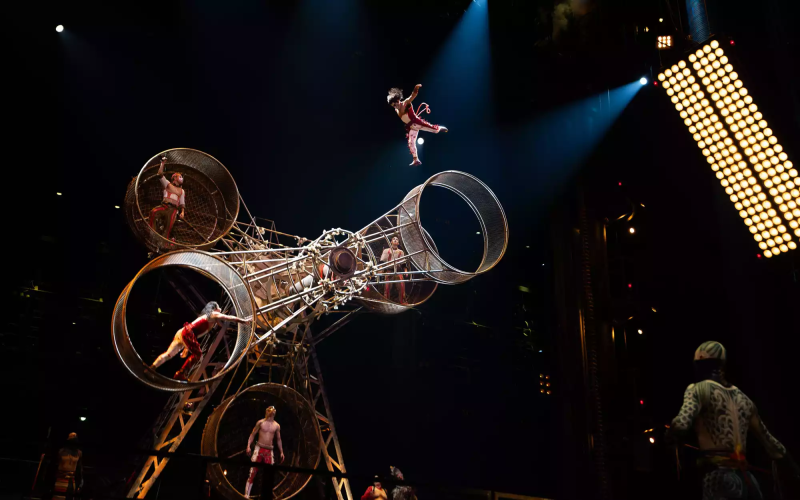
Wheel of Death from KÀ, Courtesy Cirque du Soleil Entertainment Group
When most people think of Cirque du Soleil, they envision bodies flying through the air, performers bending in ways that defy anatomy and acts so daring they sit on the edge of danger. With such breathtaking risk involved, it’s easy to assume the injury rate, especially concussions, must be high. But thanks to a new study led by Ohio University’s Dr. Jeff Russell, we now know just how often head injuries actually happen under the big top.
Russell, an associate professor of Athletic Training in Ohio University’s College of Health Sciences and Professions and a researcher specializing in performing arts medicine, led a team that analyzed a decade’s worth of concussion data from Cirque du Soleil. The goal was to better understand the incidence of head injuries among performers in one of the world’s most physically demanding and imaginative performance companies.
“You’d think with all the acrobatics and stunts, the concussion rate would be through the roof,” Russell said. “But it turns out, it’s about on par with what you’d see in baseball or softball.”
The study analyzed nearly 270 million “exposures,” defined by Russell as any instance in which a performer participated in a rehearsal, performance or training session, over the course of 10 years. For every 10,000 exposures, there were approximately 1.3 concussions, which was lower than the team expected.
The data came from Cirque du Soleil’s extensive digital medical records system, made possible through the collaboration with athletic trainer Todd Richardson, who has worked with the company since 2004 in both full-time and consulting roles. Richardson, who has worked on shows such as Mystere, “O”, Viva Elvis, Michael Jackson “ONE”, KÀ, Mad Apple, Kooza and Corteo, played a critical role in the study, reviewing and compiling data from the organization’s electronic medical records database and reviewing the processes of how Cirque collected, managed and categorized the data.
“Dr. Russell approached me about the possibility of one of his graduate students wanting to look at concussion rates in our performers,” Richardson said. “COVID came and the project was delayed for a few years and eventually we were able to revisit and move forward with the project.”
But making sense of that enormous dataset required deep statistical expertise, which is where Dr. Janet Simon, an associate dean for research and associate professor in the College of Health Sciences and Professions, entered the research. As a statistician, Simon was brought onto the project specifically to run the analyses and ensure the data told an accurate story.
“Jeff approached me needing help with the analysis portion of this study and asked if I wanted to run it and be part of the group,” Simon explained. “That became my role, running the data and providing context.”
Once Cirque provided the raw records, Simon spent weeks conducting quality control, combing through entries to correct errors and ensured every variable made sense before running statistical models.
“Sometimes things get entered incorrectly,” Simon explained. “Our job was to clean the data first, then run the analyses so we could make accurate comparisons over time and among different types of performers.”
After cleaning the data, Simon analyzed changes across the 10-year span and compared patterns between performer groups such as acrobats, dancers, actors and musicians.
Unsurprisingly, acrobats accounted for the largest share of concussions, being 83% of all cases, while dancers represented about 10% and actors and musicians even less. The overall concussion rate, however, remained stable across the decade.
According to Simon, most injuries occurred during performances rather than training sessions, with about 70% happening during shows, and the majority of those during the first performance of the night. The team also examined how concussions occurred, whether from contact with a surface, equipment, props or another performer. Across these mechanisms, the patterns were consistent. There were also no significant differences between resident Las Vegas shows and touring productions.
While performances may be difficult to modify, Simon noted that the 30% of concussions that occurred during training may present opportunities for change.
“Training is where we can intervene,” she said. “In sports, we talk about minimizing concussions in practice, and that same thinking applies here. Could training be structured differently? Could safeguards reduce preventable injuries?”
Her analytical background, although rooted in athletics, translated directly to the circus data.
“The technique is the same,” she said. “You’re just applying the principles to a different population.”
Russell and Simon worked closely with fellow researcher Dr. Mychelle Berry, a graduate of Ohio University’s Doctor of Athletic Training program. Berry, who at the time of the study was a Doctor of Athletic Training student working on the manuscript, handled much of the initial data cleaning and collaborated with Russell and Simon to review variables, refine questions and interpret results. Berry had an independent study with Russell to work on the project as part of her doctoral program. With seven years of experience as an athletic trainer in the performing arts, including with the Columbia City Ballet and Pittsburgh City Ballet, to name a few, Berry brought a practical understanding of performer health that enriched the analysis.
“Even though I ran the analyses, we met regularly so she could understand and interpret the outcomes,” Simon said.
Berry completed her DAT online through Ohio University while working full-time as a professor and athletic trainer. The program required students to be practicing clinicians, challenging them to balance real-world work while researching. For Berry, it provided a direct pathway to expand her expertise in performing arts medicine.
She connected with Russell early in the program on a small concussion-related project. When he mentioned the Cirque dataset, Berry, who had previously researched concussion education in high school athletes during her master’s program, grasped the opportunity.
According to Berry, her work on the study sharpened her academic writing, deepened her understanding of research design and strengthened her statistical literacy through close collaboration with Simon.
“I completed the doctorate online, and I didn’t meet the faculty in person until graduation,” Berry said. “But Dr. Russell was great, he helped me a lot with academic writing, providing feedback and corrections. And Dr. Simon handled the statistics, I gave her the information, and she ran the analyses. Working with them gave me confidence in handling research that I now use as an educator.”
For Berry, who has long been fascinated by performing arts medicine, the project offered a rare chance to merge research with this passion.
“Not many athletic training programs focus on performing arts,” she said. “Finding one that let me explore that area and connect with people like Dr. Russell who had relationships in the industry was exciting.”
As a full-time professor at Immaculata University, where she teaches anatomy and physiology, Berry now regularly applies the skills she developed during the Cirque research. The experience also expanded her professional network. Through Russell’s connections, she was even able to connect with Cirque personnel during a Philadelphia tour stop, giving her own students the opportunity to go backstage and get first-hand experience.
“Even though we’d only met once in person before I graduated, I was still able to use those unique connections,” she said. “The program helped me access opportunities like that without needing to be on campus.”
In addition, the study also revealed one unexpected trend, a spike in reported concussions in 2019. But the research team hypothesizes this wasn’t an actual increase in injuries, rather, it reflected improved reporting protocols.
“In 2019, Cirque changed how they approached concussion management,” Russell said. “They became more proactive and systematic in identifying and reporting these injuries. That shift alone likely accounts for the uptick we saw.”
Then, in 2020, COVID-19 halted productions worldwide, creating a natural break in the data. Now, with Cirque returned to full operation, Russell and Simon intend to move the research into a forward-looking phase.
“This first phase was all about looking back,” Russell explained. “Now we want to understand what’s happening post-2019. In five years, we’ll have new data to analyze, especially with increased awareness and improved tools.”
Despite the vast research on concussions in sports like football, ice hockey and soccer, little has been published on the performing arts, particularly circus performers. According to both Russell and Richardson, that’s what makes this study especially meaningful.
“There are not a lot of studies in the literature relating to the performing arts, so this is a unique opportunity to provide real world details of the frequency of injury, subsets of performers who get injured and return to performance timelines,” Richardson said.
Findings like these can also have a direct impact on performer safety moving forward.
“These studies can help identify risk patterns that can be used to modify training and performance to try to alleviate future concussion risk,” Richardson added.
“The more we learn about concussion, the more tools we have to identify it and the more likely we are to catch cases that might otherwise be missed,” Russell said. “This is the first study I’m aware of that looks exclusively at head injuries in circus performers. It’s a real contribution to the field. Circus arts are expanding rapidly, and many smaller shows don’t have the medical resources that a company like Cirque has. By putting data like this into the world, we’re helping advocate for better health and safety standards across the entire circus community.”