
How an OHIO Distinguished Professor helps students build this critical skill
From the D.C. punk scene to receiving OHIO's highest faculty honor, Kevin Mattson connects yesterday's political events with the challenges of today.
Henry Gorsuch, BSJ '26 | March 23, 2026
Share:
The 1980s Washington D.C. punk scene, with its aggressive music and rejection of authority, seems like an unlikely training ground for an Ohio University Distinguished Professor. Yet for Dr. Kevin Mattson, that counterculture was exactly where he found his political voice. He was an activist in the anti-nuclear movement and co-founded an organization to connect music with political action.
In that environment, Mattson learned the fundamental skills that would eventually define his academic career.
“I always felt like I was better at doing that sort of discussion format of engaging people about their own ideas," Mattson recalls, "and that somehow I think stuck with me from the 1980s... up to the present day.”
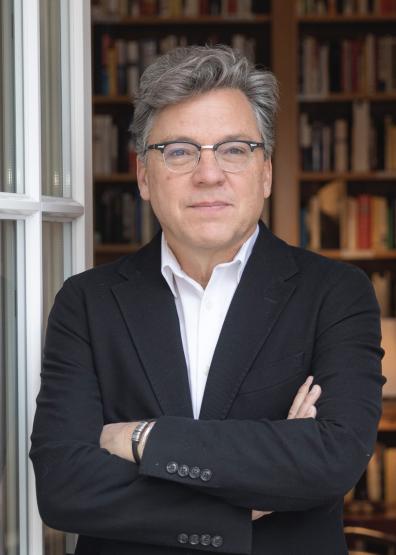
That commitment to democratic deliberation and open debate has propelled Mattson to the highest honor for a faculty member at Ohio University. Having received the 2025 Distinguished Professor Award, Mattson is currently on sabbatical, yet his impact on the university’s intellectual culture remains palpable. He describes himself as a "presentist," a historian who views the past as a vital tool for navigating the challenges of today.

The band Minor Threat was a pillar of the 1980s Washington D.C. punk scene, where Mattson first learned about political organizing and activism. (Photo by Glen E. Friedman)
Connecting the past to the present
Mattson views history as an antidote to modern political cynicism. He acknowledges that many students today feel frustrated by the current political climate, and he argues that understanding historical context is crucial for democratic deliberation.
“I think that there's a growing cynicism about the possibilities of, especially what seems to be electoral politics,” Mattson says. “And I guess my one last hope is that citizens who get educated and think through their own ideas and how they relate to wider political structures, that that's something that's good and that we can benefit from.”
For Mattson, this means looking past surface-level differences to find the threads that tie eras together.
“One of the things that I think is great about history is that it's fun to make connections between two things that might seem very different from one another at first,” Mattson says. “And saying, ‘Oh no, there's actually a great deal of commonality.’”
The classroom as a democratic space
In the classroom, Mattson fosters deliberative, discussion-based learning grounded in the evidence found in primary documents.
“My first rule of teaching history is that you are best off if you basically use primary documents, documents written or spoken at the time that you're studying,” he explains.
He is a deep believer in academic freedom and encourages students to voice their own interpretations based on those texts. He recalls one class during a discussion on the 1920s when a student announced he was "proud" he had never read Sigmund Freud because he believed the work was patriarchal.
“I turned to him and I said, how can you be proud of something you haven't done?” Mattson remembers. “...I think it also pointed out to be a serious point, which is like, don't assume that you know what something means unless you've read it on your own terms.”
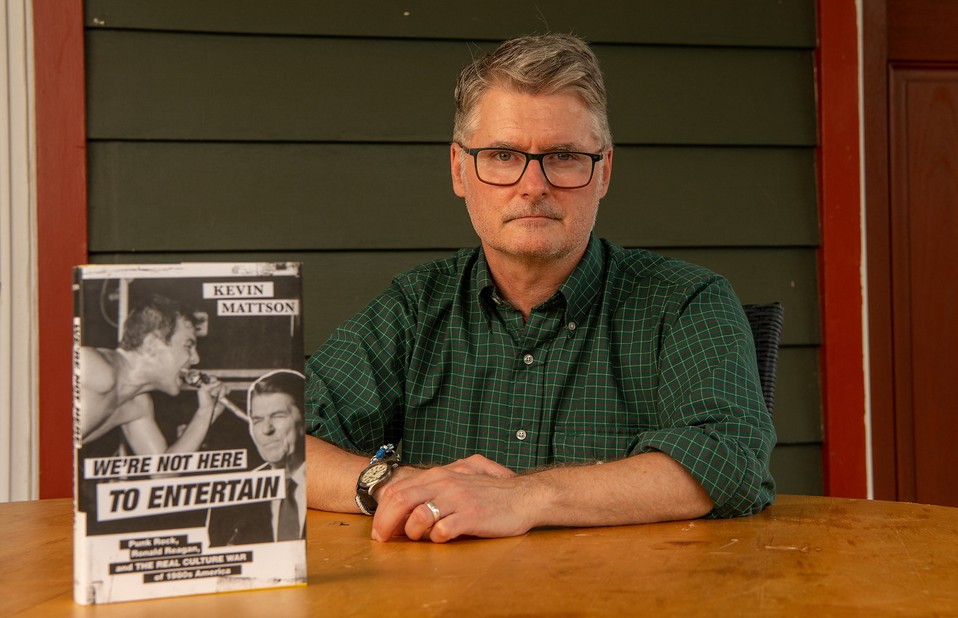
Distinguished Professor Dr. Kevin Mattson poses with his book, We're Not Here to Entertain: Punk Rock, Ronald Reagan, and the Real Culture War of 1980s America
The humility of history
Mattson’s research covers a wide range of topics, including the intellectual history of the American left and the Jimmy Carter presidency. His work requires rigorous adherence to evidence, even when it challenges established memories.
While researching his book on Jimmy Carter, Mattson interviewed the former president’s speechwriter regarding the famous 1979 "Crisis of Confidence" speech. When the speechwriter’s memory of events conflicted with the physical documents Mattson had found in the library, it served as a stark reminder that historians must scrutinize even first-hand accounts.
“He basically said, ‘I guess I've learned a lesson, which is that memory is, you know, full of holes.’ I have so many holes in my own memory,” Mattson says. “You go back and you interview people... and what you find very often is that the person's trying to manipulate you into thinking the way that he or she thought about things in the past.”
Mattson on Jimmy Carter
Distinguished Professor Kevin Mattson joined OHIO's Ask the Experts podcast to discuss Carter's legacy following the former president's death in early 2025.
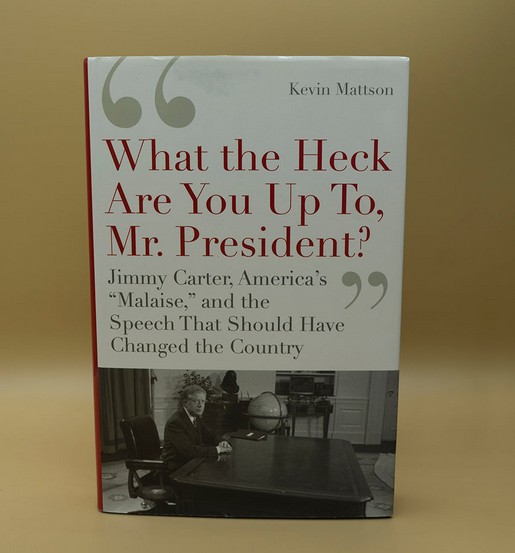
Mattson’s book, What the Heck Are You Up To, Mr. President?, re-examines Jimmy Carter’s presidency and the history behind his famous "Crisis of Confidence" speech.
Independent thinking
As he looks forward to new opportunities afforded by the Distinguished Professor award, Mattson’s primary goal remains to teach his students. He strives to create a space where students can grapple with controversial ideas safely and intellectually.
For Mattson, success means students develop the capacity to navigate the world on their own terms.
“I don't care where they go politically. I don't care what their agenda is ideologically,” Mattson says. “But as long as they say that they can think for themselves independently...then I'm happy and feel like I've achieved what I set out to do.”