
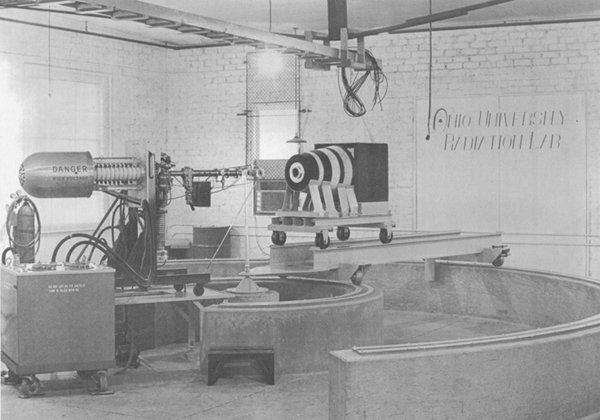
History of the Edwards Accelerator Laboratory
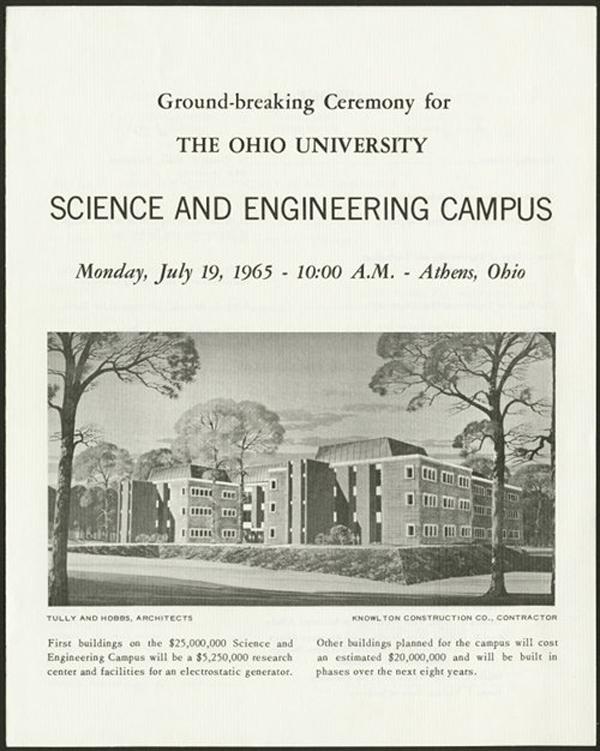
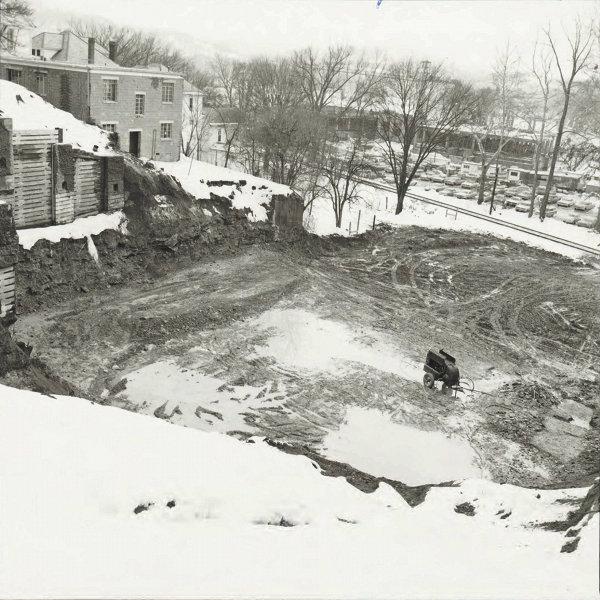
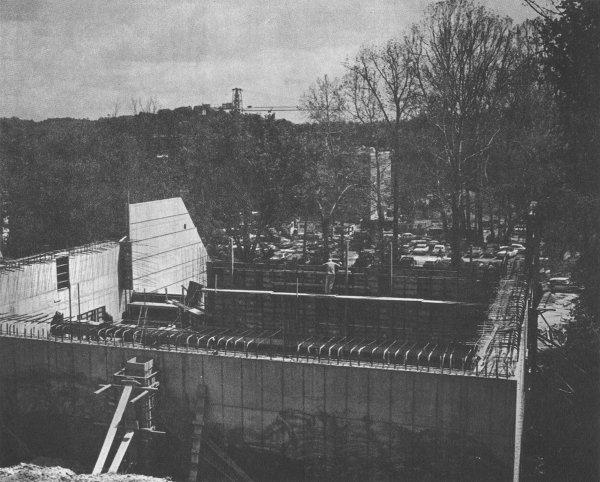
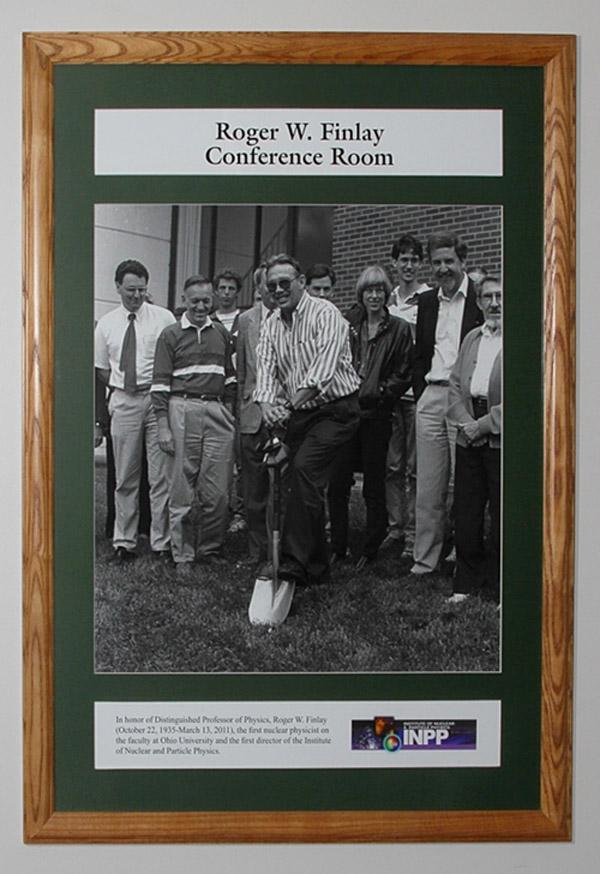
Nuclear physics at Ohio University was started in 1962 with the hiring of Professor Roger Finlay. The initial research program utilized a small 150-kV Cockroft-Walton accelerator for generating neutrons that was located in an old automobile garage. The Department of Physics, however, had more ambitious plans. Construction of the Ohio University Accelerator Laboratory (OUAL) began in 1965 and was completed in 1967, with funds supplied by the state of Ohio. In addition, Clippinger Laboratories, which houses the rest of the Department of Physics and several other science departments, was completed nearby on campus in 1967. Additional faculty hires in the area of nuclear physics also took place during this time period.
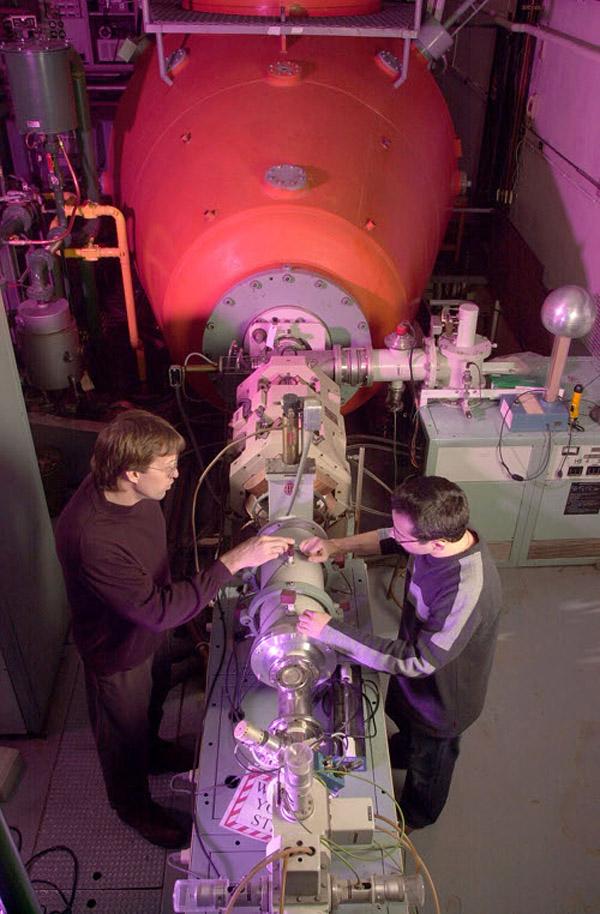
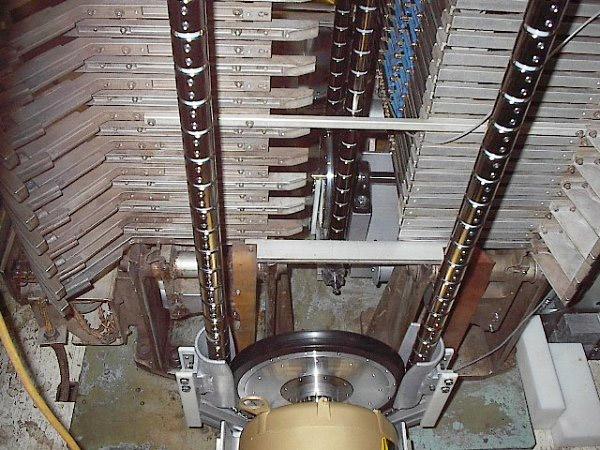
The purchase of the 4.5-MV tandem accelerator was funded by a $1 million dollar grant awarded by the U.S. Atomic Energy Commission to Ohio University in 1967. The principal investigator was Professor Ray Lane, who had been recently hired. The accelerator was manufactured by the High Voltage Engineering Corporation located in Burlington, Massachusetts. The machine was designed to deliver high currents and consists of a unique "T" configuration, with the charging system running vertically and the beam horizontally. The accelerator itself took 18 months to manufacture and over 10 months to install, with the first experiments starting in 1971. Interestingly, the only other accelerator of this design was also installed in "Athens" —at the National Centre for Scientific Research "Demokritos" in Athens, Greece — and it too is still in operation!
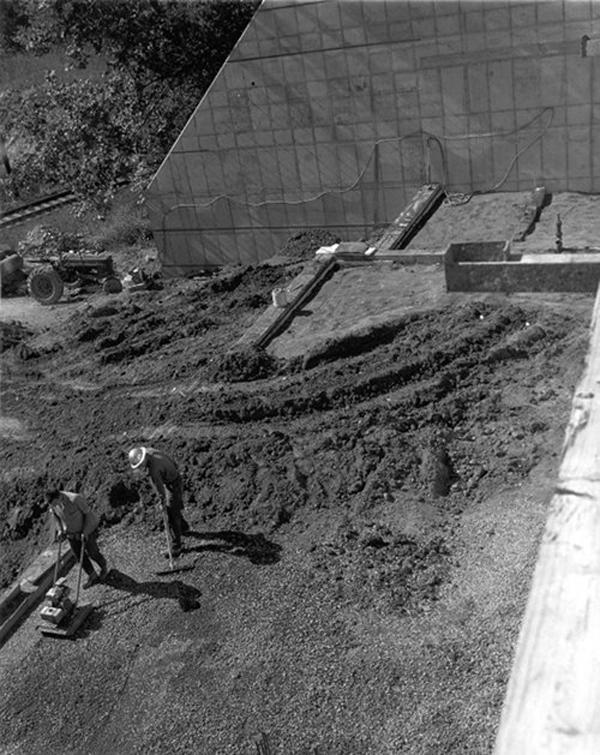
The initial research program was focused on nuclear structure, with a particular emphasis on experimental techniques involving neutrons. Funding was largely provided by the Atomic Energy Commission (now known as the Department of Energy) and the National Science Foundation. Scientists in the laboratory have always opportunistically sought out new research areas, particularly when the unique capabilities of the accelerator could be leveraged.
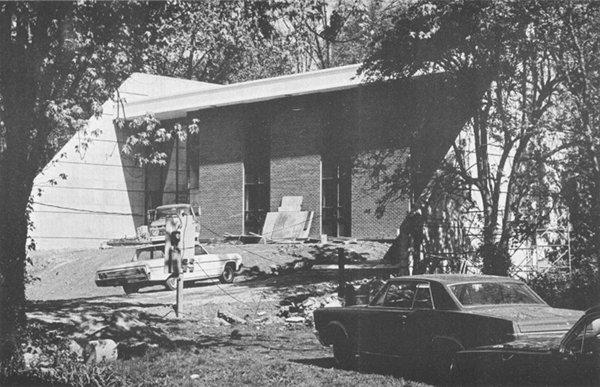
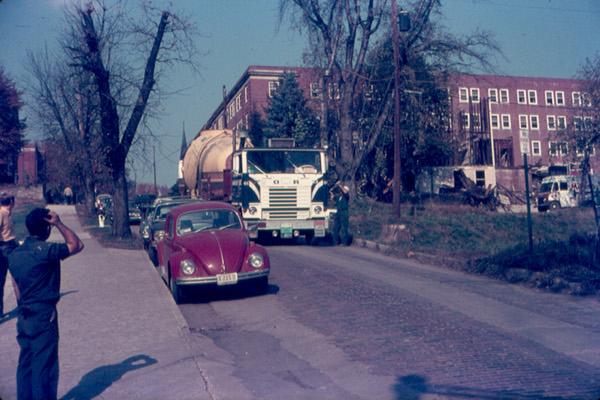
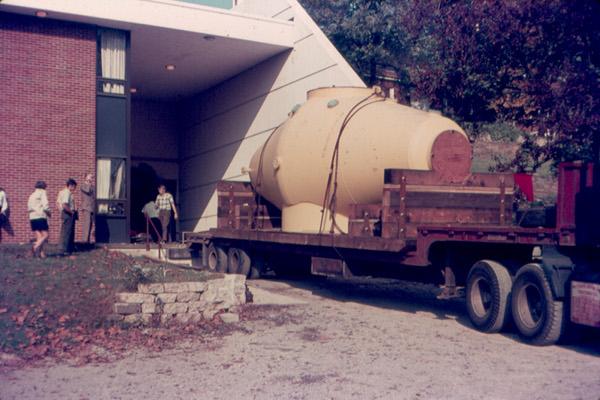
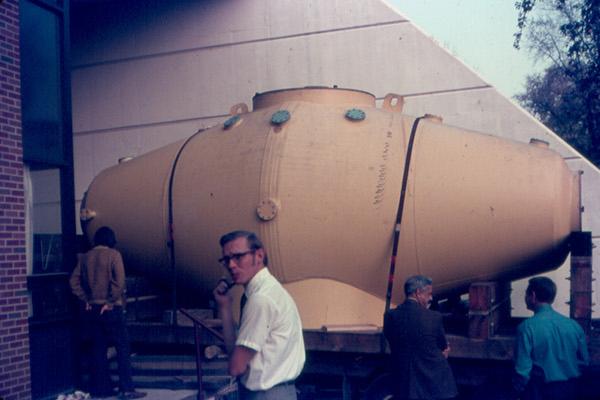
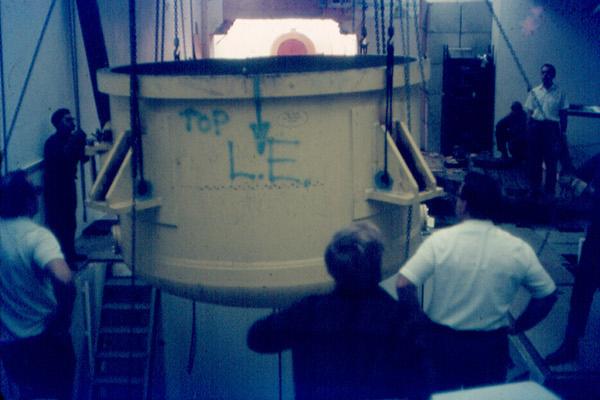
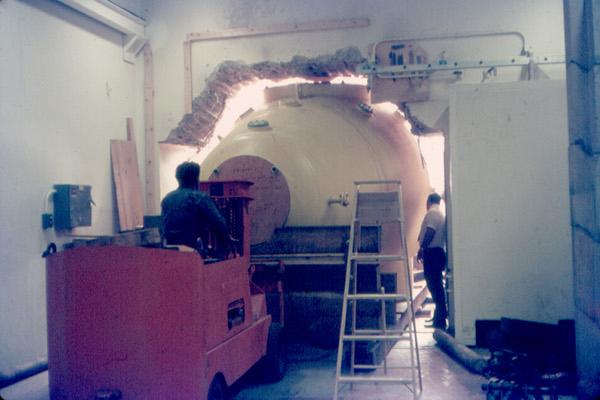
The laboratory was eventually named the John E. Edwards Accelerator Laboratory, in honor of John E. Edwards, who was a stalwart professor in the Department of Physics from 1932 until 1972, served as Department Chair, and was a recipient of Ohio University′s Distinguished Professor Award. The lab is still also referred to by many via the original acronym OUAL.
Starting in 1978, the laboratory began to direct some efforts towards the investigation of new methods for cancer treatment, in collaboration with the Ohio University College of Osteopathic Medicine. The idea behind this research was that radiotherapy with neutron beams may be superior to conventional X-ray and Cobalt therapy in the treatment of certain types of cancer. More recent projects in medical physics have involved collaborations with researchers from Ohio State University and Massachusetts Institute of Technology to provide fundamental data for boron neutron capture therapy.
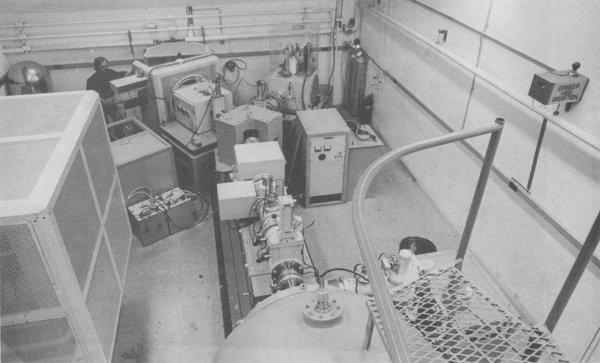
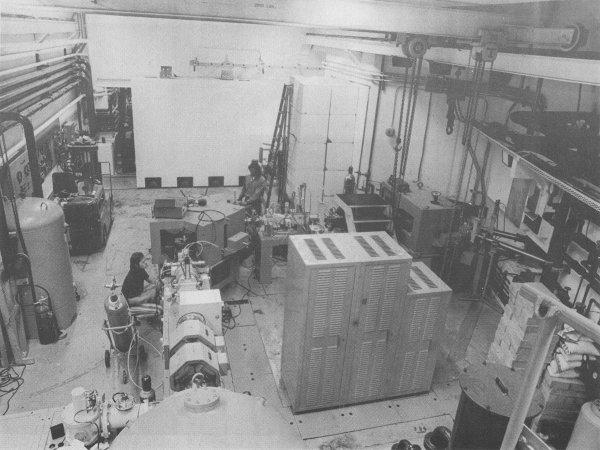
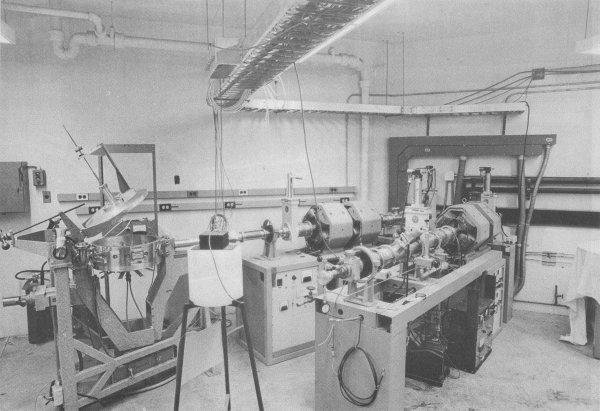
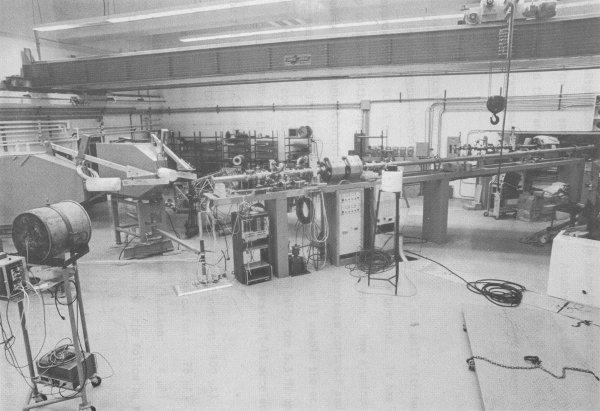
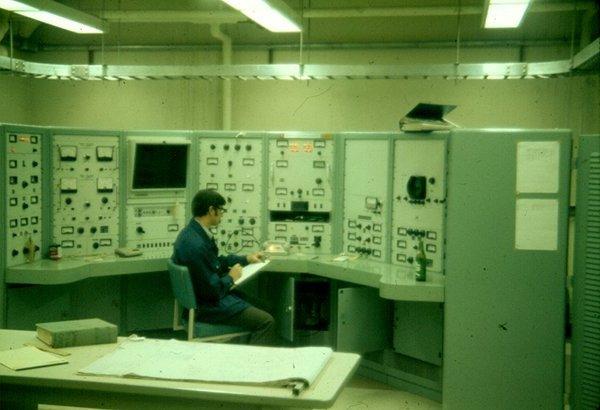
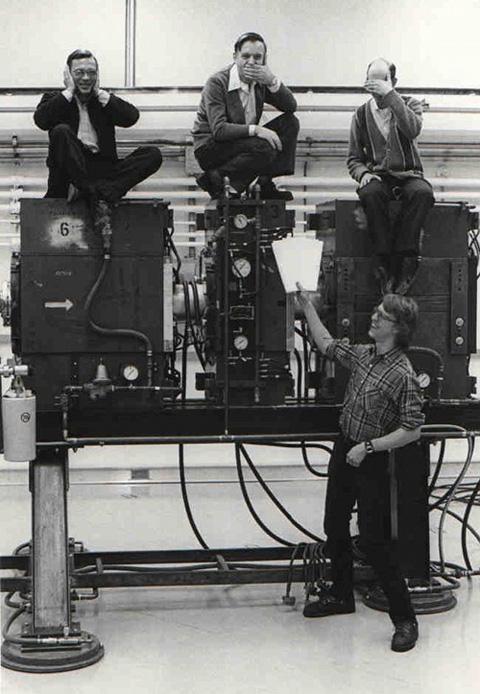
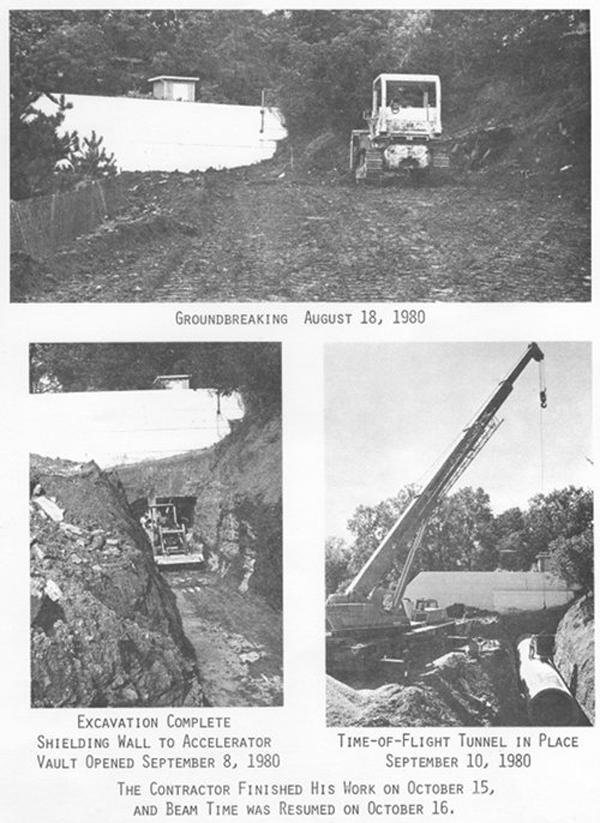
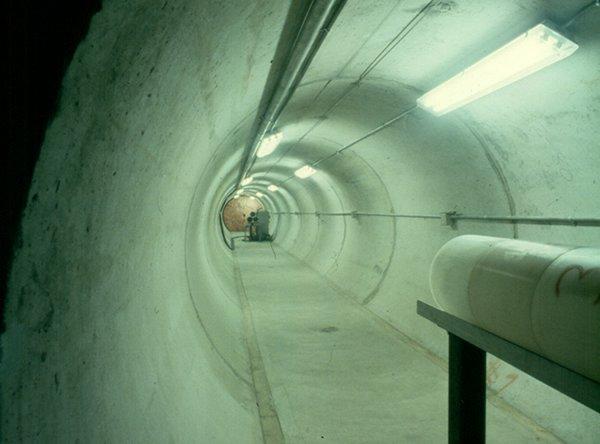
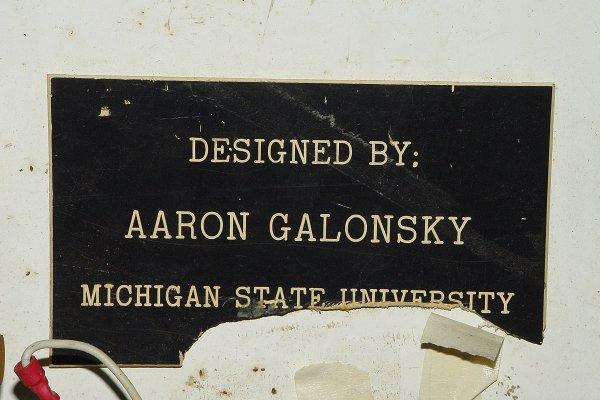
In 1980, the first architectural change in the building was made since its construction in 1967. A 30-meter-long time-of-flight tunnel was constructed underground in the vacant land just east of the building, utilizing funds from the Ohio University 1804 fund, the Department of Energy, and the National Science Foundation. A rotating beam-swinger magnet supplied by Michigan State University was also installed. The combination of beam swinger and tunnel allows neutrons to be studied as a function of angle with very well-shielded detectors. The long flight path provides for excellent neutron energy resolution.
In 1987, an interdisciplinary program in Condensed Matter and Surface Science was started at Ohio University. This program led to a faculty hire with research specialization in accelerator-based materials studies and the establishment of additional research capabilities in the accelerator laboratory. The W.M. Keck Thin Film Analysis Facility integrates several techniques within a suite of coupled UHV chambers to provide analysis and preparation facilities for research on surfaces and thin films. Accelerator-based probes include Rutherford Backscattering Spectroscopy, Nuclear Reaction Analysis, Elastic Recoil Spectroscopy, Proton-Induced X-Ray Emission, and Ion Channeling.

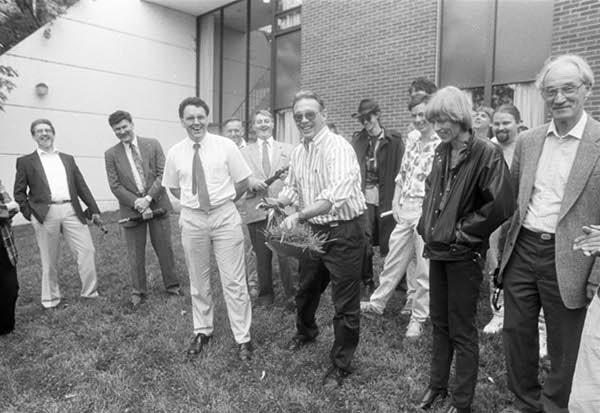
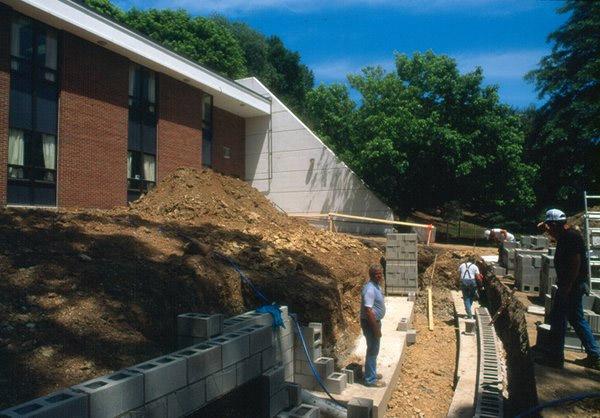
The Institute of Nuclear and Particle Physics (INPP) was established at Ohio University in 1991 to promote experimental and theoretical research in nuclear physics at the University. In 1994, the Edwards Accelerator building was expanded with the addition of a conference room, an undergraduate laboratory, an electronics shop, and office space. This addition was financed by roughly equal contributions from Ohio University and funds generated by overhead return through the INPP. The Department was renamed the Department of Physics and Astronomy at about this time, to reflect our growing teaching and research interests in astronomy and astrophysics.
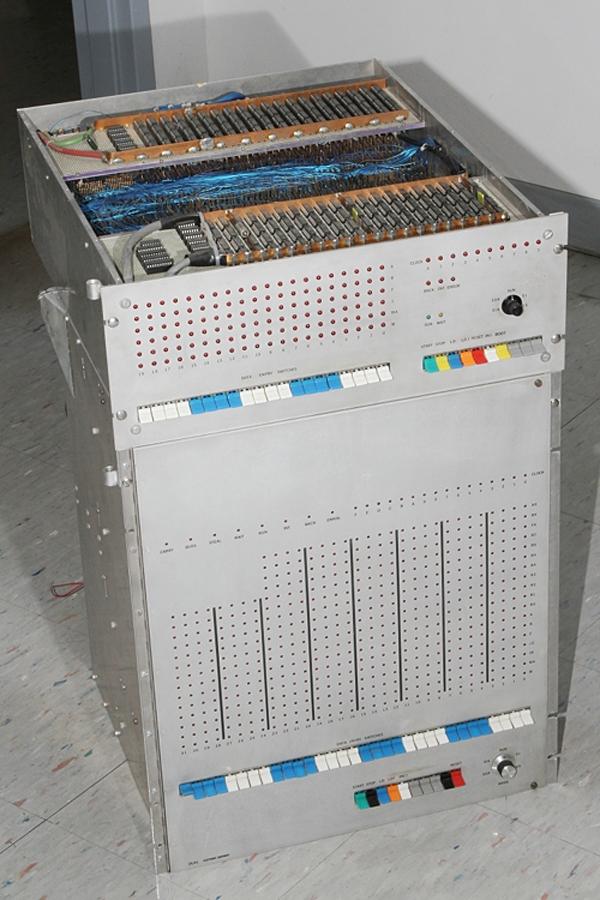
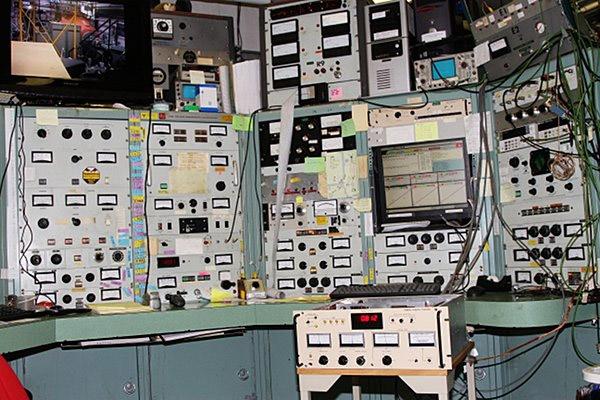
One of the strengths of the laboratory has always been the design and construction of specialized experimental equipment, including hardware, electrics, and computers. These developments are possible because of our on-campus location, excellent technical staff, and other departmental resources such as our machine shop. The laboratory provides an excellent environment for both undergraduate and graduate students to learn all facets of experimental physics, including design, fabrication, data taking, and analysis. The laboratory infrastructure has also supported the development of equipment for several experiments that have been performed at other laboratories.
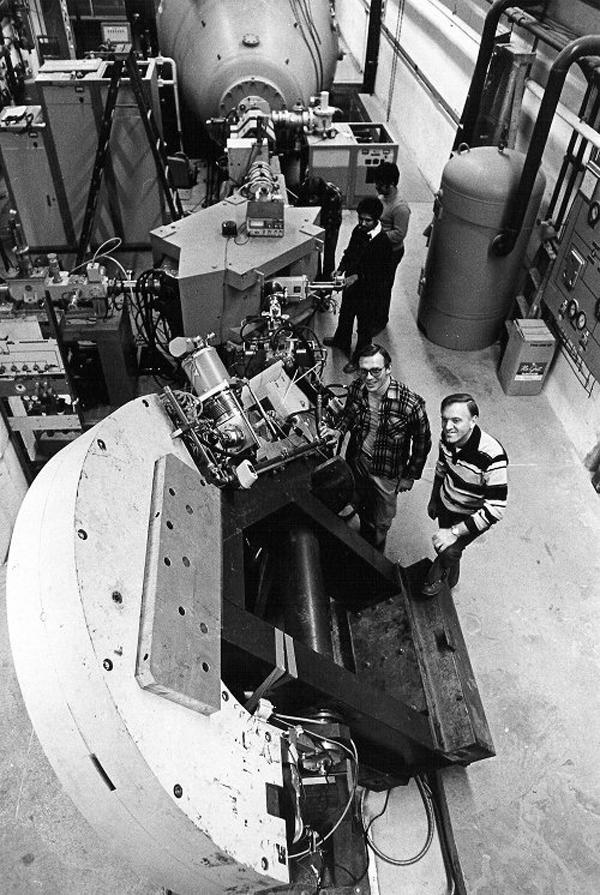
Over time, the laboratory has increasingly hosted users from outside universities and laboratories. These users are often drawn here because of our capabilities and expertise in the generation and production of neutrons. One particular example is the development of neutron radiography, which has been led by scientists from Lawrence Livermore National Laboratory.
The Edwards Accelerator Laboratory has sustained a very high level of productivity over the years, with many Ohio University faculty performing a significant fraction of their research here. As of July 2012, Ohio University has produced 76 Ph.D.s in experimental nuclear science, of which 58 involved experimental work performed at at Ohio University. A list of Ph.D. students, their advisors, and thesis topics is given at the end of this page. Four Ohio University faculty who have worked in the laboratory, Roger Finlay, Steve Grimes, Raymond Lane, and Jacobo Rapaport, have received Ohio University′s Distinguished Professor Award. This award is the highest permanent recognition attainable by faculty at Ohio University.
The research focus of the laboratory has continued to evolve over time. Nuclear structure, and in particular statistical properties of nuclei, remains an important research focus. A relative new research area for the lab is nuclear astrophysics, which is concerned with providing an understanding of how nuclear physics impacts astrophysics (e.g., the origin of the elements and energy generation in stars). Applications of nuclear physics are becoming increasingly important. Example applications include high-precision fission measurements (needed to design the next generation of nuclear reactors) and the remote sensing of fissile materials using neutrons and gamma rays (motivated by the desire to prevent the unauthorized transport and or/use of uranium and plutonium).
In 2004 the University recognized the interface between nuclear physics and astrophysics as one of its "Research Priorities," awarding $1.3 million to the "Structure of the Universe" initiative. This initiative has led to increased ties between the nuclear physics and astrophysics groups and enhanced their research programs, including a faculty hire in low-energy experimental nuclear physics and $100,000 for refurbishment of the Edwards Accelerator Laboratory.
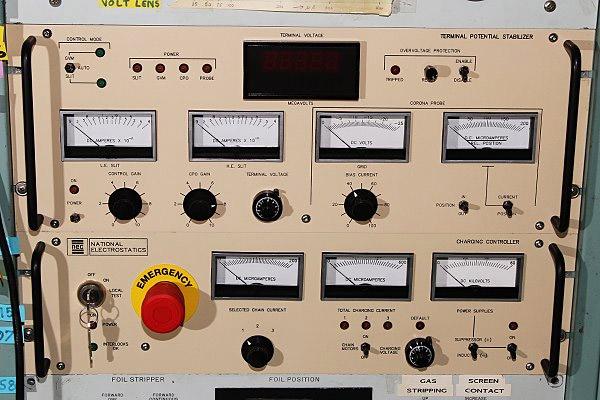
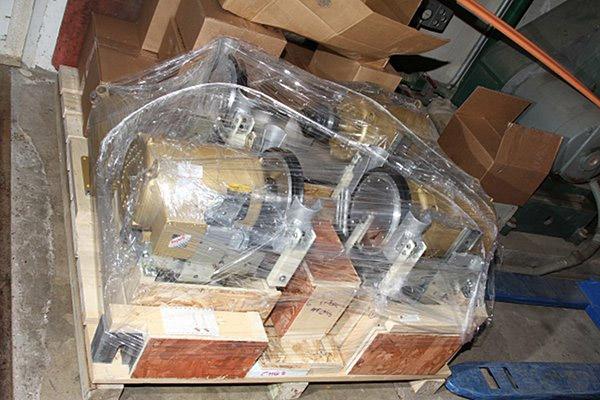
With the assistance of a $321,000 grant from the National Science Foundation, the accelerator was upgraded to a Pelletron charging system provided by the National Electrostatics Corporation. This upgrade replaced the aging charging belt system and was completed in January 2012. The new system has demonstrated considerably improved terminal stability, has allowed operation at higher terminal voltages, and is expected to reduce required maintenance time and expense.
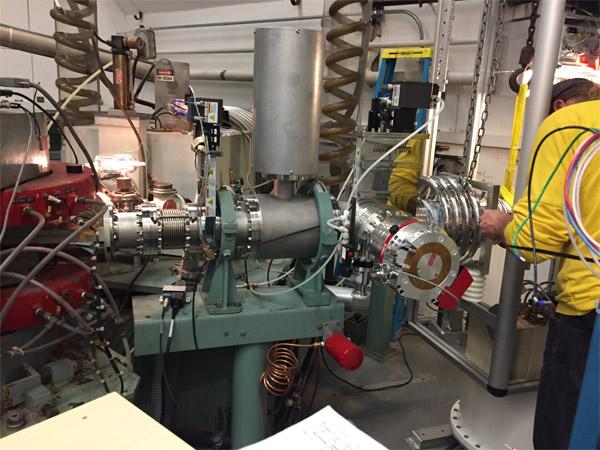
In January 2020, commissioning was completed on a new Alphatross helium ion source obtained from National Electrostatics Corporation using $187,000 from a National Science Foundation Major Research Instrumentation grant. This upgrade replaced the duoplasmatron ion source that had been operation since the accelerator lab's beginning. The new source delivers higher beam intensities, shorter start-up time, and more stable operation.

Experimental Nuclear Science Ph.D. Graduates
This list of experimental nuclear science Ph.D. graduates from Ohio University includes students who utilized the tandem accelerator for materials science purposes, as well as three students who conducted theoretical research that are included for completeness (two advised by Grimes and one by Finlay). It should also be noted that there were several experimental high-energy physics Ph.D.s in the department in the pre-1975 era who are not included.
Name | Year | Advisor | Thesis
- Nisha Singh | 2026 | Determining the Structure of Exotic Atomic Nuclei for Astrophysical Explosions
- Justin Bryan | 2026 | Frantz | Measuring Single Particle Suppression of the η Meson Using the sPHENIX Detector in Au+Au Collisions at √ S NN = 200 GeV
- Chirag Rathi | 2025 | Voinov | Investigation of the Hauser-Feshbach Formalism Away From Stability & Development of a Nuclear Level Density Database
- Joseph Derkin | 2025 | Brune | Narrow Resonance Measurements of the 17O Compound Nucleus
- Justin Warren | 2025 | Brune | A Study of Neutron Induced Reactions on 35Cl Utilizing CLYC Scintillation Detectors
- Shyam Chauhan | 2024 | Frantz | PHENIX π0 − h± Two Particle Correlations Measurements in 200 GeV Au+Au Collisions and Development of Pi0 Calibrations Technique for sPHENIX Electromagnetic
- Yenuel Jones-Alberty | 2023 | Brune | Studying 11B proton structure via the 10Be(p,n) 10B reaction
- Robert Radloff | 2022 | King | CREx Transverse Asymmetry Measurements
- Gula Hamad | 2022 | Meisel | Measurements of the 96Zr(α,n) and 65Cu(α,n) Cross Sections at Edwards Accelerator Laboratory for Astrophysics and Applications
- Joseph A. Rowley | 2022 | Hicks | Improved Λp Elastic Scattering Cross Sections Between 0.9 and 2.0 GeV/c and Connections to the Neutron Stars
- Shiv Subedi | 2021 | Meisel | Investigating and Reducing the Impact of Reaction Rate Uncertainties on 44Ti and 56Ni Production in Shock Driven Nucleosynthesis of Core Collapse Supernovae
- Ustav Shrestha | 2021 | Hicks | Photoproduction of Λ* Resonances using the CLAS Detector
- Doug Soltesz | 2021 | Meisel | Use of (3He,n) Reactions to Constrain Nuclear Reaction Rates in the Hydrogen and Helium Burning Environments of Type-I X-ray Bursts
- Som Paneru | 2020 | Brune | Elastic Scattering of 3He+4He with SONIK
- Bishnu Karki | 2020 | Roche | Deep Exclusive π0 Electroproduction Measured in Hall A at Jefferson Lab with the Upgraded CEB
- Taya Chetry | 2019 | Hicks | A Study of the Reaction γd→ π+π- d (From Vector Mesons to Possible Dibaryons)
- Rekam Giri | 2019 | Brune | Cross Section Measurements of the 12C(α,γ)16O Reaction at Ec.m.=3.7, 4.0, and 4.2 MeV
- Abinash Pun | 2019 | Frantz | Measurements of Di-Jet π0-h± Correlations in Light-Heavy Ion Collisions at RHIC-PHENIX
- Tyler Danley | 2018 | Frantz | Photon-Related Elliptic Azimuthal Asymmetry and Photon-Hadron Correlations with an Isolation Cut in Au+Au Collisions at √sNN = 200 GeV at RHIC-PHENIX
- Mongi Dlamini | 2018 | Roche | Measurement of Hard Exclusive Electroproduction of π0 Meson Cross Section in Hall A of JLab with CEBAF at 12 GeV
- Nadyah Alanazi | 2018 | Voinov | Studying the Fusion Evaporation Reaction (α,n) with 54Fe, 56Fe, 57Fe, and 58Fe
- Andrea Richard | 2018 | Crawford | Spectroscopy of the A = 33 Isobars in the Island of Inversion
- Nicholas Compton | 2017 | Hicks | The Differential Cross Section and Λ Recoil Polarization from γd → K0Λ(p)
- Sushil Dhakal | 2016 | Brune | Study of DD Neutrons and their Transmission in Iron
- Cody E. Parker | 2016 | Brune | The 3H(d,γ) Reaction and the 3H(d,γ)/3H(d,n) Branching Ratio for Ec.m.≤300 keV
- Shamim Akhtar | 2016 | Brune | Study of the 12C(α,γ)16O Reaction via the α-Transfer Reactions: 12C(6Li,d)16O and 12C(7Li,t)16O
- Shloka K. Chandavar | 2015 | Hicks | Photoproduction of scalar mesons using the CEBAF Large Acceptance Spectrometer (CLAS)
- Bing Xia | 2014 | Frantz | Neutral Pion - Charged Hadron Jet Correlations in d+Au Collisions at 200 GeV
- Anthony Paul Ramirez | 2014 | Voinov | Study of nuclear level density from deuteron induced reactions on iron and copper isotopes
- Nowo Riveli | 2014 | Frantz | Direct Photon - Hadron Correlations Measurement in Au+Au Collision at Nucleon Center-Of-Mass Energy of 200 GeV With Isolation Cut Methods
- Dilupama A. Divaratne | 2014 | Brune | One and Two Neutron Removal Cross Sections of 24O via Projectile Fragmentation
- Youngshin Byun | 2013 | Grimes / Voinov | Study of nuclear level density and gamma-strength function in 90Zr, 196Pt, and 197Pt
- Kevin W. Cooper | 2013 | Ingram | Characterization of diamond like carbon thin films fabricated by unbalanced magnetron sputtering under ultra-high vacuum conditions
- Buddhini Waidyawansa | 2013 | Roche | A 3% Measurement of the Beam Normal Single Spin Asymmetry in Forward Angle Elastic Electron-Proton Scattering using the Qweak Setup
- Rakitha Beminiwattha | 2013 | Roche | A Measurement of the Weak Charge of the Proton through Parity Violating Electron Scattering using the Qweak Apparatus: A 21% Result
- Wei Tang | 2012 | Hicks | Photoproduction of K*+Λ/Σ0 and K0Σ+ from the proton Using CLAS at Jefferson Lab
- Daniel Sayre | 2011 | Brune | Measurement of the 2.68-MeV resonance interference and R-matrix analysis of the 12C(α,γ)16O reaction
- Dustin Keller | 2010 | Hicks | U-spin symmetry test of the Σ*+ electromagnetic decay
- Babatunde Oginni | 2009 | Grimes | Study of nuclear level densities from evaporation of compound nuclei of mass numbers 61, 64, 65, and 82
- Aderemi Adekola | 2009 | Brune | Proton-transfer study of unbound 19Ne via the 2H(18F,α)15O reaction
- Shaleen Shukla | 2008 | Grimes | Calculation of nuclear level densities near the drip lines
- Serdar Kizilgul | 2008 | Hicks | Study of pion photo-production using a TPC detector to determine beam asymmetries from polarized HD
- Catalin Matei | 2006 | Brune | Nucleosynthesis of 16O under quiescent helium burning
- Ishaq Hleiqawi | 2006 | Hicks | K*0 photoproduction and electroproduction measured at CLAS
- Christopher Bade | 2006 | Hicks | RF methods to increase deuteron polarization in HD targets and NMR spin-polarization analysis at LEGS
- Yannis Parpottas | 2004 | Grimes | Astrophysically important states in 18Ne and 26Si studied with the (3He,n) reaction
- Glen MacLachlan | 2004 | Opper | The ratio of electric and magnetic proton form factors at Q2=1.13 (GeV/c)2 via recoil polarimetry
- Americo Salas Bacci | 2003 | Grimes | Level densities of 28Si, 46Ti, 52Cr and 60Ni from Ericson fluctuations
- Asghar Kayani | 2003 | Ingram | Deposition and characterization of diamond-like carbon films with and without hydrogen and nitrogen
- Eugen Trifan | 2003 | Ingram | Study of the early stages of growth and epitaxy of GaN thin films on sapphire
- Raymond Wheeler | 2002 | Grimes | Nuclear spectroscopy using charged particles
- James Oldendick | 2002 | Grimes | Low energy reaction modes of 6Li and 10B on 27Al
- Yixiu Kang | 2002 | Ingram | Deposition and Characterization of Amorphous GaN Thin Films
- Xiaochun Wang | 2001 | Rapaport | The 13C (p⃗,n⃗)13N reaction: spin observable measurements at 200 MeV
- Diane Reitzner | 2001 | Opper | Charge symmetry breaking in np→dπ0 close to threshold
- Po-Lin Huang | 1998 | Grimes | The study of the role of the two-body force in determining level densities
- Cheri Hautala | 1998 | Rapaport | Measurement of polarization observables in the quasielastic region on natCa and natPb using the (p⃗,n⃗) reaction at 200 MeV
- Saleh-Ibra Al-Quraishi | 1997 | Grimes | Analysis of reaction modes of low energy reactions of deuterons with 56Fe and 27Al nuclei
- Michael Maldei | 1997 | Ingram/Gulino | A study of the suitability of amorphous, hydrogenated carbon (a-C:H) for photovoltaic devices
- Soon-Cheon Seo | 1996 | Ingram | The characterization of diamond-like carbon films deposited using unbalanced magnetron sputtering
- Joel Keay | 1996 | Ingram | Hydrogen analysis of diamond-like carbon using MeV ion beams
- Rodney Michael | 1995 | Hicks | K+-nucleus elastic scattering at 715 and 635 MeV/c
- Hong Zhang | 1995 | Hicks | Proton compton scattering and π-production with polarized photons
- Chi Tang | 1995 | Ingram | A design of experiment study of the nucleation of chemical vapor deposited diamond films
- Werner Abfalterer | 1995 | Finlay | Level widths and level densities of nuclei in the 32≤A≤60 mass region inferred from fluctuation analysis of total neutron cross sections
- Fred Bateman | 1994 | Grimes | A study of the 29Si level density from 3 to 22 MeV
- James Guillemette | 1994 | Grimes | A study of the higher excitation levels in 14C via the 10Be(α,n0)13C reaction in the 2.5 MeV ≤ Eα ≤8.5 MeV energy range
- Xun Yang | 1994 | Rapaport | Dipole and spin dipole resonances observed in charge exchange reaction on p-shell nuclei at intermediate energies
- Lian Wang | 1993 | Rapaport | The 10B(p,n)10C reaction and quasifree scattering on p-shell nuclei at 186 MeV
- Henry Clark | 1993 | Hicks | Nuclear decay following deep-inelastic scattering at 500 GeV
- Earl Saito | 1993 | Lane | Level study of 14C via neutron scattering to the unbound levels of 13C
- Vivek Mishra | 1992 | Grimes | Level density of 57Co in the energy region 1 MeV to 14 MeV
- Brent Park | 1991 | Rapaport | Energy dependence of Gamow-Teller and dipole strength distribution in A = 32 and A = 40 nuclei via (n,p) reactions
- Nourredine Boukharouba | 1991 | Grimes | Low-energy optical model studies on 54Fe and 56Fe
- Yun Wang | 1988 | Rapaport | Nuclear structure studies with monoenergetic neutrons: zirconium isotopes
- Rupak Das | 1988 | Finlay | Unified description of the n+209Bi mean field between 20 MeV to 60 MeV via the dispersion relation
- Edward Sadowski | 1988 | Lane | A study of the higher excitation levels of 11B via the 10B(n,n)10B and 10B(n,n′)10B*(0.72, 1.74, 2.15, 3.59, 4.77 MeV) reactions
- Sharad Saraf | 1988 | Grimes | Multi-step compound nuclear reactions induced by 8.0 to 14.8 MeV neutrons on 54Fe and 56Fe with comparison to equilibrium and pre-equilibrium models
- Paul Egun | 1987 | Brient | The study of proton transfer reactions and their application to nuclear level counting via the reactions 23Na,28Si,32S(d,n)
- Dau Wang | 1987 | Rapaport | Nucleon induced reactions on p-shell nuclei
- David Resler | 1987 | Lane | Structure of 14C via elastic and inelastic neutron scattering from 13C: measurement, R-matrix analysis, and shell model calculations
- Hirannaiah Satyanarayana | 1986 | Grimes | Level densities of 26Al, 27Al, and 28Si studied with the (d,n) reaction
- Md. Saiful Islam | 1985 | Finlay | Elastic and inelastic scattering of nucleons from 16O
- Ricardo Alarcon | 1985 | Rapaport | Elastic and inelastic scattering of low energy nucleons from 28Si, 32S, 34S and 40Ca
- Steven Graham | 1985 | Grimes | Neutron-induced charged particle reactions on 58Ni and 60Ni with comparision to statistical model calculations
- Ali Soleimani Meigooni | 1984 | Finlay | Nucleon-induced excitation of collective bands in 12C and the application to neutron dosimetry at En>20 MeV
- Paul Koehler | 1984 | Lane | Structure of 19O from measurement and R-matrix analysis of σ(θ) for 18O(n,n′)18O*(1.98 MeV)
- Steve Mellema | 1983 | Finlay | Microscopic and collective model analysis of nucleon scattering from 54,56Fe
- Rajendra Kurup | 1983 | Finlay | The isospin and strong coupling effects near shell closing
- Ramesh Tailor | 1983 | Rapaport | Neutron scattering from s-d shell nuclei
- Vivek Kulkarni | 1981 | Rapaport | Study of neutron-deuteron reactions using a magnetic quadrupole triplet spectrometer
- Mohammed Mirzaa | 1978 | Rapaport | Neutron scattering on even isotopes of tin
- Mohammad Hadi Hadizadeh-Yazdi | 1978 | Finlay | Isospin dependence of nuclear deformations
- Roger White | 1977 | Lane | A study of the higher excitation states of 12B via the 11B(n,n)11B reaction
- David Bainum | 1977 | Finlay | Neutron inelastic scattering from closed-shell nuclei
- Kumaroth Devan | 1976 | Brient | Low-lying states of 104Ag and 106Ag
- Tarlok Cheema | 1976 | Rapaport | Energy dependence of the nucleon-nucleus optical potential via neutron scattering
- Juan Ferrer | 1975 | Rapaport | Neutron elastic scattering at 11 MeV and the isospin dependence of the nucleon-nucleus optical potential
- Gabriel Doukellis | 1975 | Rapaport | Multilevel multichannel study of the structure of 27Al at excitation energies between 13.0 and 15.0 MeV
- Charles Nelson | 1973 | Lane | A study of the structure of 12B via elastic scattering of neutrons from 11B
- Siegfried Hausladen | 1973 | Lane | A study of the structure of 11B from elastic scattering of neutrons from 10B
- John Lemming | 1972 | Finlay | Polarization and angular distribution of neutrons emitted from the 18O(p,n)18F reaction at proton energies between 3.00 and 3.50 MeV
- Harold Knox | 1972 | Finlay | Differential cross section and polarization of 2.63 MeV neutrons scattered from 12C
- John Cox | 1972 | Lane | Differential cross section and polarization for neutrons scattered from 10B at 2.63 MeV
- Gene Stoppenhagen | 1968 | Finlay | Polarization of the neutrons produced in the D(d,n)3He reaction at low deuteron bombarding energies
- Michael Gilpatrick | 1967 | Finlay | Angular correlation of inelastically scattered neutrons and the associated gamma rays from carbon 12 at En=14.65 MeV
- Paul Beach | 1966 | Finlay | Elastic scattering of 14.1 MeV neutrons from nitrogen, oxygen, and argon
- Albert Frasca | 1965 | Finlay | Elastic scattering of 14 MeV neutrons from carbon, boron, potassium, and calcium
- Tran Trong Gien | 1965 | Finlay | Relativistic formulation of the lifetime matrix in collision theory
- Douglas Humphrey | 1965 | Finlay | The angular distribution of neutrons inelastically scattered from the 0.48 MeV level of 7Li
- William Gettys | 1964 | Finlay | Inelastic nucleon scattering and the shell model
- Richard Castle | 1963 | Finlay | Measurement of the circular polarization of the 1.28 MeV gamma ray following the beta decay of Europium 154
Other Institutions
We are also aware of several additional Ph.D. theses from other institutions that were based in part upon research carried out at the Edwards Accelerator Laboratory:
- Kevin Choe, 2025, Air Force Institute of Technology, supervised by Christina Dugan
- Rebecca Toomey, 2022, Rutgers, Department of Physics and Astronomy, supervised by Jolie Cizewski, "A measurement of the 18O(α,n)21Ne reaction"
- Evan Bray, 2020, Pennsylvania State University, Department of Astronomy and Astrophysics, supervised by David N. Burrows, "Characterizing x-ray hybrid CMOS detectors for future x-ray space telescopes"
- Panagiotis Gastis, 2020, Central Michigan University, Department of Physics, supervised by George Perdikakis, "Towards constraining the key nuclear reactions in neutrino-p process nucleosynthesis"
- Bryan J. Vande Kolk, 2020, University of Notre Dame, Department of Physics, supervised by Michael C. Wiescher, "Cross section measurements of 10B(p,α)7Be"
- Whitney Raas, 2007, Massachusetts Institute of Technology, Department of Nuclear Science and Engineering, supervised by Richard Lanza, "Towards the development of an explosives detection system using neutron resonance radiography"
- William Howard, 1997, Massachusetts Institute of Technology, Department of Physics, supervised by Jacquelyn Yanch, "Accelerator-based boron neutron capture therapy"
- Nilendu Gupta, 1995, Ohio State University, Biomedical Engineering, supervised by Thomas E. Blue, "Fabrication and preliminary testing of a moderator assembly for an accelerator-based neutron source for boron neutron capture therapy"