Fostering creativity in 3D
In 3D print labs across OHIO's Athens campus, students create, construct and innovate.
Megan Doyle, BS '28 | November 3, 2026
Share:
Technology and art merge into one in a 3D print lab. Since 3D printers became widely available in the early 2010s, people have been able to create virtually anything with the click of a button. With cutting-edge machinery and state-of-the-art materials available to students in all areas of study, the 3D print labs across OHIO’s Athens campus, students have endless possibilities for innovation right at their fingertips.
From the Center for Entrepreneurship’s CoLab in Alden Library to the Chaddock + Morrow College of Fine Arts’ CREATE_space in Tupper Hall, students are creating everything from ribbons and cookie cutters to rockets and robots.
How it works
Douglas Bowie, technology and outreach liaison in the McClure School of Emerging Technologies (which offers a lab in the basement of the Schoonover Center for Communication), compares a 3D printer to something as simple as a household craft tool.
“It’s a big, fancy glue gun,” Bowie says. “But instead of shooting out glue, it shoots out plastic. It’s not really all that different than the glue that comes out of a glue gun, if you were going to go back and forth in layers to build a tower of glue.”
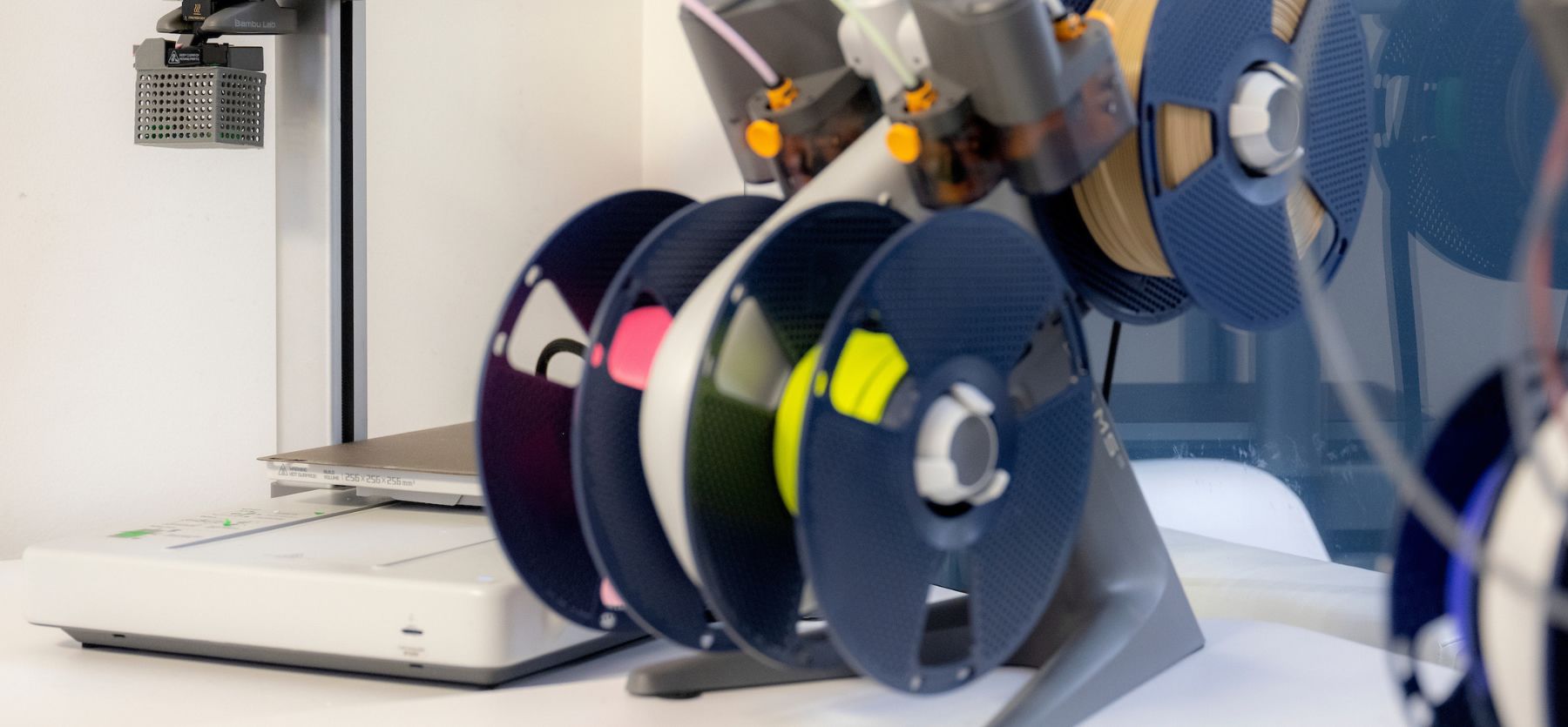
The “glue” in this analogy is a plastic commonly referred to as “filament.” Of course, when it comes to transforming an idea into a tangible object, there is more to 3D printing than meets the eye.
“There are three parts,” Bowie explains. “There’s our fancy software like AutoCAD, Tinkercad, and Blender, where we make the shape. And on the other end, we’ve got the printer that barfs out what we ask for by playing hot glue gun with the plastic.”
The third part is in the middle of the machine: a hidden piece called a slicer. It traces the shape in layers, from top to bottom, until the shape is complete.
“That’s how we translate this weird shape in a virtual context to a physical shape in a printed context,” Bowie explains.
How Bobcats use the technology
This process of 3D printing is how students can make their ideas a reality. Liz Pahl, assistant director of the Center for Entrepreneurship, takes pride in how students use the technology in the CoLab to design their projects and build their entrepreneurial skills.
“I think it helps them by allowing them to build things in real life,” says Pahl. “To imagine the item itself, refine its design, and use their imagination to build it allows them to learn a new skill which I think is really huge.”
By providing materials for little to no cost to students, the CoLab in the Center for Entrepreneurship allows them to experiment freely with advanced technology, which keeps creativity and innovation affordable.
“If someone is printing something that requires a lot of filament, they purchase their own. But for smaller projects, we are happy to provide the filament for that,” Pahl says.
The CoLab’s accessibility extends beyond the financial. Students can use the CoLab to create regardless of their experience level with 3D printers. The space is open to all majors, which allows students’ imaginations run wild.
“That’s kind of what I love about our lab. It’s for all levels,” says Pahl. “It’s for people who’ve never done it before, or it’s for people who know exactly what they’re doing.”
Bobcats uplifting the community
OHIO students in the Center for Entrepreneurship have made an impact in the community through their 3D-printed creations. Many of the projects that students have made in the Center for Entrepreneurship have gone towards making Athens a better place.
Students in the CoLab created a cookie cutter for Culinary Services and the President’s Office as well as the full alphabet for the Athena Cinema’s marquee in uptown Athens. And it was all done for “pennies,” says Pahl.
Students also printed green ribbons to recognize Athena Cinema’s Mental Health Awareness Month movie showings and stamens for the official flower of the city of Athens, aluminum passion flowers produced by Passion Works Studio.
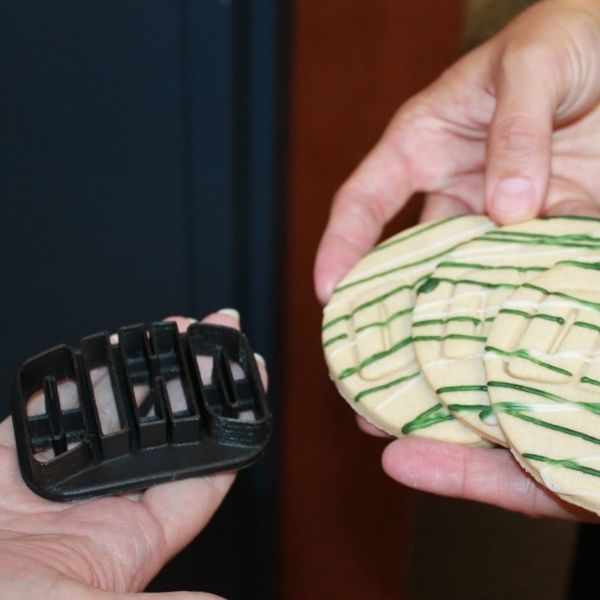
A special cookie cutter for Culinary Services and the President's Office.

The full alphabet for Athena Cinema's marquee.
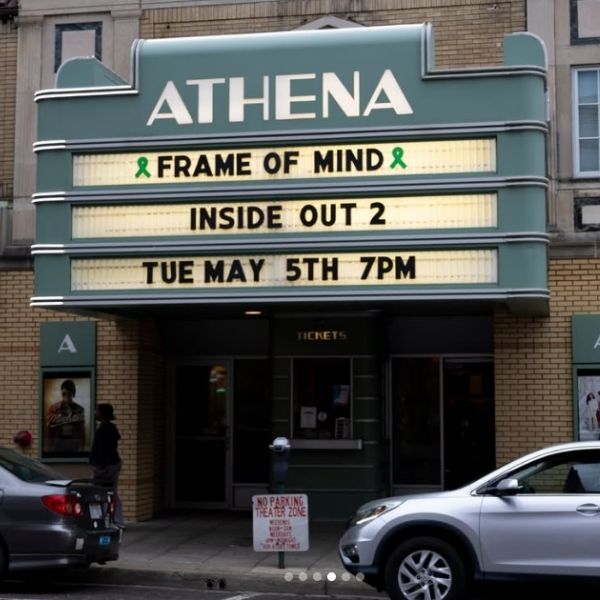
Green ribbon for the Athena Cinema's marquee for a National Mental Health Awareness Month movie showing.
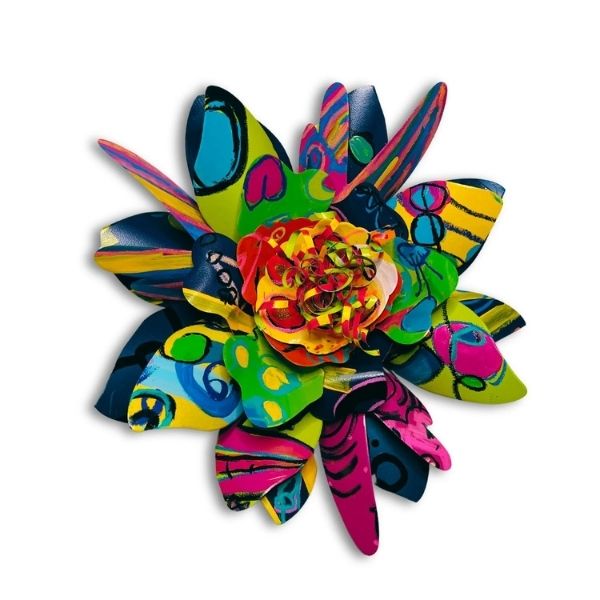
Passion flower stamen.
Student expertise
The 3D printing labs on campus are state-of-the-art facilities where students can embrace their creativity. But what keeps them up and running is the hard work and commitment of student managers.
Evan Biernat, a second-year student studying cybersecurity engineering, is the 3D lab manager of the CoLab’s 3D printing space. He says his mission is to provide a space at the university where students can create and receive support in their projects.
“The printers are 100% free to use, and if people don’t know how to use them, I have office hours Monday through Friday where I will teach people how to 3D print,” says Biernat. ‘It takes about 20 minutes, and then they know how to 3D print forever after that.”
Biernat spends hours every day in the CoLab, ensuring that the technology is working properly and answering questions. Through this resource, students can use the facility with guidance to ensure a smooth and enjoyable process. Biernat says managing the lab has been a great experience that allows him to help his fellow students.
“It’s a lot of working with people because a lot of them need help learning or have a small problem with their project, so having another person there to help does a lot of good,” he says. “It’s been so cool. I’ve met so many people and everybody there is super passionate about whatever project they’re working on, so it’s a lot of fun.”
Making space for a better world
The Russ College of Engineering and Technology offers 3D printing resources in the Russ College Makerspace.
Dr. Gregory Kremer, professor of mechanical engineering in the Russ College, spoke about what students are up to in this Makerspace, which is located on the first floor of Stocker Center.
“The idea was to be a hub of student activities,” says Kremer. "We have a lot of active student groups that do missiles and rockets, that do robotics competitions, and more."
Kremer says the space serves two purposes: coursework and student projects. Students can use the technology in the Russ Makerspace to create projects for their classes or to do personal projects. To accommodate the needs of students in different areas of study, the space is equipped a variety of machines and tools.
“The primary area has about eight 3D printers of various sizes and capabilities, so we can do larger projects that require a lot of printing,” says Kremer. “We also have things like laser cutters, a general workbench for basic assembly, an electronics workbench for soldering or making connections, and plenty of work tables for students to talk through projects and ideas.”
The Stocker Center lab is open to students of all areas of study and, like the CoLab, is free to use and run by student managers.
“If a student has an idea, especially if its related to a class or club, we try to cover those costs internally," Kremer says. "Students may be asked to bring their own filament on occasion, but there wouldn’t be any other costs besides that.”
Keeping technology accessible keeps students creative. Kremer emphasizes the impact that 3D printing has on the greater community of not only OHIO, but Athens itself.
“We, as engineers and technologists, we want to be doing things that make a difference," he says. "We want you to have access to whatever you need in order to be creative, build things, and get better at making things. I think it’s meant to be part of a larger ecosystem to make our university one that is able to, by students doing cool things, make the world a better place.”
While a little more complex than a fancy glue gun, 3D printers are accessible and available to all at OHIO.
Athens campus 3D print labs include:
- CoLab – Alden Library
- CREATE_space – Tupper Hall
- MakerSpace – Schoonover Center
- Russ College Experience Lab – Stocker Center
- Additive Manufacturing Lab – Ohio University Innovation Center