Image
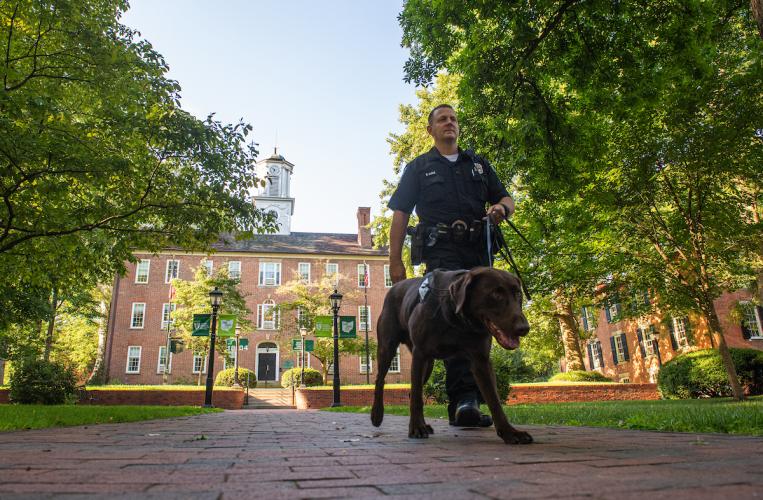
An online bachelor's in criminal justice prepares graduates for patrol officer and sheriff's deputy roles, detective and criminal investigator positions, supervisory ranks such as sergeant and lieutenant, and federal agent careers that require a four-year degree, including FBI special agent. It also supports related paths in corrections, probation and parole, and natural resources law enforcement. A bachelor's degree does not replace police academy training, but it is often what qualifies officers for promotion, investigative assignments, and federal hiring.
At Ohio University, the Bachelor of Science with a major in criminal justice is a degree-completion program for students who already hold an applied associate degree in a related field. It can be completed fully online through OHIO Online, and 80% of our criminal justice students already work full-time in the field.
Law enforcement careers generally fall into four tiers: entry-level sworn positions, investigative roles, supervisory and administrative leadership, and federal agencies. Unlike an applied associate degree, which centers on the technical skills needed for entry-level work, a bachelor's degree adds the research methods, statistics, writing, and social science foundation that agencies value in investigators and leaders.
Patrol officers and sheriff's deputies carry out general law enforcement duties, including responding to calls, patrolling assigned areas, and making arrests. In Ohio, every peace officer must complete a basic training academy approved by the Ohio Peace Officer Training Commission (OPOTC) and pass the state certification exam, according to the Ohio Attorney General's Office. A criminal justice degree complements that certification rather than substituting for it.
Detectives gather facts, interview witnesses, and build cases for prosecution, typically after serving first as patrol officers. Unlike patrol work, investigative roles depend heavily on report writing, evidence analysis, and courtroom testimony, which are skills the bachelor's curriculum reinforces. Nick Freisthler, a 2020 OHIO Online graduate, now serves as a detective with the Troy Police Department.
Officers who move into sergeant, lieutenant, and captain ranks shift from field work to managing people, budgets, and policy. Our program is designed specifically to help graduates qualify for careers in law enforcement administration and police administration. For many officers, finishing a bachelor's degree is the step that keeps them eligible for command-level promotions.
Federal agencies set stricter education requirements than most local departments. FBI special agent applicants must hold a bachelor's degree or higher from a U.S. accredited college or university, plus qualifying work experience; current FBI postings accept one year of full-time sworn law enforcement experience at the GL-09 level. Ohio University has been continuously accredited by the Higher Learning Commission since 1913, and that institutional accreditation covers online degrees.
Matthew Barger, an Ohio University graduate, became the officer in charge of the U.S. Marshals Service Violent Fugitive Task Force for the Southern District of West Virginia. His team locates and arrests fugitives charged with violent crimes in coordination with local, state, and international partners.
State agencies employ sworn officers with focused jurisdictions, such as wildlife, parks, and waterways. Criminal justice graduate Jennifer McClain Eskey works as a natural resources officer with the Ohio Department of Natural Resources, combining her law enforcement experience with her degree.
Beyond sworn policing, the degree prepares graduates for parole and probation, forensic science, and adult and juvenile corrections. Makalia Jones, a deputy sheriff at the Franklin County Corrections Center, oversees the care, custody, and control of inmates. Alumna Josie Lott moved from fraud investigator with the Highland County Department of Job and Family Services to case manager with the Ross County Adult Probation Department, a role she credits to holding the degree.
The median annual wage for police and detectives was $77,310 in May 2025, according to the U.S. Bureau of Labor Statistics. Detectives and criminal investigators earned a higher median of $93,790, compared with $76,210 for police and sheriff's patrol officers. The BLS projects about 60,100 openings each year from 2025 to 2035 and notes that a bachelor's degree may be required for advancement to lieutenant or higher, while some departments offer additional pay to officers with college degrees.
The program is an upper-division, degree-completion major. Applicants need a conferred applied associate degree in a criminal justice-related technical field, such as law enforcement, corrections, police administration, paralegal studies, or human services, along with a cumulative GPA of 2.0 or higher.
The program is intentionally designed to be completed in two years, and full-time students completing articulation agreements are likely to finish in four semesters. Full course details are available in the Ohio University Undergraduate Catalog.
Students who have not yet earned an applied associate degree can begin with OHIO's Associate of Applied Science in Law Enforcement Technology, which is also available online. New students may enter as pre-criminal justice majors and work toward the associate and bachelor's requirements at the same time.
Not always. Ohio requires completion of an OPOTC-approved basic training academy and a passing score on the state certification exam, while education requirements beyond that are set by each hiring agency. A bachelor's degree becomes more important for investigative assignments, command ranks, and federal positions.
Yes. The Bachelor of Science with a major in criminal justice is built for working professionals, with asynchronous courses that fit around shift schedules. Most of our students are already employed full-time in criminal justice.
Federal agencies such as the FBI evaluate whether a degree comes from an accredited institution, not whether it was earned online. Ohio University's online B.S. in criminal justice carries the same institutional accreditation as degrees earned on our Athens and regional campuses.
The academy makes you a peace officer, but a bachelor's degree shapes how far that career can go. Unlike state certification, the degree is what federal agencies require, what many departments look for at the rank of lieutenant and above, and what prepares officers to lead investigations, specialized units, and entire agencies.
For the 80% of our criminal justice students already working full-time in the field, it builds directly on the experience they have already earned. Our graduates now serve as detectives, sheriff's deputies, natural resources officers, probation professionals, and federal task force leaders.
Your next assignment starts here. Explore the online Bachelor of Science with a major in criminal justice or talk with an OHIO Online admissions advisor about how your associate degree can move you forward.