Image
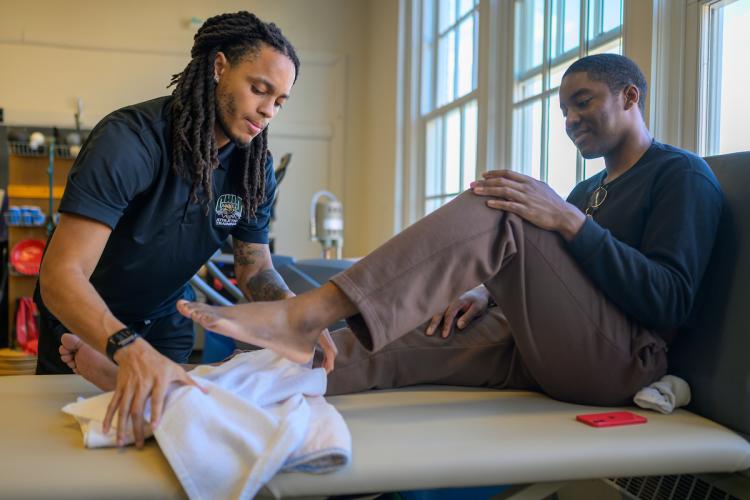
In a Doctor of Athletic Training (DAT) program, the clinical practice track prepares credentialed athletic trainers to apply existing research evidence to patient care, while the clinical research track prepares them to generate new evidence by collecting and analyzing original data. In Ohio University's online Doctor of Athletic Training, both tracks share the same 17-credit core and 12 elective credits. The difference comes down to 13 track-specific credit hours and the culminating project: a capstone tied to your work setting versus an original research manuscript suitable for journal publication.
The DAT is a post-professional clinical doctorate for athletic trainers who are already certified and practicing. Unlike the entry-level Master of Science in Athletic Training, which prepares students to sit for the Board of Certification (BOC) exam, the DAT builds advanced skills on top of that credential. Unlike a Ph.D., which is designed to train full-time researchers, our DAT aims to develop "scholarly clinicians" who use data to improve patient care.
The master's degree is now the starting point for the profession. In 2015, the Athletic Training Strategic Alliance moved the professional degree to the master's level, and the Commission on Accreditation of Athletic Training Education (CAATE) has not allowed programs to admit students into bachelor's-level professional programs since fall 2022. The U.S. Bureau of Labor Statistics reports a median annual wage of $62,520 for athletic trainers in May 2025 and projects 13% employment growth from 2025 to 2035, much faster than average.
The clinical practice track focuses on using research to inform clinical decisions. Students complete a minimum of 13 credit hours in HLTH 6100 Evaluation and Quality Improvement in Health Care, AT 6360 Psychosocial Issues in Athletic Training, AT 6400 and AT 6410 Evidence-Based Care in Athletic Training I and II, and PT 7150 Imaging in Rehabilitation.
The culminating experience is a capstone project applicable to the student's own work setting. As the DAT curriculum explains, the capstone may take the form of a systematic review, meta-analysis, quality improvement project or case study.
This track suits athletic trainers who want to stay patient-facing and lead change inside a clinic, school, hospital or team setting. It is a strong match for professionals moving toward head athletic trainer, clinical coordinator or practice leadership roles.
The clinical research track prepares clinicians to collect and analyze data themselves. Students complete a minimum of 13 credit hours, including AT 6322 Statistics for Advanced Athletic Training Practice II, HLTH 6770 Grant and Proposal Writing in Public Health, and AT 6940 Athletic Training Research Project, which is repeated for at least 6 credit hours.
The culminating experience is original research involving data collection and analysis. Unlike the clinical practice capstone, which may synthesize existing literature, the research track ends with a manuscript suitable for publication in a professional journal.
This track suits athletic trainers who want to contribute new knowledge to the field, teach in higher education or pursue grant-funded projects. It also gives students room to investigate a question they care about rather than joininng an existing study.
Every student completes 17 core credit hours: AT 6120 Leadership and Professionalism in Athletic Training, AT 6160 Patient-Oriented Outcomes in Athletic Training, AT 6222 Statistics for Advanced Athletic Training Practice I, AT 6310 Neuromechanics of Sports Injury Rehabilitation, AT 6350 Sport Injury Risk Assessment, and IHS 5513 Health Informatics for the Health Professions. Students in both tracks also choose at least 12 elective hours, and those without a prior research methods course take EXPH 6080 Research Methods and Statistical Applications.
Our DAT totals 42 credit hours and can be completed in as few as four semesters. Classes are 100% online and asynchronous with no required residencies, and tuition is $571 per credit hour for Ohio residents and $593 for nonresidents.
| Clinical practice track | Clinical research track | |
|---|---|---|
| Primary goal | Apply evidence to patient care | Generate new evidence |
| Track credit hours | 13 minimum | 13 minimum |
| Signature coursework | Evidence-based care, quality improvement, imaging | Advanced statistics, grant writing, research project |
| Culminating project | Work-setting capstone (systematic review, meta-analysis, QI project or case study) | Original research manuscript suitable for publication |
| Typical next step | Clinical leadership and advanced practice | Academia, research and grant-funded work |
Applicants to either track must hold a master's degree from a CAATE-accredited program, or be a credentialed athletic trainer with a master's degree in a related area, with a 3.0 GPA. Per our DAT admissions requirements, applicants must also be BOC-certified, be credentialed in their state of residence, hold a National Provider Identifier (NPI) number if U.S.-based, and submit a resume or CV.
Students must show full- or part-time employment as an athletic trainer each semester they are enrolled. That requirement keeps coursework connected to real practice in both tracks.
The Board of Certification (BOC) is the only certifying body for athletic trainers, and its exam is recognized by every state athletic trainer regulatory agency. Because a DAT does not replace BOC certification or state licensure, both remain prerequisites rather than outcomes of the degree.
Choose the clinical practice track if your goal is to improve outcomes for the patients you see every day. Choose the clinical research track if you want to design studies, publish and shape the evidence other clinicians rely on.
Either path can be paired with a graduate certificate in Clinical Informatics, Healthcare Leadership, Health Policy or Performing Arts Medicine. To talk through which track fits your goals, request information or apply to the online Doctor of Athletic Training at Ohio University.