Image
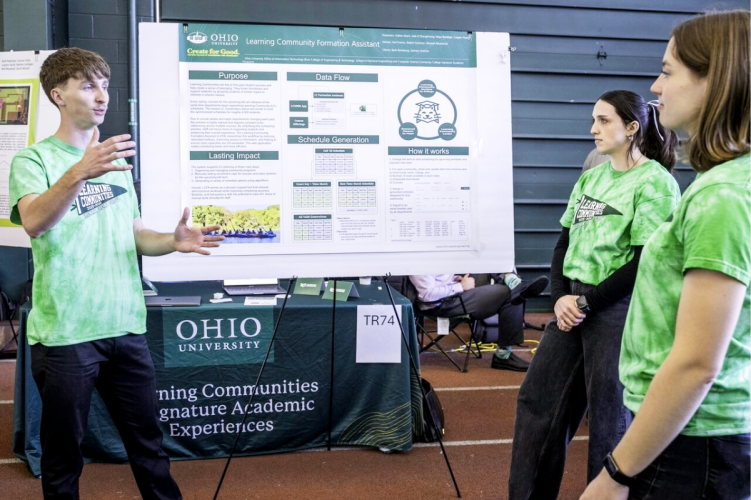
Dalton Muck, Jade O’Shaughnessy and Maya Roediger present their capstone project at the April 2026 Student Expo, where they received a first-place award in Engineering and Technology.
Ohio University Learning Communities on the Athens campus have supported the transition of first-year students for more than 26 years, continuing a long tradition of engaging students as soon as they step onto campus. Learning Communities, as well as First-Year Seminars, are AAC&U High-Impact Practices that support deeper student engagement with their education.
In fall 2026, there were 235 Learning Communities supporting an estimated 98% of first-year students. Department chairs, directors and assistant deans identify a subset of courses they suggest students take as part of their first semester. The courses selected are based on major graduation plans, and students then take the cluster of courses as a cohort.
Every February, the Learning Communities Office gathers cluster seat requests from across all colleges. The requests are filtered across the departments that offer the courses, and a request is then made to each department for seats in those classes. Once course offerings are released, the next stage is to develop the clusters so that classes do not conflict in their days or meeting times. On average, more than 550 classes and 15,000 seats are associated with the clusters. The UC1900 Learning Community Seminar class is also integrated into the cluster. For many years, this information has been developed and organized using a large Microsoft Excel spreadsheet.
In collaboration with the Russ College’s School of Electrical Engineering and Computer Science and the Office of Information Technology’s Student Software Engineering Program, the Learning Communities staff worked with a student senior capstone team to explore ways to modernize the cluster development process. The students on the team were enrolled in their Software Design and Development capstone course with professor Nasseef Abukamail.
Robert Foreman, manager of Software and Application Engineering, was open to helping frame a capstone project that would advance the cluster development process. Karl Francis, a software engineer with OIT’s Software Engineering team, served as the advisor for the capstone team throughout the year. The Student Software Engineering Program has also supported other campus software efforts over the years, including PACE (Program to Aid Career Exploration), the Bobcat BrewTrail and the Environmental Health and Radioactive Isotope Tracking System.
The student team developed a Learning Community Formation Assistant web application that will allow Learning Community staff to develop communities based on prior-year data and cross-reference it against new course offerings where like class meeting patterns exist. In addition, there is a “schedule planner-like" operation that allows us to enter the courses needed for a community, and the tool will return options that work within the parameters. Lastly, the tool works within a given framework of the total number of course seats the department has provided for our use with Learning Communities.
A beta version of the tool was available in early spring 2026 so that it could be tested at the same time as clusters were developed using the typical method. The tool will be fully utilized for the 2027 cycle. As an efficiency measure, it is anticipated to result in a minimum 33% reduction in time.
“This group of students was a joy to advise," Karl Francis, their advisor, said about the group’s level of excellence. "They took notes well and, more importantly, took action to address the feedback. The team worked well with the customer and by the end of the school year the team had developed a deep understanding of the customer's technical challenges and how they could be resolved.”
The student team members all graduated this past May and included Dalton Muck, CS and AI 2026, who served as a CS Learning Community Leader fall 2024 and is currently working as an Artificial Intelligence Software Engineer with Huntington National Bank; Jade O’Shaughnessy, CS 2026, who also served as a CS Learning Community Leader in fall 2024 and is currently working as an Engineering Rotation Program Analyst with US Bank; Cooper Young, CS 2026, who is currently working as an Associate Consultant with Makse Group; and Maya Roediger, Honors CS 2026.
“I am very proud of them and the work they did," Foreman added. "They were probably one of the most cohesive groups of students we've had. They worked really well together. That is what we aspire to with our student program.”