Image

Luke Davenport
A new study published in Advanced Photonics Research is drawing attention not only for its scientific innovation, but also for the story behind it: an undergraduate student leading cutting-edge research at the frontiers of nanotechnology.
Luke Davenport, an undergraduate researcher at the Nanoscale and Quantum Phenomena Institute (NQPI) at Ohio University, led the development of a new class of chiral nanomaterials that exhibit strong absorption in the ultraviolet (UV) region, an area that has long been difficult to access experimentally.
Working under the guidance of Professor Martin Kordesch from the College of Arts and Sciences Physics and Astronomy Department and in collaboration with theorists Dr. Oscar Avalos-Ovando and Distinguished Professor Alexander Govorov, Davenport and the team combined advanced fabrication techniques with computational modeling to open a new pathway in nanophotonics.

Davenport’s journey into this project began early in his undergraduate career as an Engineering Physics major in the Honors Tutorial College.
“I was eager to get hands-on experience in a lab early on,” he said. “The motivation for this project was the opportunity to push the boundaries of what we can achieve with scalable sputter deposition techniques.”
That ambition led to a bold question: could an intermetallic compound like zirconium nitride be engineered into chiral nanostructures with tunable optical properties?
The answer, as it turns out, is yes, under the supervision of Kordesch, a materials physics expert with extensive experience in growing a wide range of thin films.
At the heart of the breakthrough is a fabrication technique known as glancing angle deposition (GLAD), which allows materials to grow into complex, three-dimensional shapes at the nanoscale.
Using this method, the team created microscopic spiral-like structures, materials with “handedness,” meaning their geometry differs depending on orientation, much like left and right hands.
Davenport explains it in simple terms:
“Many things around us, like DNA or a spiral staircase, have a specific handedness. In this project, we forced zirconium nitride to grow into microscopic spirals. The material then interacts differently with light depending on which way the light itself is twisting,” Davenport said.
This interaction is known as circular dichroism, and what makes the team’s result especially striking is that it occurs strongly in the ultraviolet region, a spectral range critical for chemistry, biology and photonics.
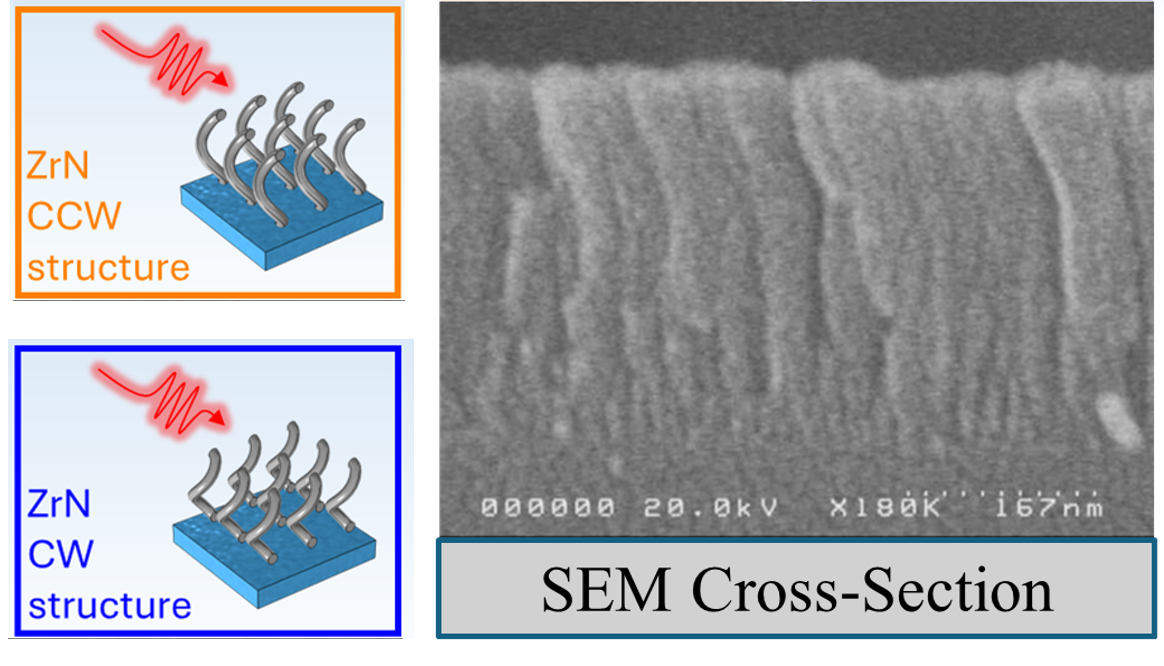
The path to this result was far from straightforward. Fabricating such structures required precise control over deposition conditions, materials and geometry.
“One hurdle was getting the deposition process to be stable,” Davenport said. “We ultimately had to pivot to using only RF sputtering. Then came the challenge of tuning all the parameters, especially gas mixtures, while controlling the tilt and rotation needed to form the chiral nanostructures.”
These challenges highlight the complexity of translating nanoscale design concepts into real materials.
To fully understand the observed optical behavior, the experimental work was paired with advanced simulations using COMSOL Multiphysics.
For OHIO alumnus Avalos-Ovando, theory played a crucial role in revealing what experiments alone could not. Avalos-Ovando is now an assistant professor of physics at the University of North Carolina at Greensboro. Connect with him on LinkedIn.
“COMSOL simulations allow us to understand where the electrons prefer to go within the structure upon light excitation, something typically very difficult to observe in experiments,” he explained.
The modeling revealed that the strong optical response arises from a combination of interband electronic transitions and the confinement of electromagnetic fields within the chiral geometry.
Still, simulating such systems was no trivial task.
“In our experiment, there were several patterns, so the ‘perfect structure’ approach was not feasible,” Avalos-Ovando noted. “We had to test multiple configurations and identify the geometry that best matched the experimental spectra.”
This iterative, experiment-driven modeling approach proved essential to validating the results.

Most chiral optical materials studied to date operate in the visible or infrared range.
“Achieving strong chirality in the UV opens new possibilities, particularly because many biologically and chemically relevant molecules absorb strongly in this region,” noted Govorov, a global pioneer and leader in chiral plasmonics.
The implications are wide-ranging:
As Avalos-Ovando puts it, “Simulations allow us to explore thousands of possible configurations and guide experiments toward desired behaviors. This combination is accelerating discovery in nanophotonics and quantum materials.”
For Davenport, the project was transformative.
“This project solidified my desire to pursue materials research long term,” he said. The experience has already propelled him toward a series of prestigious internships and a Ph.D. program in materials science and engineering at Northwestern University.
He also offers straightforward advice to other students.
“Don’t be afraid to reach out to professors whose work sounds interesting… and collaborate,” Davenport said. “Our experimental work was vastly strengthened by the theoretical simulations.”
The team is already exploring next steps, including extending their approach to related materials such as titanium nitride and hafnium nitride, and investigating new chiral geometries.
These efforts aim to deepen the connection between materials, light and chirality, an intersection with growing importance in sensing, energy and quantum technologies.
Ultimately, this work is as much about people as it is about materials. It highlights how undergraduate researchers, when given the opportunity and mentorship, can contribute meaningfully to scientific discovery and breakthroughs.
At NQPI, that philosophy is not the exception, it is the model.