Image
Raye White
The Hopewell Ceremonial Earthworks in Ohio gained recognition as a UNESCO World Heritage Site in 2023, but work toward achieving that designation was years in the making. Today, the efforts to promote the sites continue with assistance from the George V. Voinovich School of Leadership and Public Service.
Dating to some 2,000 years ago and located at eight sites along Ohio River tributaries, the large earthen structures that align with cycles of the sun and moon are believed to have been built as gathering places for far-flung indigenous groups populating the north-central region of North America at the time.
“Their scale and complexity are evidenced in precise geometric figures as well as hilltops sculpted to enclose vast, level plazas,” the UNESCO website notes. “These earthworks served as ceremonial centres and the sites have yielded finely crafted ritual objects fashioned from exotic raw materials obtained from distant places.”
Prior research conducted by archeologists including experts with the Ohio History Connection, formerly the Ohio Historical Society, confirmed the sites’ significance as a ritualistic and cultural gathering place dating back centuries. More recently, attention has turned to attracting more modern-day visitors.
To that end, the Ohio History Connection in 2018 contracted with OHIO’s Voinovich School to produce an economic impact assessment of what a World Heritage designation could mean for the state. With that recognition in hand, the school is now working with the Heath-Newark-Licking County Port Authority on ways to bring more awareness and foot traffic to boost economic development in the region.
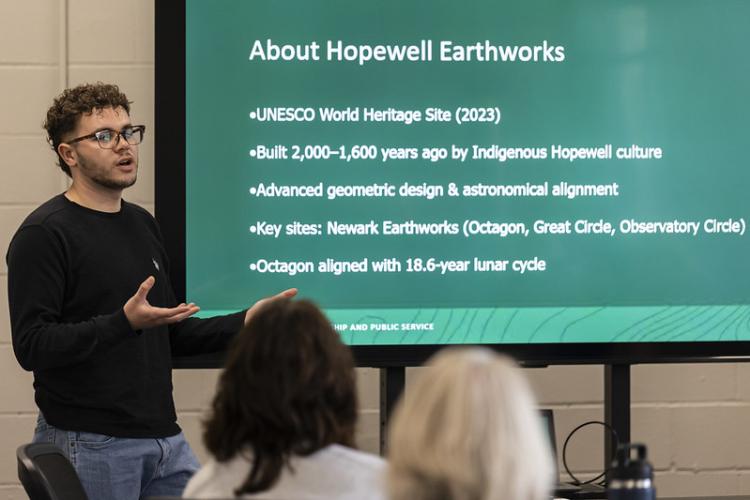
Brent Lane, senior executive in residence at the Voinovich School whose expertise includes regional competitive advantages and community development that capitalizes distinctive cultural and natural heritage assets, served as a consultant on the 2018 study and is leading the latest research with the help of OHIO students.
The project reflects one of the many facets of the Voinovich School’s mission of promoting economic development and prosperity in the region while fostering community-engaged research by OHIO students.
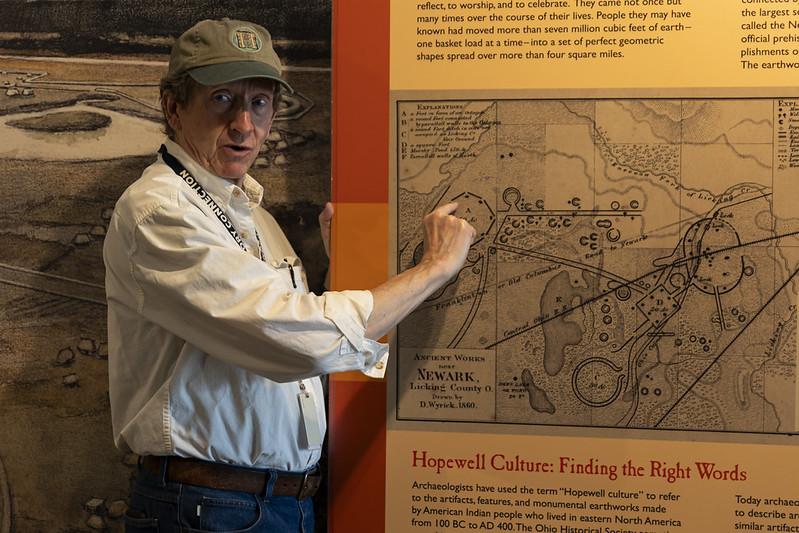
Among the students involved in the latest Hopewell project is Caden Mayle, a Voinovich Research Scholar set to graduate this spring with a degree from the College of Business focusing on marketing and strategic leadership in management.
His prior research under Lane has included documenting the importance of “heritage houses,” or homesteads dating back decades in the area.
“I will look for data and statistics for whatever the project is we’re working on. Sometimes it’s methods to fix an issue,” he said.
“So right now with the Hopewell Project, Brent has me looking at how to convert day visitors to Licking County to overnight visitors,” Mayle said. That includes research on approaches used by others in promoting similar sites.
Lane said he sees the Voinovich School’s continued work focusing on the earthworks as a natural extension of its broader focus.
“We have this public mission, not only to help communities capitalize on their natural and cultural resources, but also to communicate them as an education mission,” he said.
“Recognizing the expertise of the Voinovich School, the Port Authority reached out to work with us in evaluating opportunities for engaging with the public in ways that enhance cultural appreciation, preserve the sites and at the same time create economic stewardship in the broader Licking County community among businesses and citizens,” Lane said.
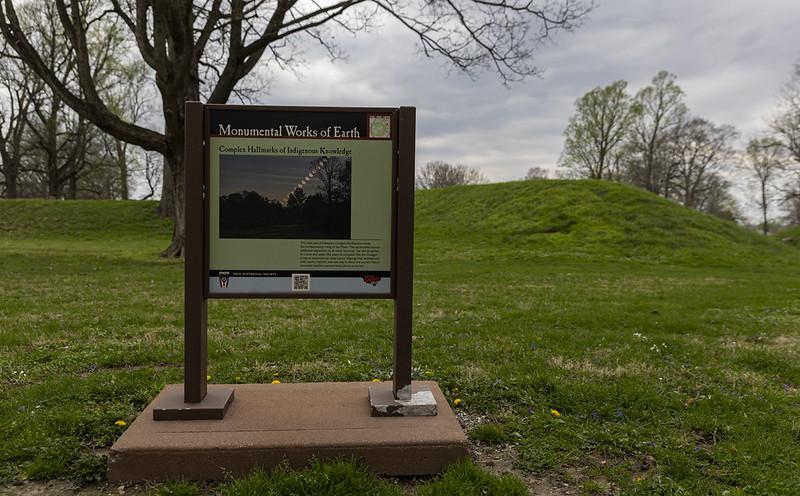
Goals of the latest research include the feasibility of a potential Visitor Experience Center and other approaches to bring people to the state and encourage them to plan overnight trips and experience the breadth of the ancient monuments located in three south-central Ohio counties, he said.
“To become a World Heritage site is important for conservation purposes, but it can also have some economic benefits – if you work at it,” Lane said.
“It’s not just a matter of looking at economic impacts and tourism attraction, hotel stays and things like that,” he added regarding his ongoing interest in the subject. “It’s also advocating for a more comprehensive proactive strategy of engagement.”
The earthworks were originally constructed as convening sites, he noted.
“It brought people together from long distances,” Lane said.
To further that goal in the 21st Century, Lane said a key to the research is the involvement of OHIO students because they bring the perspective of a younger demographic that is sometimes missing from the types of visitors who may be drawn to ancient historical sites.
Mayle said broadening interest in the sites could be accomplished by developing marketing styles to target those audiences, especially younger groups such as Generation Z.
“Hopewell would especially benefit from this audience because Gen Z has a high focus on ethics and appreciating methods of preserving rich history,” he said. He added that increasing the number of visitors to the sites would provide numerous benefits to the region, and would also require some planning.
“To actually bring more visitors into the state, it’s better if there are more accommodations and things like weekend plans for those visitors,” such as multi-day packages and itineraries to attract out-of-state consumers interested in learning more about the heritage and history of the state, he said.
Mayle has been accepted into the Master of Public Administration Program at the Voinovich School and is eying a potential career in the field of Christian non-profits.
The Voinovich School’s latest Hopewell research project is expected to conclude in the next few months.