Image
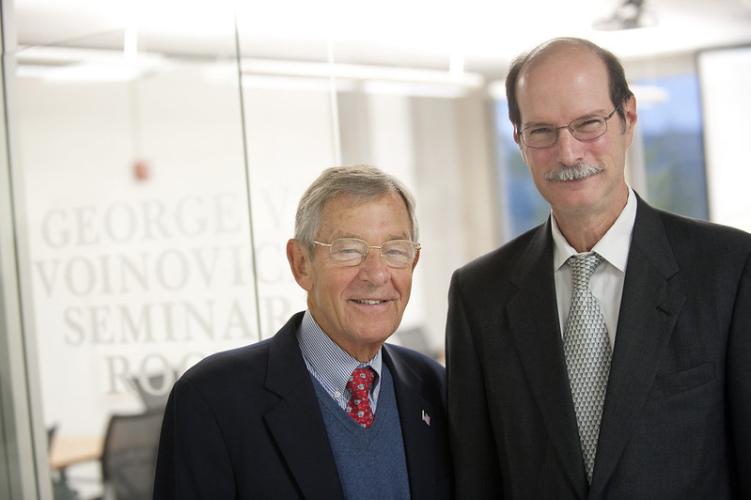
Former Ohio governor and U.S. Senator George Voinovich and Founding Dean Mark Weinberg.
The George V. Voinovich School of Leadership and Public Service employs the expertise of its talented faculty and professionals and its partners to educate future public policy professionals and help Appalachian communities and the State of Ohio address their challenges and opportunities.
It does this with a special focus on local problems ranging from education and the environment to health and economic well-being. The effort began 45 years ago as an Ohio University institute focused on assisting local governments and supporting rural development.
Over a long history the Voinovich School of Leadership and Public Service and its predecessor organization’s impact improved the operations of thousands of small and medium businesses, local government entities, and nonprofits. The school also value added billions of dollars to the region’s and states communities and economy. In addition, the school has improved water quality, educational achievement, energy production, behavioral and children’s health, and the effectiveness of current and future leaders of industry, government and nonprofit organizations.
Such is the school’s story as told in a book penned by a longtime top aide to the OHIO school’s namesake, former Ohio governor and U.S. Senator George Voinovich.
Author Greg Browning, a former chair of the Ohio University Board of Trustees, who like Voinovich earned his undergraduate degree at OHIO before embarking on a lengthy career in public service, saw the need for documenting the history of the school while providing a model for other institutions to follow.
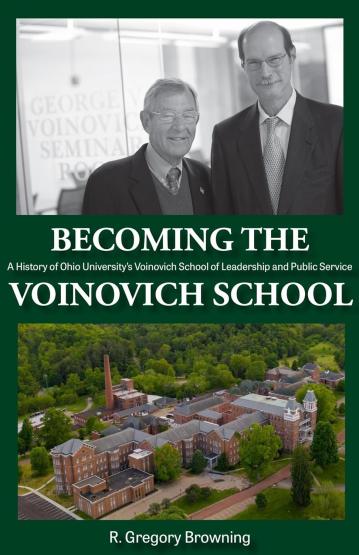
Integral to the story is the involvement of Mark Weinberg, the Voinovich School’s founding dean, who joined OHIO in 1976 as a political scientist charged with creating a public administration program. His leadership in shepherding the school’s eventual growth while aligning its many initiatives with the Voinovich ethos, which includes nurturing public-private partnerships, is a recurring theme.
The result is “Becoming the Voinovich School: A History of the Voinovich School of Leadership and Public Service.” It is an in-depth history of the school and its predecessor organizations, and its emergence as an educational dynamo that leverages faculty and professional expertise and applied research to help grow regional and state prosperity. The book’s publication is funded in part through a grant from the Community Foundation For Greater New Haven.
It is currently available as a download and can be purchased in hard copy starting March 31 through Ohio University Press or Amazon.
The book reveals an innovative yet practical approach to problem solving provided by an outwardly focused school. Examples range from public-private partnerships in various sectors ranging from education to energy, including longstanding involvement in repurposing the federal uranium enrichment plant in Piketon, Ohio, to a unique history of helping technology-based start-ups in the region to assisting regionally-based companies gain contracts to provide the federal government with their goods and services to helping with pediatric behavioral health problems.
Those programs also include decades of help to the region’s local governments through consulting and training projects offered, in many cases, through the work of the Voinovich Academy for Excellence in Public Service.
Browning and Weinberg hope the book will serve as a resource to not only current Voinovich School professionals and stakeholders, but also to policymakers and to leaders in other institutions, public and private.
“The mix of programs could be different, there could be various institutional barriers, but the school’s approach, which reflects lessons learned in many projects and with many partners and advisors, including engaged alumni, is applicable broadly,” Weinberg said.
Added Browning, “The basic approach, the methodology, could be used in most any arena, including rural and urban settings.”
“It shouldn't be a book that's put on a shelf, and we call it a day,” he continued. “The hope it that it has practical utility in giving both students and practitioners a better understanding of what works in terms of managing and leading in the public sector using a results and partner-oriented approach. It can also be useful for educators to know that the school has always included students in its projects thus allowing them to link classroom-based learning with real world work experiences.”
That mission began with the creation of the Institute for Local Government Administration and Rural Development (ILGARD) – an early iteration of what would become the Voinovich School. It now encompasses economic and community development, education and child wellness, environmental restoration, and health and well-being.
The book’s first chapter focuses on Voinovich, who died 10 years ago and would have been 90 this year. The 1958 graduate of Ohio would go on to serve in seven different local, state and federal offices over a 44-year career in public service.
Voinovich’s public service philosophy included a major commitment to creating effective public-private partnerships. He believed the growing complexities of life make one-sector solutions problematic. With that in mind, Voinovich wrote a book late in life that was published posthumously titled “Empowering the Public-Private Partnership: The Future of America’s Local Government.”
Weinberg, described in “Becoming the Voinovich School” as “a political scientist with business acumen,” cited the influence of Voinovich’s approach in the evolution of the school.
“It changed the nature of public service at OU by addressing issues across business, government and nonprofit sectors,” he said. “It changed how external units, like the region’s Mayors’ Partnership for Progress, and many more programs, collaborated.”
Weinberg said other aspects of the former governor’s approach embodied by the school include: distributive leadership both inside and outside the University, such as a faculty collegial and collaborative model; and a unique student integration model as part of its operational capacity, which includes the Voinovich Scholars Program and graduate assistants working for outside units and developing companies.
“From the beginning, the valuable community impacts derived through partnerships attracted important long-term political support from the Ohio Legislature, executive branch and alumni,” he said. The support helped foster joint program and project development across campus and with other universities in the state and nation.
In his afterward for the book, Weinberg wrote, “Senator Voinovich’s belief in government’s highest calling, which became the school’s mission statement, captures the entire 1981-2023 history of these public service enterprises and their mission, purpose, strategy and value.”
As was his way, Voinovich articulated this vision in a direct fashion: “I believe the government’s highest calling is to empower people and galvanize their energy and resources to help solve our problems, meet our challenges, ands seize our opportunities.”
According to both Browning and Weinberg, this perspective continues to shape the work of the Voinovich School and it is a central theme of “Becoming The Voinovich School.” Empowering this vision is a practical, non-partisan approach to problem solving. This direction works exceedingly well and garners positive responses from local, state and federal officials and the public they serve.