Laboratory Ventilation Devices
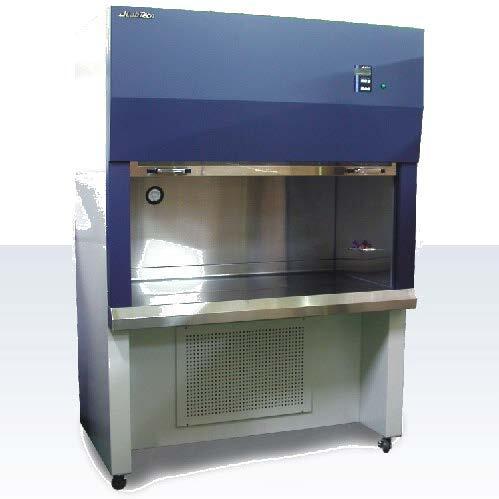
Fume hoods, biological safety cabinets and clean benches are three common laboratory ventilation devices designed to protect the worker and/or the experiment. It is important to know when each is necessary and under which conditions each should be used.
Fume Hoods
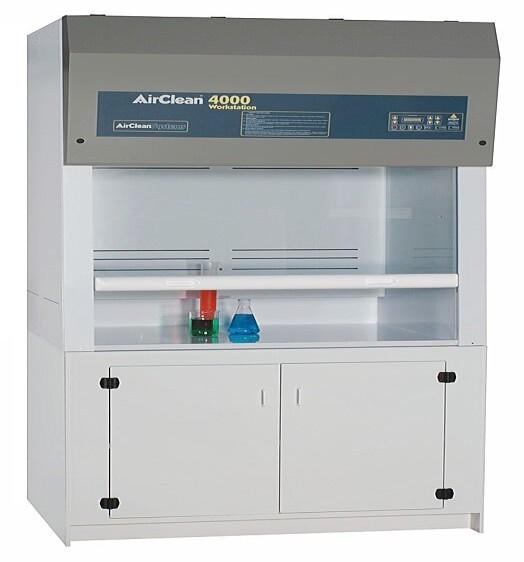
Laboratory fume hoods are used for the safe containment of flammable, toxic, or offensive materials. Even though they protect against most hazards they are not designed for highly toxic or violently reactive materials (contact EHS if you work with these materials). Safe fume hood working practices are the key to ensuring that your fume hood is providing maximum protection. Ohio University’s fume hoods are certified annually to ensure that they are working properly. If your fume hood does not have an up to date certification sticker, contact EHS so the fume hood can be tested. The testing of a fume hood consists of a check for optimum velocity, and a smoke test to ensure that no material is spilling out of the fume hood. Modifying a fume hood could upset the balanced airflow in the hood, causing vapors or gasses to spill out of the hood into the working area of the researcher. Over filling the fume hood with equipment can also disrupt airflow; separate items and use risers to maintain air flow around the apparatus. Be sure to place materials you will be working with at least 6 inches into the fume hood to ensure that the fume hood can effectively capture the vapors.
Safe Fume Hood Practices
- Check fume hood to make sure it is working- Check the magnehelic or digital gauge to ensure that the fume hood is working. The arrow should be between the two wax pencil markings, or the digital readout should be green.
- Setup work at least 6 inches from the sash- This avoids unwanted turbulence that can cause material to leak out.
- Avoid using paper and other light material in the hood- Light material can be sucked into the exhaust system and plug it up.
- Lower sash to optimum working height- The sash should be 16-17 inches above the airfoil. Some hoods have a marked optimal height.
- Avoid traffic around the fume hood- Opening doors and walking by the hood can create enough turbulence to pull material out of the hood.
- Never put your head in a fume hood when working with chemicals- If you need to rearrange materials in a fume hood, remove or close all hazardous materials. Allow the hood to run for 10 minutes before rearranging your set-up.
- Clean spills in the fume hood immediately
- Avoid storing chemicals in fume hoods- When finished using a chemical, take it to an appropriate storage area.
- Do not modify the structure of the fume hood in any way- Modifying the fume hood may render it ineffective, posing serious health risks. Consult EHS before modifying a hood.
- Report any problems with the fume hoods to EHS immediately.
Biological Safety Cabinets
Biological safety cabinets (BSCs) are primary containment devices for use with biological materials. BSCs are broken into three classes, each class has a specific purpose:
- Class I BSCs protect the worker and the environment, but provides no protection to the experiment. Ambient air is pulled from the working space into the cabinet and across the experiment. This ambient air can introduce contaminants into the experiment. All the airflow is into the cabinet, so the worker is protected from the experiment. The air is passed through a HEPA filter, and then is exhausted; use of the filter protects the workers and the environment from the exhaust.
- Class II BSCs (the most common at Ohio University) protect the workers, the environment and the experiment. Ambient air is pulled from the work space into the cabinet, where the air is initially passed through a HEPA filter. The filtered air is then passed over the experiment being conducted. After passing over the experiment, the air is again passed through the HEPA filter. Some of the filtered air is used for the experiment and some of the filtered air is exhausted. Class II BSCs can either exhaust filtered air into the work space or exhaust the filtered air outside. Filtering only removes particles; filtering does not remove vapors and gases. Therefore, BSCs that exhaust the filtered air into the workspace cannot be used with hazardous chemicals since these chemicals would be recirculated into the room. If biological work requires a class II cabinet with chemical use, the air from that cabinet must be filtered then exhausted outside of the building through permanent ducts.
- Class III BSCs protect the workers, the environment and the experiments. The cabinet is gas-tight with a non-opening view window, and has rubber gloves attached to ports in the cabinet that allow for manipulation of materials in the cabinet. Class III BSCs are typically used for the most hazardous biological work; this level of hazardous biological work is not permitted at Ohio University so no class III BSCs are used.
Class Bench
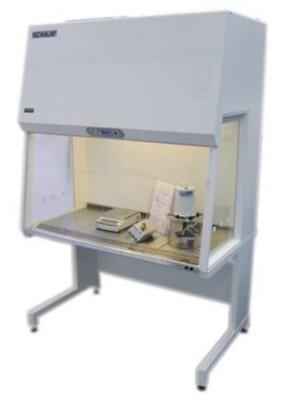
A clean bench supplies particle free HEPA-filtered air to a product. Clean benches are typically used to provide a dust and particle free air supply when working with some medical or electronic devices. The ambient air is pulled into the cabinet and passed through a HEPA filter. The filtered air is passed over the experiment or devices and exhausted directly onto the worker. Do not use biohazardous materials or chemicals in a clean bench because contaminated air is directed towards the workers.