
The Chemical Engineering M.S. program prepares students for doctoral study and industrial positions requiring advanced understanding of chemical engineering principles, some subject matter specialization, and project management experience. Graduates are poised to become leaders in government and industry positions and contribute to improving the human condition.
Chemical Engineering
Master of Science
Chemical Engineering Master's Degree
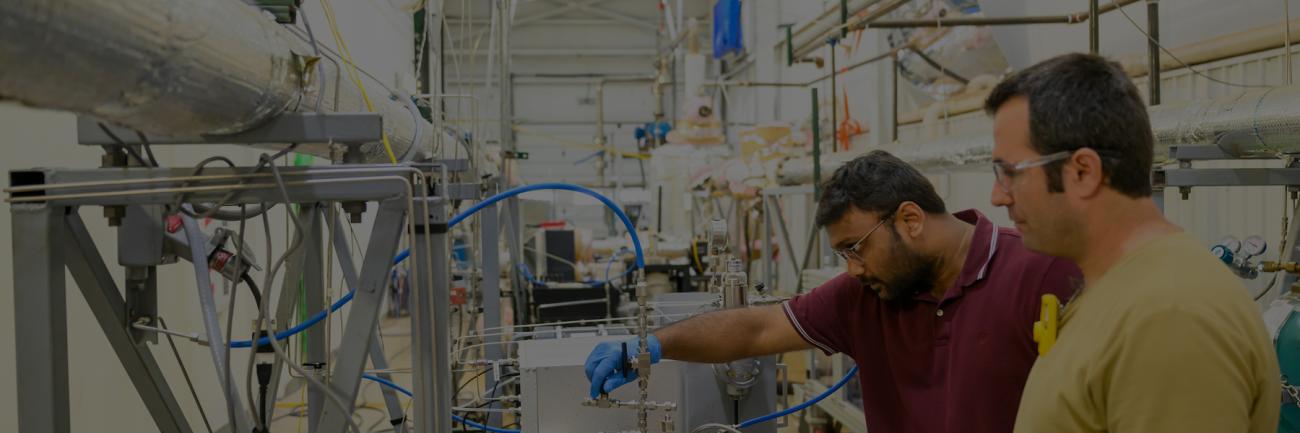
Students in the Chemical Engineering Master of Science (M.S.) program learn to apply graduate-level concepts in engineering mathematics, kinetics and reactor design, thermodynamics, and transport phenomena to engineering problems.
They also develop expertise in one or more areas of technical specialization, such as advanced materials processing, molecular modeling, nanotechnology, corrosion and flow in multiphase systems, biocorrosion and biofouling mitigation, electrochemical engineering, batteries and fuel cells, energy and pollution control, air quality and atmospheric chemistry, and biomedical and biochemical engineering.
Careers with a Chemical Engineering M.S.
Admissions Requirements
More about Admission in the Chemical Engineering Graduate Handbook
GRE scores are no longer required. Most successful applicants will have a bachelor’s degree in chemical engineering or a closely allied field. Those whose educational preparation does not include the full range of required coursework typical of an accredited bachelor’s degree in chemical engineering may be admitted with requirements for additional coursework to fill such gaps. Applicants lacking background in mathematics through differential equations, in general chemistry, in general physics, or in thermodynamics will not be considered. Many applicants qualify for an online application fee waiver; please inquire.
English Proficiency Requirement: Please review information about Ohio University's minimum English Language Proficiency requirements for graduate study.
Accelerated Graduate Pathway
This Accelerated Graduate Pathway: Chemical Engineering program allows approved Ohio University undergraduates to take up to 16 hours of graduate courses while an undergraduate and apply up to 9 of these hours to both their B.S. and M.S. degrees. See the Undergraduate Catalog or contact the department for details about admission into the AGP and which courses can be taken.
Fee Waiver
Applicants with good English scores and B.S. grades are entitled to a waiver of the application fee. There is no need to claim financial hardship. Any applicant with a reasonable chance to be admitted will get it. Contact graduate chair Prof. Tingyue Gu (gu@ohio.edu) to receive a fee waiver.
International students
This program permits full-time enrollment in residence at Ohio University, and an I-20 may be issued based on admission to this program.
Application Deadlines
Fall Admission
Feb. 1 for international applicants, July 15 for U.S. students (but it's a competitive process, so it's a good idea to make the Feb. 1 deadline).
Spring Admission
Sept. 1 for international applicants, Dec. 1 for U.S. students (the competitive process makes Sept. 1 a wise goal).
Summer Admission
Dec. 1 for international applicants, April 1 for U.S. students (the earlier the better).
All application deadlines are soft deadlines to ensure that there is ample time for F-1 visa application.
Scholarships and Financial Aid
Admission and support such as tuition scholarships, research and teaching assistantships are competitive. All newly admitted students receive full financial support or they have a fellowship from elsewhere.
Ohio University Graduate College Financial Support Information
Chemical Engineering M.S. Courses & Degree Requirements
View Degree Requirements in the Official Academic Catalog
Chemical Engineering Graduate Handbook: Requirements & Procedures
Graduate Student Resources & Deadlines
The Chemical Engineering M.S. requires a minimum of 36 credit hours and successful completion of the student’s approved course of study.
Seminar
Students must participate in Seminar every semester during study that it is offered except when out of town and registered only for 1 dissertation hour. Students in Athens who are not required by funding conditions to register for full-time coursework may register for 1 hour of CHE 6000 rather than dissertation in the final semester.
Students are expected to present one CHE 6000 Seminar if they have not done a full-length presentation at a board meeting or national meeting during their time in the program.
Culminating Experience
Students must successfully complete and defend a thesis. Students on the non-thesis option should refer to the additional course requirements listed above.
Ready for the Next Step?
Contact Us
Questions? Contact the Department of Chemical and Biomolecular Engineering at chemical@ohio.edu.
Related Programs
-
Biomedical Engineering Master's DegreeThe Biomedical Engineering M.S. prepares students for doctoral study or industry positions at the interface of biology and engineering. Graduates are poised to become leaders in biomedical engineering.
-
Chemical Engineering Ph.D.Follow your passion with a Chemical Engineering Ph.D. degree in a range of research areas including alternative energy, bioengineering, or materials.