|
Universities are both storehouses and creators of knowledge. The academy balances between preserving a wealth of existing information and building new, valuable wisdom.
How can science scholars leverage so much information, so many perspectives?
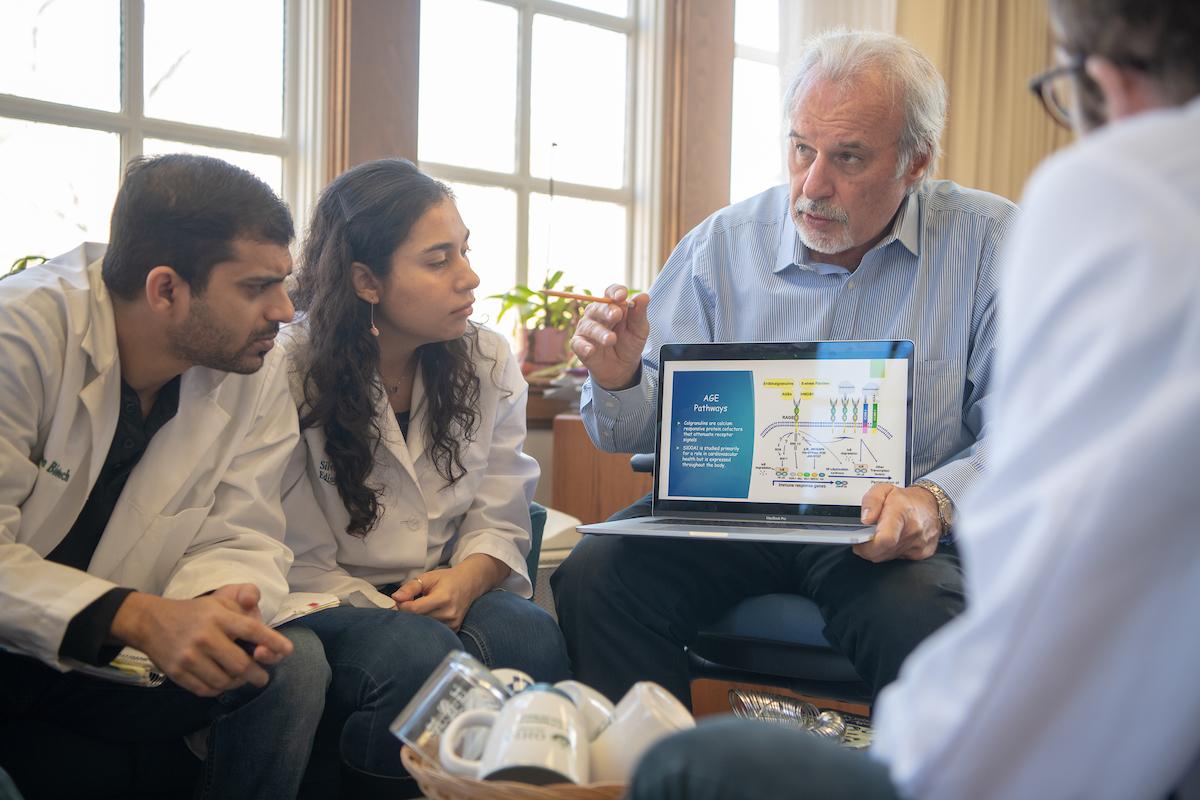
Cross-disciplinary science is the emerging, logical outgrowth of burgeoning information — an approach critical for solving complex, modern biomedical problems. Focused research in molecular biology yields results, but interdisciplinary work promises more rapid progress and advances. By studying the interaction of many levels of biological information, we better understand how they work together in relation to human immunity and disease.
Interdisciplinary competencies are becoming more and more important to research and education. The National Institutes of Health recently noted a need for “a workforce capable of crossing disciplinary boundaries and leading and participating in integrative and team approaches to complex biomedical and health problems.”
If this is the direction that research is moving, people need to be trained to work in this type of environment. Interdisciplinary team engagement encourages broader thinking, flexibility and wider learning. Ohio University graduates must grasp this cross-disciplinary perspective to contribute in private-sector or academic organizations.
From EBI’s founders to our current investigators, interdisciplinary
vision underpins our reputation for meaningful discovery.
Like our principal investigators, students benefit from the interdisciplinary research teams that contribute to our success. For example, graduate and undergraduate students participate in research initiatives in the BioMolecular Innovation and Technology Partnership (BMIT), a collaboration between faculty from EBI and the colleges of engineering, arts and sciences, health and human services and osteopathic medicine. They also may participate in the interdisciplinary Molecular and Cellular Biology graduate program that offers opportunities in a broad range of research areas, and in the growing biomedical engineering program.
EBI’s on-going commitment to bioscience education benefits the university, the institute, students and graduates. Our students’ experiences also fuel commercial, academic and clinical development of biotechnology in Ohio.
|