
Adverse Events and Unanticipated Problems in Research
Definitions
- “Adverse event” or “adverse experience” is defined by NIH as "any untoward or unfavorable medical occurrence in a human subject, including any abnormal sign (for example, abnormal physical exam or laboratory finding), symptom, or disease, temporally associated with the subject’s position in the research, whether or not considered related to the subject’s participation in the research." Adverse events include both physical and psychological harms; although they most commonly occur in the context of biomedical research, they also can occur in the context of social and behavioral research.
- “Serious Adverse Event” (SAE) is any adverse event that results in death, is life threatening, results in patient hospitalization or prolongation of existing hospitalization, results in a persistent or significant disability/incapacity, results in a congenital
anomaly/birth defect, or based upon appropriate medical judgment, may jeopardize the subject’s health and may require medical or surgical intervention to prevent one of the other outcomes listed in this definition. - “Unexpected” or “unanticipated” refers to adverse events or other problems in the research where the nature and/or severity are not consistent with the information already provided to the IRB, including the project outline form and consent form(s).
Unanticipated Problems
Unanticipated Problems (UPs) include any incident, experience, or outcome that meets all of the following criteria:
- Unexpected (in terms of nature, severity or frequency);
- Related or possibly related to participation in the research; and
- Suggests that the research places subjects or others at a greater risk of harm than was previously known or recognized.
Reporting Unanticipated Problems at Ohio University or a Research Site where an Ohio University IRB has Direct Oversight Responsibility
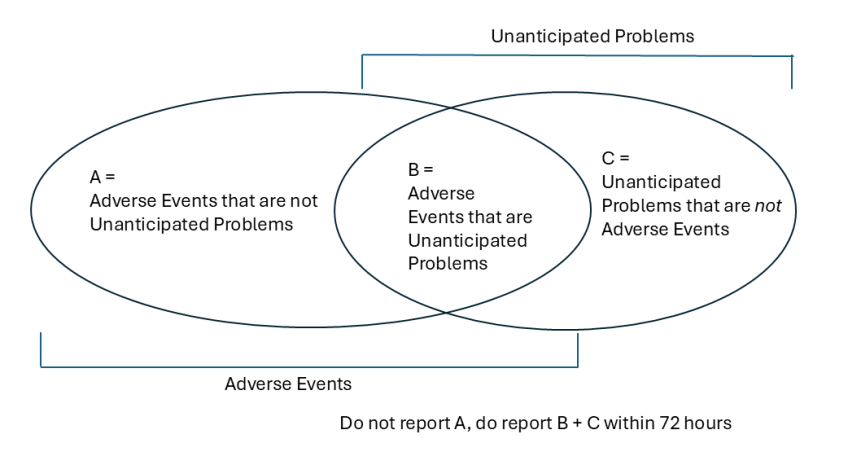
Not all adverse events need to be reported, but all unanticipated problems do. Upon becoming aware of an adverse event, the Investigator should assess whether the adverse event represents an unanticipated problem following the definitions outlined above. When an event is determined to represent an unanticipated problem, the study team is required to create and submit an Incident report in Cayuse Human Ethics.
The following diagram was extracted from OHRP’s “Guidance” on what does and does not need to be reported.
Reporting Timelines
When an adverse event that is both serious and meets the criterion for an unanticipated problem, the study team must notify the IRB immediately upon discovery (within 72 hours). Any other unanticipated problem should be reported to the IRB immediately upon discovery (within 72 hours) of the Investigator becoming aware of the problem. Adverse events that are not serious may be tracked by the study team and reported to the IRB at the time of continuing review.
IRB Responsibilities Following Receipt of Unanticipated Problem Report
The report is reviewed by one or more experienced IRB members (typically including the Chair) and a decision is made as to whether or not the report should be presented and discussed at a convened meeting. If so, the IRB Chair will notify the Institutional Official and the event may be reviewed by the IRB at a convened meeting. If an event poses serious risk to the safety of subjects or others, the Chair or designated IRB subcommittee may immediately suspend the study before presenting the report to the convened meeting. If the IRB suspends or terminates a study due to an event, it must notify the Institutional Official, who in turn is responsible for making any required reports to the appropriate federal regulatory agencies. In cases where the reviewing IRB is not an Ohio University IRB, the Office of Research Compliance (ORC) will notify that IRB and reporting will be done following the terms outlined in the IRB Reliance agreement. In cases where a researcher has IRB protocols approved by more than one Ohio University IRB, the chair of the other board will be consulted prior to action being taken that would affect protocols approved by the other board.
If this unanticipated problem is a death or serious injury, ORC must notify the University’s Legal Affairs office immediately after it receives notification. If the unanticipated problem involves a breach of confidentiality of data that is covered by the Health Insurance Portability and Accountability Act (HIPAA), ORC will notify the University’s HIPAA Privacy Officer immediately after it receives notification.
It is the Investigator’s responsibility to make all required reports of adverse events to the FDA and/or sponsor. Investigators may have additional reporting responsibilities outlined in individual contracts that are not covered by this procedure.
Serious Adverse Events (SAEs) Occurring at Sites outside the Jurisdiction of an Ohio University IRB
In multi-site studies, Investigators are required to report adverse experiences that occur in subjects enrolled elsewhere (i.e., by non-University Investigators) only when the adverse event is both serious and meets the criterion for an unanticipated problem. However, sponsors often require that adverse events that do not meet these criteria be reported to the IRB, and the Investigator should do so. At the Chair’s discretion, review of these reports may be added as an agenda item at a convened meeting.
Data and Safety Monitoring Boards (DSMBs)
For multi-site studies in which a Data and Safety Monitoring Board (DSMB) is performing aggregate analysis of adverse events, the IRB must receive a copy of the DSMB report at the time of continuing review, or within 72 hours if new risks are identified.
Data and Safety Monitoring Plans (DSMPs)
The IRB or the research sponsor may require a research study to include a plan to ensure that relevant data are collected and assessed to monitor subject safety within the study. This plan is known as the data and safety monitoring plan (DSMP). Part of the DSMP may be the establishment of a data and safety monitoring board (DSMB), also sometimes called a “data monitoring committee” (DMC), to perform the evaluation procedures detailed in the DSMP. The group charged with implementing the DSMP—whether it is the research team, a DSMB or a DMC—must have adequate expertise to perform the analysis. DSMBs for multi-site studies are responsible for forwarding summary reports of adverse events to each IRB involved in the study.