VisCom professor receives legacy award for teaching and creative work
Commercial photography Professor Gary Kirksey was recognized by the Association for Black Journalists for a career that has combined professional photography with nearly four decades of teaching, mentoring and expanding opportunities for Black visual journalists.
October 1, 2026
Share:
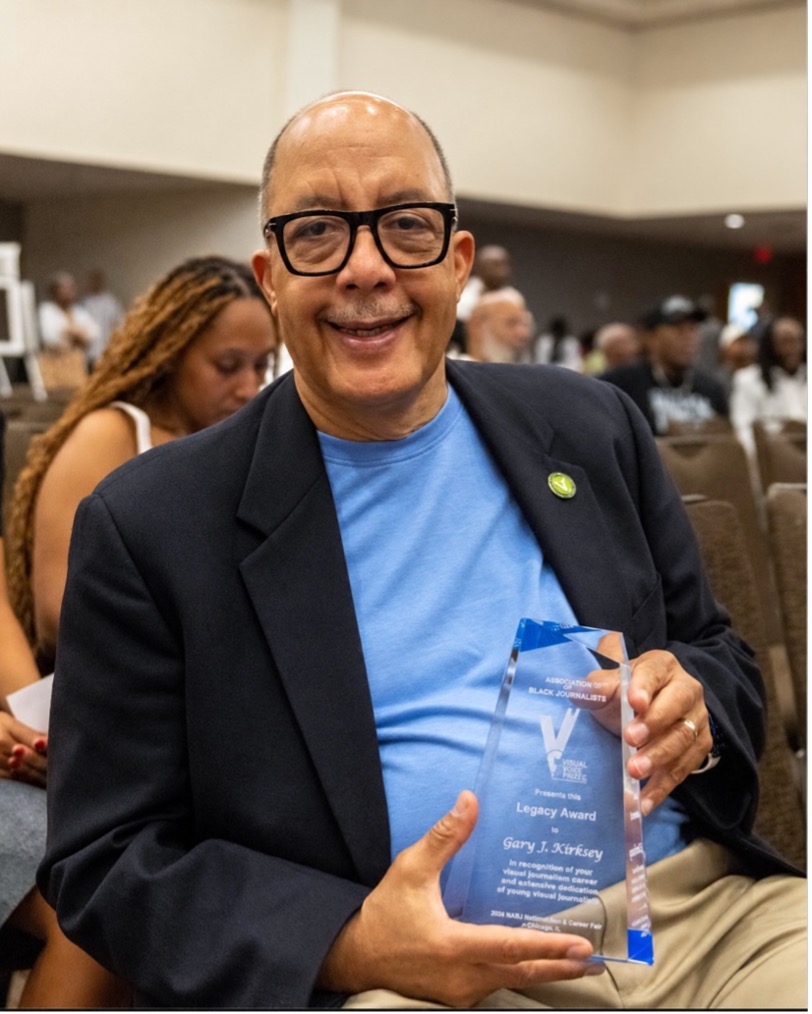
Gary Kirksey, a professor in OHIO’s School of Visual Communication, received the Legacy Award for lifetime achievement from the National Association of Black Journalists (NABJ) on August 15 at the 2026 NABJ Convention in Atlanta. The award was presented by NABJ’s Visual Task Force in recognition of Kirksey's visual journalism career and his extensive education of young visual journalists.
For Kirksey, the educational side of the recognition carries particular significance.
“The Legacy Award, I feel, means more to me about my efforts to educate young African American journalists within the field of photojournalism,” Kirksey said. “The number of students that I have helped recruit and then helped educate while they were in school, and now these alumni are not only journalists but also leaders within the journalism field, makes me extremely proud.”
The award adds to a career that has taken Kirksey from commercial photography studios to classrooms, exhibitions and professional organizations across the country. His photographs have appeared in publications including Life magazine and The Wall Street Journal, as well as in books such as “Committed to the Image: Contemporary Black Photographers.” His work has been exhibited nationally and is held in more than 40 public, private, and corporate collections in the United States.
From the darkroom to OHIO
Kirksey’s interest in photography began early. By seventh grade, he was processing black-and-white film and learning darkroom techniques. Throughout high school, he rarely went anywhere without a camera.
He later studied business at Miami University, where he worked for the student newspaper and yearbook and became the first Black photographer at The Miami Student. At the time, Kirksey said, he did not think much about being the first.
“Being active in the newspaper was just an everyday activity for me,” he said. “I just worked hard finding interesting photographs to accompany the stories I was asked to cover.”
Being one of the few Black students in a predominantly white environment was already familiar to him. He had attended a grade school where he was the only Black student.
“I learned to survive and thrive under those circumstances,” Kirksey said. “In fact, I think that’s a key to my success.”
After graduating from Miami, Kirksey worked in retail while deciding whether to pursue a career in marketing or photography. The creative side won.
A Miami alumnus who was studying at Ohio University invited Kirksey to visit Athens. The visit convinced him to enroll in OHIO’s graduate photography program, where faculty members Terry Eiler, Ed Pieratt and Chuck Scott helped shape his career.
Kirksey earned his master’s degree from Ohio University in 1982. He initially studied both photojournalism and commercial photography before gravitating toward commercial work, which complemented his business background and allowed him greater control over lighting and image-making.
Expanding opportunities in visual journalism
When Kirksey entered photography and higher education, he encountered relatively few Black photographers and professors.
He remembers Gordon Parks and Pulitzer Prize-winning photographer Moneta Sleet Jr. as important figures he could look to, but opportunities to meet Black professionals were limited. During college, Kirksey said he could count the African American professors he encountered “on one hand.”
Entering academia himself was daunting.
“I knew that I had something to prove,” Kirksey said.
At OHIO, Kirksey made recruiting African American students into visual communication an intentional part of his work.
“There was the perception that there were few or no professional African American photojournalists and commercial photographers,” Kirksey said. “This was completely inaccurate, but at the same time they were hard to be seen.”
University records from the early 1990s document the impact of those efforts. In 1991, VisCom enrolled 14 minority students, with the University crediting Kirksey’s work identifying and recruiting African American students interested in photo communication and photo illustration.
For Kirksey, representation was about more than increasing enrollment. As visual communication expanded into new areas, he wanted Black professionals to be among those “sitting at the table making decisions regarding how news and advertising is developed.”
His nearly three decades of involvement with NABJ provided another avenue for that work.
Through the organization’s Visual Task Force, Kirksey found a professional community of Black photographers. He later served as a Visual Task Force co-chair and used those connections to recruit students, mentor emerging professionals and bring Black photographers’ work to wider audiences.
Kirksey served as a regional coordinator for “Songs of My People,” a landmark photography book and exhibition involving Black photographers from across the United States. He also curated World Visions: Images of Contemporary Black Photographers at Ohio University, an exhibition featuring the work of 21 photographers, including World Press Photo and Pulitzer Prize winners.
Preparing photographers for a changing profession
In the classroom, Kirksey has emphasized not only creative and technical skills, but also the business knowledge students need to sustain professional careers.
“When I started, I was hoping to become a professor that not only stressed the technical and creative sides of commercial photography, but business aspects also,” he said.
The tools of photography have changed dramatically during Kirksey’s career, from film and darkrooms to digital photography and now generative artificial intelligence. Kirksey sees adaptation as part of the profession rather than a departure from it.
“The true leading professional is willing to embrace any new technical skills needed,” he said.
What has remained constant, he added, is the photographer’s ability to see, compose and make decisions.
“The compositional and personal vision from your brain has not changed.”
Kirksey applies a similar philosophy when evaluating students. Talent matters, he said, but drive, experimentation and the willingness to work through failure often matter more.
He pays particular attention to how students respond when an early assignment does not succeed and whether they continue working on personal projects outside class.
“I have had students that came in with experience or talent then attempted to coast in their first classes,” Kirksey said. “That is when I know if they will respond correctly to the challenge.”
A legacy built through others
Kirksey remains hesitant to describe his own career in terms of legacy, even after receiving an award bearing that name.
“Not sure I’m comfortable with that ‘legacy’ word yet,” he said. “I seldom wanted the spotlight.”
Instead, he hopes his former students remember the support he provided and the standards he expected them to meet.
“I hope people remember how I was supportive of their academic and professional careers,” Kirksey said.
He also hopes students remember being pushed beyond their first idea and being asked questions that forced them to understand the craft behind an image, including one familiar refrain: “What was your F-stop?”
Kirksey originally thought his teaching career at Ohio University would last only three or four years before he returned to the professional photography industry in New York City.
Instead, nearly four decades later, OHIO remains central to his life. It is where he developed as a photographer, built lasting friendships, taught generations of visual communicators and met his wife, Shirley. He jokes that his connection to Athens has become increasingly difficult to escape.
“The Athens veins are around my feet and now calves,” Kirksey said, “and it will be hard to cut free to leave.”