Image
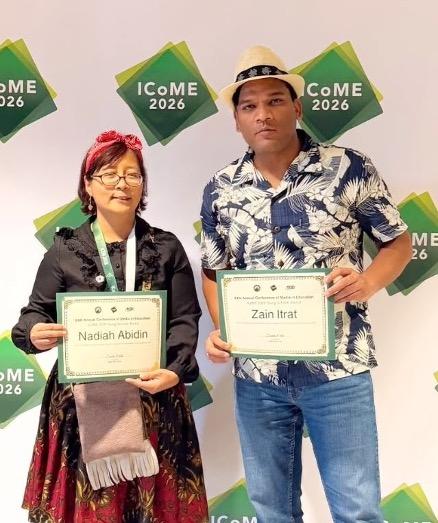
Ohio University doctoral students win Young Scholar Award at the University of Hawaii at Manoa in Honolulu.
September 11, 2026
Share:
Ohio University doctoral students Nadiah Abidin and Zain Itrat received the Young Scholar Award at the 24th International Conference for Media in Education, or ICoME 2026, held Aug. 6-8 at the University of Hawaii at Manoa in Honolulu. Abidin and Itrat were recognized for research exploring how generative artificial intelligence can help preserve and communicate cultural heritage. They presented the roundtable “From Prompt to Practice: A Collaborative Roundtable on Improving Generative AI for Cultural Storytelling” and the research paper “Human-AI Co-Creation for Heritage Educational Media: A Practice-Based Design Research Study.”
“It was such a nice surprise to be announced as the winner of the Young Scholar Award alongside my fellow graduate student Zain Itrat,” Abidin said. “The idea behind both our roundtable and full paper revolved around the use of generative AI for heritage preservation.”
Their research grew in part from work they began in Adonis Durado’s “Generative AI for Storytelling” course in Scripps College of Communication, which is offered each spring. The course explores AI-assisted visual communication, multimodal storytelling and human-AI creative collaboration. Its AI-first teaching approach was named a runner-up in the 2025 Design Incubation Design Educators Awards.
Abidin, a Fulbright student from Indonesia, said the course gave them technical tools and practical experience that helped shape the project.
“I am personally grateful for the teaching of Adonis Durado, who not only gave us a range of tools to create multimodal cultural outputs that included a graphic memoir, a history-based storybook and a film trailer, but also real-life skills that we can utilize throughout our endeavors as learners and creators in the field of media,” she said.
Itrat said the course’s combination of academic study and hands-on experimentation helped turn classroom work into scholarly research.
“It was an extremely enriching experience taking the Generative AI for Storytelling class,” Itrat said. “What made the course especially meaningful was the way it brought together a strong academic foundation with hands-on practice. In media, scholarship should not only theorize about emerging technologies; it should also involve making, testing, experimenting and producing work that helps us understand what those technologies can actually do.”
He added that working directly with generative AI deepened their understanding of both its possibilities and its limitations.
“Learning generative AI by working with it gave greater depth to our understanding of its possibilities and limitations in real-world contexts,” Itrat said. “That combination of rigorous research and practical making ultimately led to this paper and then to the award.”
The award-winning research focuses on Tablertown, a historically significant multiracial community in Appalachian Ohio. Abidin and Itrat combined archival research, genealogical records, museum collections, scholarly sources and oral history with AI-assisted storytelling.
They created three educational works: a graphic memoir about preserving Tablertown’s history, a historical storybook about Michael Tabler, Hannah and their descendants, and a cinematic trailer that uses AI-assisted visuals, animation, narration and music. Their research found that generative AI can expand creative possibilities and accelerate multimedia production, but human judgment remains essential. Researchers must verify historical details, preserve cultural authenticity and consider how communities are represented.
“The learning process has become a powerful means to support communities in presenting accurate imagery with the assistance of AI,” Abidin said.
Abidin and Itrat also developed a Human-AI Heritage Communication Model. The framework is designed to help educators, museums, archives, libraries and community organizations use generative AI responsibly to communicate local history and cultural heritage. Abidin said the project has already created opportunities beyond ICoME.
“I have been asked to collaborate and speak at several universities thanks to these presentations,” she said. “It speaks volumes about what can be accomplished when we embrace the new reality in which humans and machines coexist and collaborate in the best ways we can imagine.”
ICoME is an international conference devoted to research and innovation in educational media and technology. The 2026 conference brought together researchers, educators, graduate students and practitioners from Asia, the Americas, Europe and other regions under the theme “Learning with Purpose: Building Futures Through Care, Connection, and Innovation.” Now in its 24th year, ICoME is jointly organized by the Korean Association for Educational Information and Media, the Japan Association for Educational Media Study, the Chinese Association for Educational Technology and the Teaching, Colleges, and Community consortium in the United States.
Abidin and Itrat are doctoral students in the Media Arts and Studies program in the Scripps College of Communication. Their recognition shows how classroom experimentation with emerging technologies can develop into research with international reach while addressing larger questions of accuracy, ethics and human responsibility in AI-assisted communication.