Image
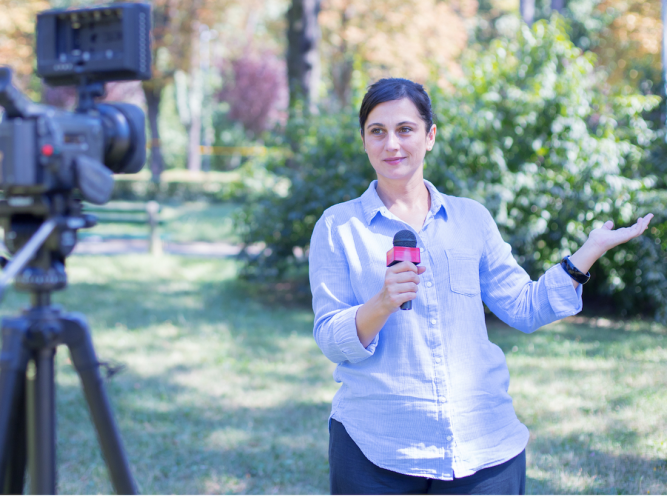
You build a journalism portfolio in a fully online program through faculty-reviewed coursework and a supervised professional internship. Your strongest class assignments, revised with instructor feedback, form the foundation. Internship work adds pieces that a professional editor or supervisor has approved. In Ohio University's online Bachelor of Science in Journalism, you complete both while living anywhere, including a required internship of at least 200 hours that you can arrange in your own community.
Ohio University's E.W. Scripps School of Journalism offers its Bachelor of Science in Journalism in a fully online format, known as the Carr Van Anda program. Students customize their course of study for careers in news reporting, magazine or online journalism, public relations and advertising.
The E.W. Scripps School of Journalism is accredited by the Accrediting Council on Education in Journalism and Mass Communications (ACEJMC). ACEJMC evaluates journalism programs on curriculum, internships and student learning outcomes. Accreditation signals that a program is measured against national standards for preparing journalists.
A degree remains the standard entry point into the field of journalism. The U.S. Bureau of Labor Statistics (BLS) reports that news analysts, reporters and journalists typically need a bachelor's degree in journalism, communications or a related field. BLS also notes that employers generally prefer candidates with internship or student media experience.
Your first portfolio pieces usually come from class. In reporting and writing courses, you interview sources, verify facts and revise your work based on faculty feedback. Each revision moves a class assignment closer to professional standards.
To turn coursework into portfolio material:
Some students also self-publish a few pieces, such as on a personal website. If you do, choose well-researched work that a faculty member or a trusted group of peers have reviewed. A small number of carefully vetted pieces will serve you better than many unedited ones.
Every journalism major in the E.W. Scripps School of Journalism must complete at least one internship before graduating. The internship must total at least 200 contact hours with one employer, and a faculty mentor approves it in advance. Internships may be paid or unpaid. When it ends, you submit an internship report, and your supervisor submits an evaluation.
Online students do not need to live near the Athens campus to meet this requirement. You can work with a faculty mentor to find a placement close to home. Scripps College helps students find more than 3,000 internships a year.
The right internship depends on your career goals. Common options include:
In each setting, a professional supervisor edits and approves your work before it is published. That review makes internship work credible portfolio material. Before you start, ask your supervisor whether you may include your work in your portfolio.
Professional organizations give online students access to training, networking and industry standards from anywhere. Several offer student memberships:
While SPJ covers journalism ethics and practice broadly, ONA concentrates on digital media and IRE on investigative and data skills. Choose the organization that matches the kind of work you want in your portfolio.
A strong portfolio is selective. Choose eight to twelve of your best pieces and organize them by type or topic.
Most journalists keep a personal website with links to their work, a short bio and a résumé. Platforms like Muck Rack also offer free journalist profiles with a portfolio section. Save a PDF copy of each published piece, since online links can break or move behind paywalls.
Studying online does not mean building your portfolio alone. In Ohio University's online Bachelor of Science in Journalism, faculty feedback shapes your coursework, and a supervised internship adds professionally edited work. You graduate with an accredited degree and a portfolio that shows employers how you report, write and work with editors.
The best time to start is your first semester. Save your strongest assignments, ask for feedback early and begin planning your internship well before you need it.
To explore courses, admission requirements and how the program fits your schedule, visit the Ohio University online Bachelor of Science in Journalism page or contact OHIO Online.