Image
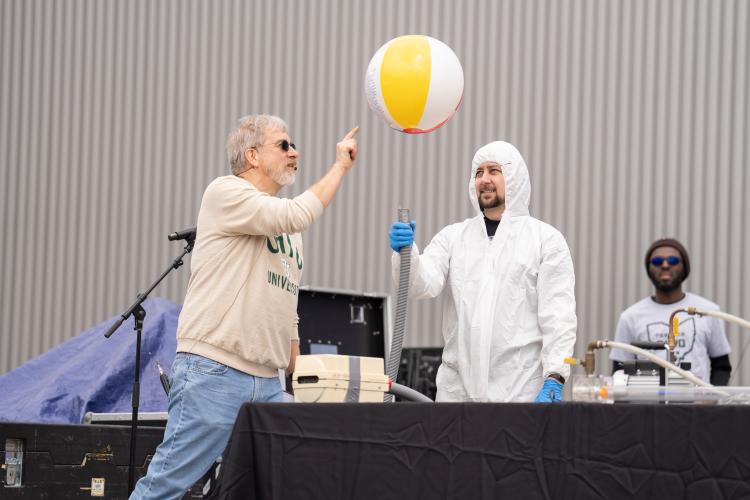
Two Ohio University physics professors turned beach balls, smoke machines, and ping-pong ball launchers into family-friendly science demonstrations at the largest STEAM event in the state: the Center of Science and Industry’s Science Day in early May.
Dr. Mark Lucas and Dr. Eric Stinaff, backed by Intel sponsorship and a team of 10 students and staff, demonstrated “The Power of Air,” explaining the critical role of air pressure and vacuums in semiconductor manufacturing. The only hurdle was to make those concepts accessible to children as young as seven.
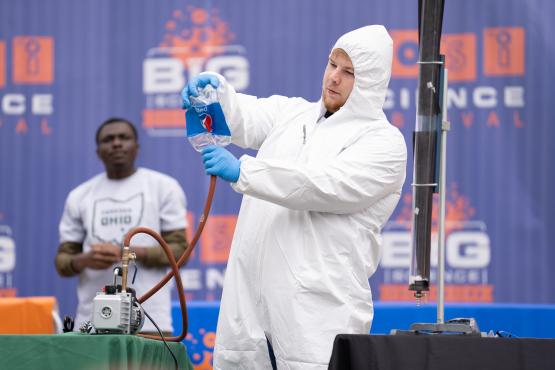
COSI Science Day is the biggest STEAM event in Ohio. The event is comprised of a four-day collaborative celebration designed to help the general public understand how science, technology, engineering, art and math influence daily life and create career opportunities. According to Alan Goss, director of the festival, the goal is particularly urgent.
“Ohio faces a significant STEAM skills gap. There’s a lot more jobs than there are people to fill them,” Goss said.
The gap showed itself much closer to home when Intel announced plans to build a chip manufacturing plant outside Columbus. With insufficient local talent to fill positions, Intel partnered with universities like Ohio University to introduce young people to semiconductor work and the crucial role of air pressure and clean environments in that field.
The OHIO team had a 20-minute mainstage exhibit which drew roughly 100 children and adults. Team members donned dust-free “bunny suits” while explaining why Intel’s computer components require ultra-clean, airless environments where even a single speck of dust can ruin production.
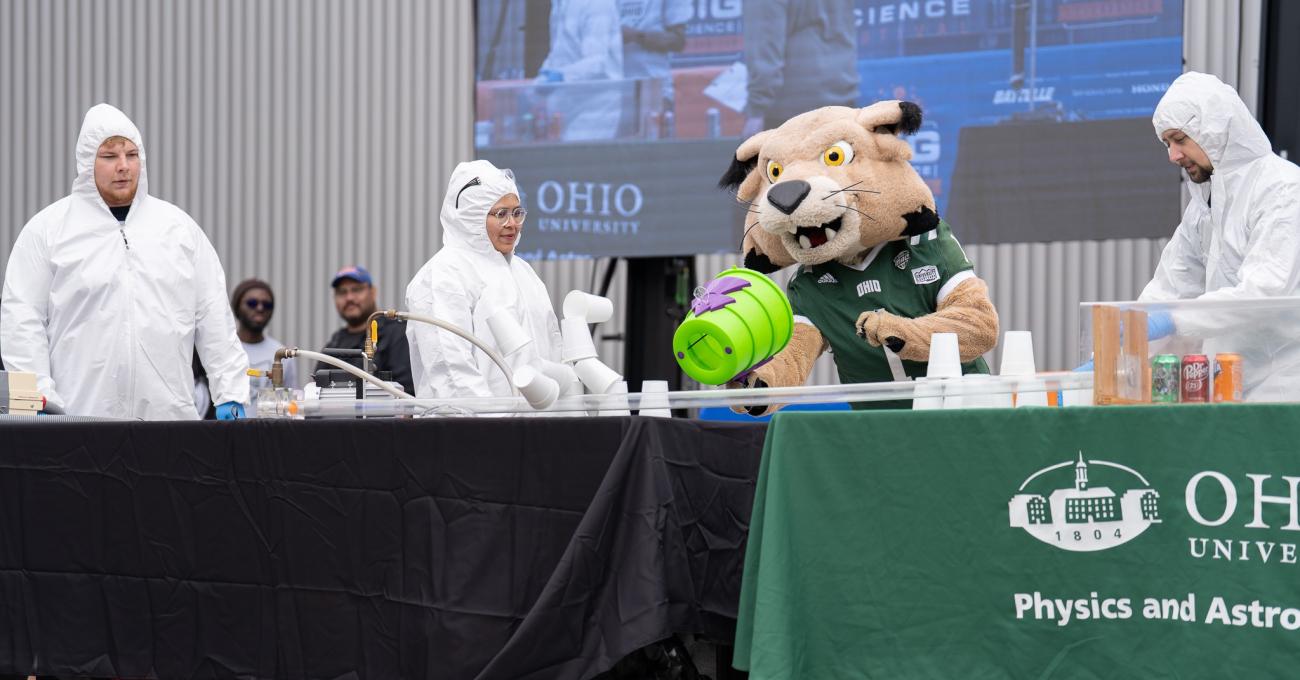
Illustrating these concepts visually, Rufus the Bobcat poured smoke into an enclosure. Students then watched the power of vacuum pressure in real time clean the air, very similar to Intel’s real-world practices.
The centerpiece of the show was a ping-pong ball launcher made from a clear plastic tube and ordinary kitchen tape. Using vacuum pressure, the device propelled a ping-pong ball to nearly the speed of sound, blasting clean through two soda cans.
In preparing for the event, the team discovered Ohio University had no t-shirt cannons. As true creators, they fabricated their own from scratch, using the same air pressure principles from their demonstration of course. When the t-shirts blasted out of the cannons, the audience swelled in size even more.
“Part of what helps the connection is that we really had a lot of fun presenting the show,” Lucas said. “We find that’s always contagious - when we’re having fun, so does the crowd.”
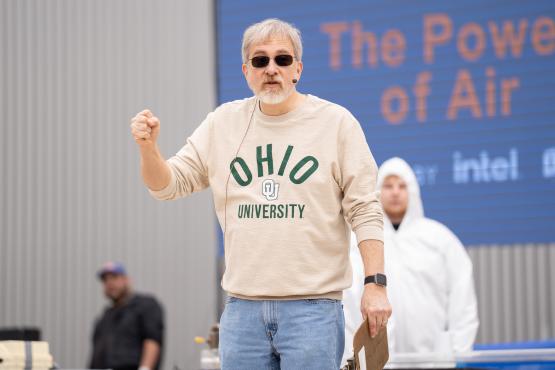
Stinaff said the OHIO team was grateful for the opportunity to be a part of the event.
“We were happy Intel asked us to do this. We had a fun time…getting this information out there and helping people learn about semiconductor advanced manufacturing,” Stinaff said, crediting the Intel partnership and emphasizing that the event’s success depended on contributions from student interns and every team member.
Goss emphasized that COSI’s mission extends far beyond job training.
“You hear people say, ‘I’m not a math or a science person,’ and well, you just haven’t found a way that you find it interesting yet,” he said. “And as soon as you do, you’ll stop thinking of yourself as ‘not’ these things.”
Data from festival attendees show that a significant portion leave wanting to learn more about something they encountered through COSI’s event.
For Goss and the entire team, the most rewarding part is making science feel accessible enough that curiosity takes root.
For more information on Ohio University’s physics program, and the wide range of career opportunities it provides to students, see the Physics and Astronomy Department website.