Tackling the data: How OHIO Football uses tech to improve training and technique
How do OHIO Football coaches and players get a window into the work that is happening on the field? Thanks to insights from sports GPS tracking technology, data about how fast a receiver is running routes to whether a player returning from injury has hit his target speed is just a screen tap away.
Photos by Charley Szydlyk | June 16, 2026
Share:
In a single football practice, coaches and players have lots of opportunities to improve their game, from sprints and routes to position drills and conditioning work.
Thanks to GPS tracking devices worn by players during training and games, OHIO Football’s performance staff can measure speed, workload, intensity and high-speed distance. The data gives coaches another tool to guide training and gives players a clearer sense of how they are performing.
The palm-sized GPS units are worn in a training vest during practice or in a shoulder-pad pouch during games. Coaches and players alike use the data the devices provide to ask better questions and get a clearer picture during training and competition.
For Noah Spielman, OHIO's associate director of football performance, the value of the technology is that it helps the staff put numbers to things coaches and players already talk about every day: How much work did a player do? How hard was that work? How fast was he moving? Is he building toward the level he needs to reach?
“Volume and intensity are everything in training,” Spielman said.
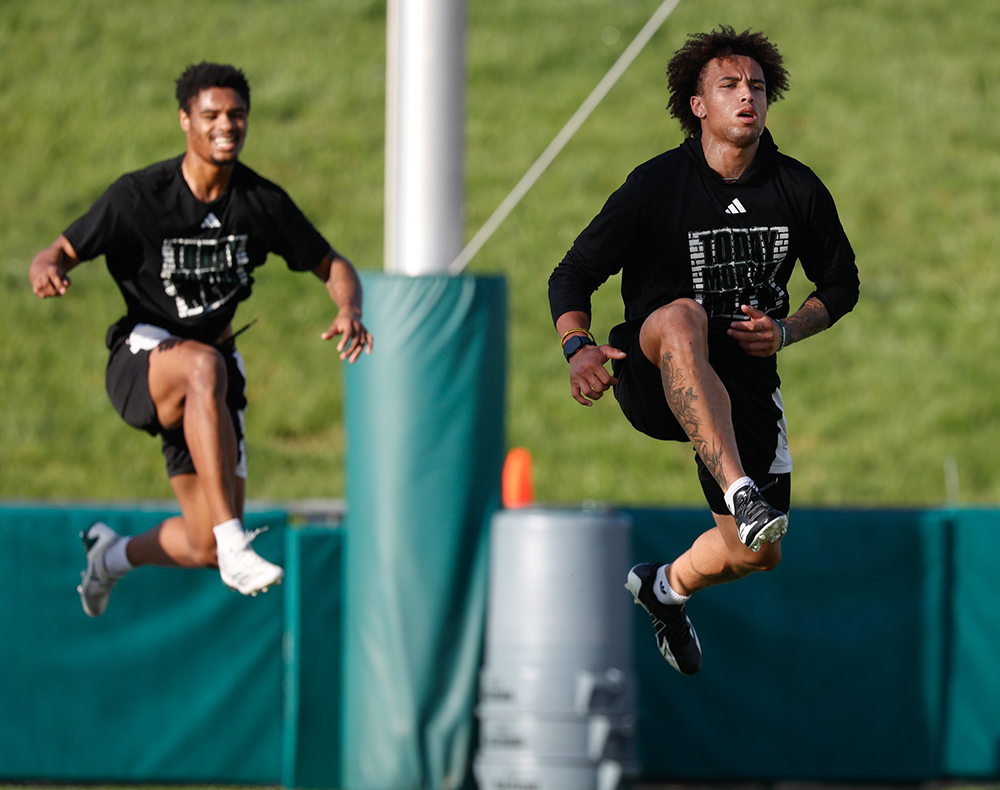
Wide receivers Khamani Debrow, left, and Dom Dorwart, right, leap during an outdoor OHIO football practice drill.
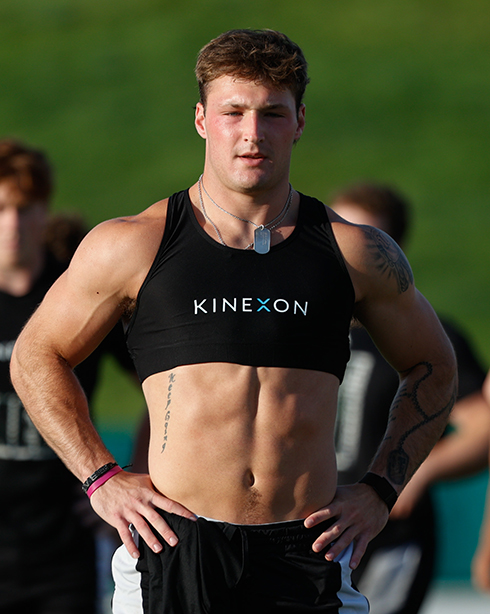
Linebacker Michael Molnar stands on the field during OHIO football practice. Players wear GPS tracking units during training and games to help the performance staff measure workload, speed and intensity.
What GPS tracking measures on the field
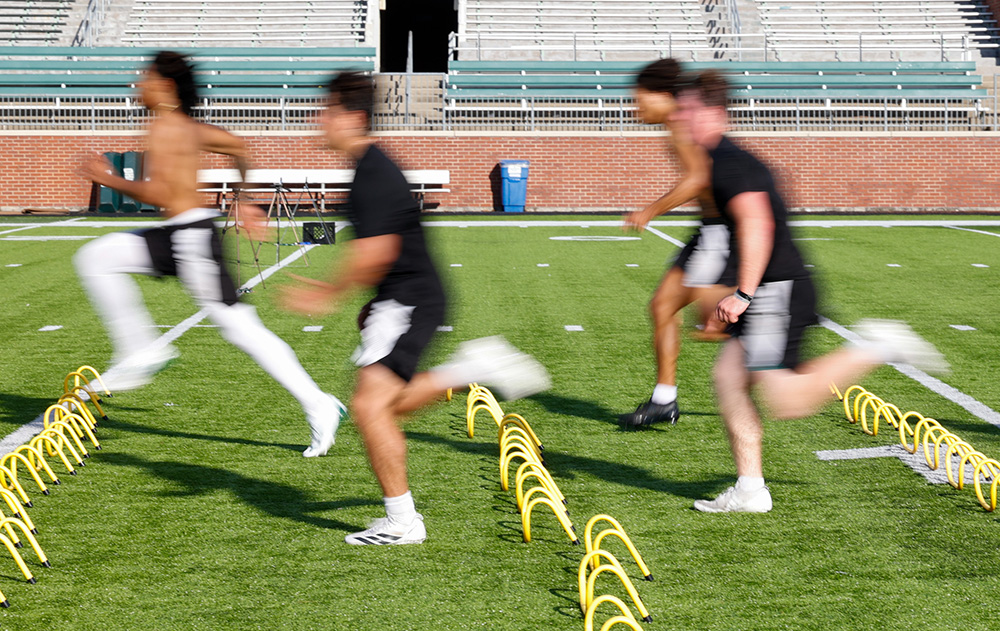
Sport performance specialists refer to “volume” as the amount of work a player completes. Intensity is how demanding that work is. During a football practice, two players might both be on the field for the same amount of time, but they may not experience the practice the same way. A receiver sprinting routes, a lineman working through repeated contact and a quarterback moving through plays all have different physical demands.
The GPS trackers help OHIO’s football performance staff better understand that work. Spielman said the staff pays close attention to a few key areas, including total workload, how intense the work is, top speed and how much distance a player covers at higher speeds.
"We like being able to see where guys are at in real time," Spielman said.
That information can help players and coaches make the most out of a practice. In addition to observation and feel, coaches can look at the data and see whether a player’s workload was higher or lower than expected, whether they reached the speed range the staff wanted, or whether the team is building appropriately over time.
There are many numbers the system can provide, but Spielman said the goal is not to get lost in every possible data point. Instead, he and head strength and conditioning coach Tyler Shumate focus on the measures that matter most to the program.
“You try to pick four things or five things or whatever it might be to single in on,” Spielman said.
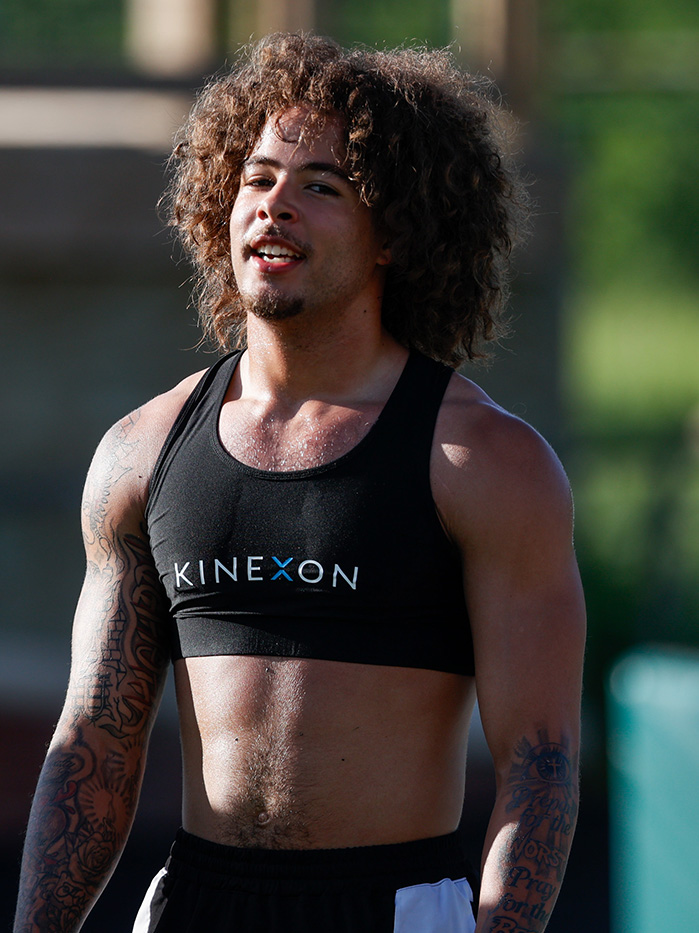
Safety DJ Walker stands on the field during OHIO football practice. The team’s GPS tracking system gives coaches and players another way to evaluate performance during training and games.
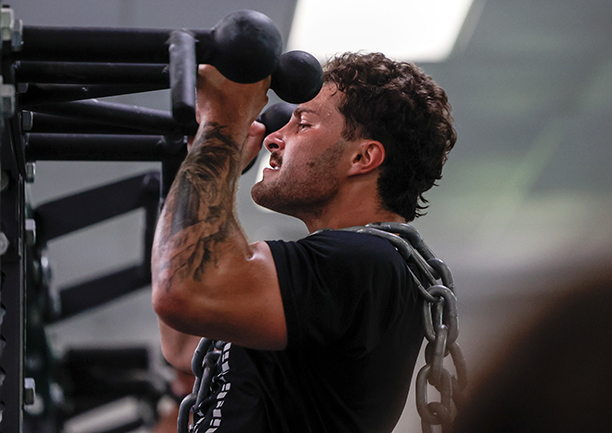
Linebacker Charlie Christopher works through an indoor weight training session as part of OHIO football’s strength and conditioning program.
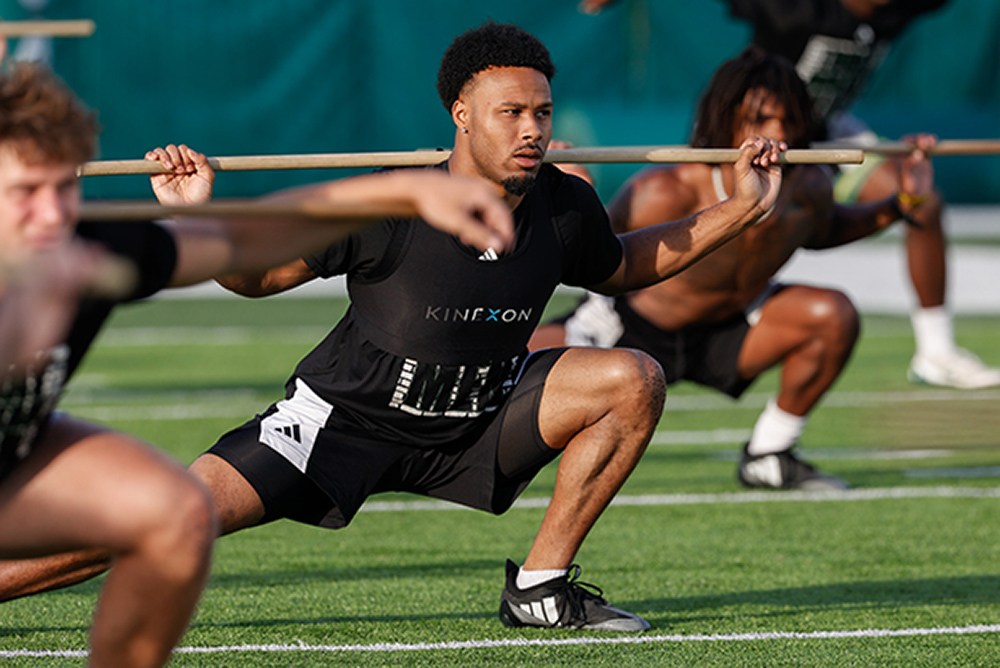
Defensive back Ronald Jackson Jr. works through an on-field strength exercise during OHIO football training.
Watching the data in real time
The trackers can be used during summer training, practices and games. Throughout practice, Spielman can view data on an iPad or laptop. That means the staff can see, for example, whether a player hit a certain percentage of his top speed during a sprint or how much total work he completed in a session.
The information also becomes part of the team’s daily feedback. Spielman said the staff regularly shares top speeds with players, sometimes breaking them down by position group. On max-velocity training days, when players are expected to sprint at full speed, those numbers can bring out friendly competition.
“It drives intent from the guys,” Spielman said. “It’s just fun for them to see too, like, ‘Oh, who’s fastest?’”
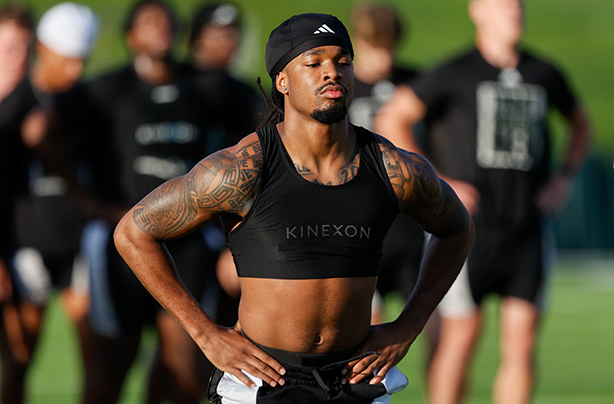
Cornerback Kendall Bannister takes part in OHIO football practice wearing a GPS tracking unit, one of the tools coaches use to better understand player movement and training demands.
What players see in the numbers
For players, the data can make progress easier to understand.
Dom Dorwart, a wide receiver majoring in psychology with an emphasis in sport psychology, said the tracker helps him assess both his workload and his growth.
“For me, personally, it shows me how much my workload is and also where I am improving in my velocity in certain drills and just in football play altogether,” Dorwart said.
Dorwart said the technology gives players numbers they can use to shape their training. It can help show where a player is improving, where he may need more work and how his body is responding over time.
“I definitely think that the GPS tracker enhances the way we perform because we have the data and numbers, which you cannot argue with, to use in furthering training regimens and tailoring the workout to the strengths and weaknesses of players,” Dorwart said.
That does not mean every decision is outsourced to the device. Spielman said the trackers are useful because they put objective numbers behind what coaches are already seeing on the field.
“At the end of the day, these GPS units are a great resource for us to ask really good questions,” Spielman said.
Those questions can help the staff decide whether the team is progressing appropriately through training. Spielman said the performance staff can compare current workloads with previous periods, such as training camp or summer workouts, to see whether players are on track for the demands ahead.
The numbers may show that the staff needs to increase intensity or extend the duration of a workout. Other times, they may show that the team needs to pull back.
“Sometimes you look at [the data] and you’ve got to tone it down,” Spielman said. “It goes both ways.”

Linebacker Cody Raymond takes part in OHIO football practice. The GPS units help the football performance staff put numbers behind what coaches are already seeing on the field, including workload, intensity, speed and high-speed movement.

Linebacker Jack Fries runs during OHIO football practice. Top-speed data gives players a concrete way to see progress, and Spielman said players often ask what speed they hit during a route, sprint or game.
Supporting injury recovery and return to play
The technology can also support conversations around recovery and return to play. Spielman said the data can be especially helpful when athletic trainers are working with players returning from soft-tissue injuries, such as hamstring injuries. If trainers want a player to run at a certain percentage of his maximum speed, the staff can use the tracker to confirm whether he reached that target and share information such as load, speed and distance covered.
While the data does not replace the work of athletic trainers, strength coaches or position coaches, it adds a welcome layer of individual player performance.
Noah Spielman describes the technology as “a great resource for us to ask really good questions,” not as a replacement for coaching experience.
Keeping the data in context
That balance is important to how OHIO uses the technology. The GPS trackers can show a player’s top speed, workload or high-speed distance, but coaches still have to interpret what those numbers mean in context. A number might confirm what a coach saw during practice or it might prompt a follow-up conversation with a player.
Dorwart said fans might be surprised by how much thought goes into the team's behind-the-scenes training. He said the trackers offer a glimpse into the commitment that happens away from the “flashy plays and the big wins.”
“I feel like the everyday work we do to be successful on the field isn’t always shown or perceived in the same way we see it,” Dorwart said.
Spielman sees that same commitment in the way players respond to the data. Players often ask what speed they hit during a route, a sprint or a game. Some ask when they can wear a unit. The feedback gives them a number to connect with the work they are putting in.
Still, Spielman is careful not to overstate the technology. The trackers are a tool, not the foundation of the program.
“You don’t have to live and die by it,” Spielman said.
For OHIO football, the GPS units help make parts of the game more visible. They show how fast a player moved, how much work he handled and how his body responded. They give coaches another way to guide training and give players another way to understand their progress.
Spielman said OHIO’s players are already wired to train hard and do what is asked of them. The technology is a boost to help the staff and athletes see that work more clearly.
“That’s just the culture of Ohio football,” Spielman said. “It’s super special."