Image

When Jeff Kuhn steps off a plane in Morocco, Saudi Arabia or Mongolia, he isn’t just representing himself. He is representing Ohio University and a global community of educators trying to make sense of rapid technological change.
Kuhn, who directs OHIO’s esports program, is one of roughly 200 experts selected each year for projects with the U.S. Department of State’s English Language Specialist and U.S. Speaker Programs. The two initiatives tap leaders in education, technology and cultural exchange to deliver trainings, workshops and public diplomacy programs in more than 80 countries. The specialist program includes about 800 experts worldwide, although only a fraction are chosen for assignments in any given year.
“It’s really about shared understanding,” Kuhn said. “No matter where you are — Bolivia, Madagascar, Japan — you realize quickly that we’re all wrestling with the same questions about education and technology. You walk in expecting barriers and instead find a group conversation.”
Kuhn’s expertise sits at the intersection of educational technology, gaming and artificial intelligence. He has delivered talks, workshops and keynotes in 24 countries, engaging thousands of educators and students. His sessions range from introductory AI literacy to in-depth conversations about cultural uses of AI, game-based learning and the future of technology in classrooms.
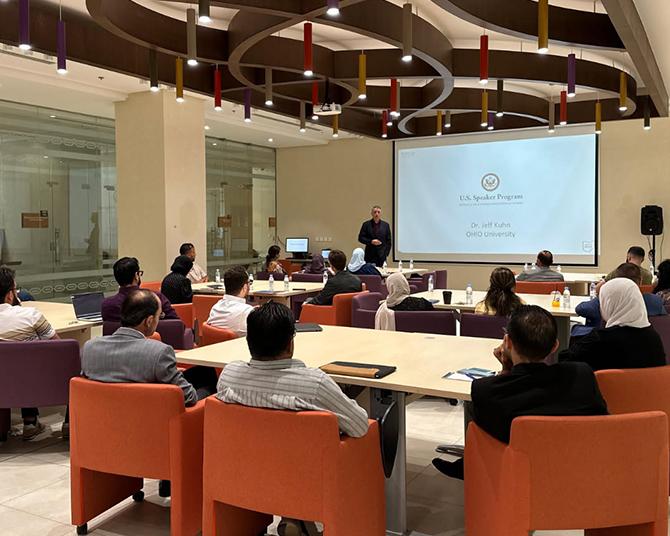
As a State Department speaker, he recently traveled to Saudi Arabia to discuss AI’s cultural, academic and economic implications. As a specialist, he spent time in Morocco, visiting five cities on a single assignment and tailoring workshops to groups with widely different levels of experience.
“In one room you may be introducing educators to the basic concepts of AI,” he said. “In the next, you’re talking to people who want advanced applications. It becomes less about lecturing and more about collaboration.”
Some work is highly practical, such as helping educators adopt interactive platforms like Kahoot. Other projects address broader challenges. Through one embassy partnership, Kuhn helped respond to a regional education need with a creative solution: a solar-powered “school in a box,” a portable, energy-independent unit that brought digital learning into areas with limited infrastructure.
“You never know what you’re walking into,” he said. “But that’s the rewarding part.”
Kuhn’s professional path has never been linear. Before earning his master’s degree in linguistics and his Ph.D. in educational technology, he served in the Peace Corps in Mongolia, an experience he says continues to shape how he approaches culture, language and learning.
His dissertation examined problem-solving and distributed cognition among online gamers, and his research since then has focused on how people behave and learn in digital environments. At OHIO, he leads the university’s esports program in the Scripps College of Communication and teaches an annual seminar on esports, and has taught classes on world-building, and new media storytelling.
In recent years, Kuhn has become increasingly recognized for his work in artificial intelligence education. His master class on generative AI, originally created for international educators, is now available on YouTube.
“The international work keeps me on the cutting edge,” he said. “Seeing how educators elsewhere use technology helps me rethink what we can do back on campus. It feeds directly into my work in esports and in the classroom.”
For Kuhn, the value of the State Department programs extends far beyond professional development.
He recalls a trip to Venezuela during a period of heightened political tension between the United States and the Venezuelan government. He expected resistance but instead found openness, and a clear reminder of what these exchanges are designed to do.
“You recognize quickly that the politics don’t define the people,” he said. “It becomes about listening, understanding and sharing ideas about teaching and technology. That experience stays with you.”
Those experiences follow him home as well. When international students from Turkey or Brazil walk into OHIO’s esports arena, Kuhn already understands the music they grew up with, the games they play and the stories they tell.
“It helps me build connection,” he said. “Something as simple as playing music from their home country can make a student feel seen.”
And for OHIO, Kuhn says, the benefit is clear. “It shows that our university is part of a global pool of experts. When I’m out in the world teaching AI or game-based learning, I’m carrying our name with me.”
Kuhn already has his eye on future assignments. At the top of his list is Ukraine.
“The way educators there have adapted during active conflict, and the technology solutions they’ve built just to keep teaching, is extraordinary,” he said. “There’s so much we could learn from one another.”
Wherever he goes next, his philosophy remains steady: technology looks different in every culture, but the drive to teach, learn and innovate is universal.
“At the end of the day, it’s about understanding,” Kuhn said. “Not assuming what people know or what their cultural expectations are, but learning together. That’s what keeps me doing this work.”