Image
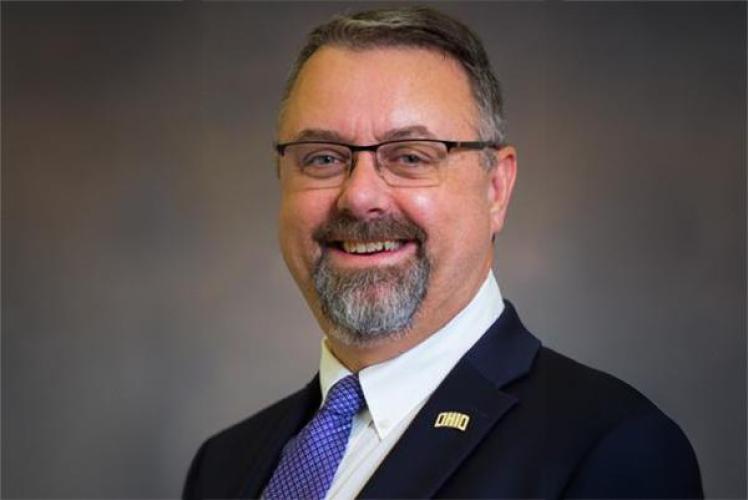
Scott Miller
From environmental stewardship to a leadership position as a key industry liaison, Scott Miller’s decades-long service to Ohio University has covered the gamut of the institution’s vital role in advancing the interests and needs of the Appalachian region.
As associate dean for industry partnerships and outreach at the Russ College of Engineering and Technology, Miller is one of the University’s go-to officials for fostering public-private partnerships with a range of industries.
Those duties are an outgrowth of his experience working at OHIO’s George V. Voinovich School of Leadership and Public Service and reflect how career paths can often take unexpected twists and turns.
After graduating from Wright State University with a Bachelor of Science, Secondary Education degree with an emphasis in biology, Miller embarked on a short detour into teaching chemistry and physical science in the Huber Heights City School District.
That multidisciplinary background aided in his decision to apply to OHIO’s Master of Science in Environmental Studies program. His thesis was informed by a graduate internship with the Nature Conservancy’s Gap Analysis program to build habitat suitability models to predict the presence of rare and endangered species.
Based upon lessons learned from that program, Miller built a model for the reintroduction of river otters in Ohio, which independently validated the Department of Natural Resources’ reintroduction sites. While the research project doesn’t really scream “industry partnerships,” it did prepare him for early work on watershed planning which became a central program focus for the Institute for Local Government Administration and the Rural Development (ILGARD), the precursor to the Voinovich School.
The growth of the watershed team led to a new opportunity: leadership of the Consortium for Energy, Economics and the Environment (CE3), a multi-disciplinary applied research unit made up of more than 40 researchers from six colleges.
With strategic funding from the Office of Research, CE3 tackled complex challenges including writing the first statewide energy strategy in more than 20 years in cooperation with the Office of Senator George Voinovich, the state’s first climate action strategy, environmental, economic and social assessments of the Marcellus shale boom in the region, and many more research studies. CE3’s primary mission was to study the complex interactions between SE Ohio’s extractive economies and the economic and environmental consequences that are disproportionately borne by the region.
“We looked at the region’s economy and saw a common theme – a history of resource extraction,” he said. “Whether it be coal, oil, gas, timber, clay, steel – any natural resource that could be taken out of the region was done so and shipped off to other places to grow their economies. What was left here was environmental degradation that needed to be mitigated and taken care of.”
“What we realized is, what we’re talking about is a system providing benefits for some, costs to others. So we’ve got the environment, economics and energy all intertwined,” Miller added.
Miller led that group for almost 15 years before moving his skills across campus.
“The work we did, the partnerships I helped nurture, and the impact we made with that work through the Voinovich School prepared me nicely for the work over here at the Russ College of Engineering and Technology,” Miller said.
“I still stay connected to all my work in that area but being in the dean’s office over here I’m looking at those kinds of partnerships, both inside and outside the institution, in service to the Russ College of Engineering and Technology,” Miller continued. “These days I’m focused on everything from aerospace and defense-related work to automotive and manufacturing – lots of different kinds of technologies.”
That work included serving as point person for industry attraction at the former Russ Research Center in Beavercreek. OHIO maintains a presence in the area by currently sharing a facility with the University of Dayton Research Institute in downtown Dayton. During his time at the Research Center, Miller has worked extensively with contractors linked with Wright-Patterson Air Force Base and the surrounding communities. His continuing duties also include working with Intel, Kenworth, Anduril Industries and other existing and emerging businesses in the state.
“Being in the dean's office, I try to carry the college’s portfolio now” with about 90 faculty members across eight research centers at the college, he said. He couples those researchers with relevant industries in public-private partnerships that benefit both.
“I can open doors. I'm a very good connector and bring the ability to form those connections to our faculty,” Miller said, adding his job entails a lot of travel and meetings.
The end results are “win-win” opportunities and identifying resources that benefit the colleges faculty and students and its external partners, the associate dean explained. “Those partnerships are everything from private sector corporations and industry to government agencies to non-profit organizations.”
A National Energy Executive through the U.S. Department of Energy’s National Renewable Energy Laboratory in Colorado, Miller currently serves on OHIO’s Corporate Engagement Task Force to improve industry-university relations. He serves on the advisory board for the Digital Transformation Center, and the AR/VR Association of Ohio. He previously chaired the University Clean Energy Alliance of Ohio
Miller said he maintains a love of the great outdoors that he fostered in his early academic days and enjoys traveling to national parks with his family, his next stop being Glacier National Park this summer.
When he finds time, he’s also an avid bicyclist who logs a couple thousand miles a year.