Image

Recent graduates with a Master of Science in Environmental Studies degree from OHIO’s George V. Voinovich School of Leadership and Public Service are seeing their academic work pay off quickly with jobs in the private sector.
In the cases of three of those alumni, that success has landed them positions with EMH&T, a venerable Ohio firm with 100 years of experience in a broad array of land surveying, civil engineering and related services.
Common threads for Senior Archeologist David Lamp, Environmental Scientist Cassidy Mollick and Water Resources Specialist Morgan Riddiford are not only the hands-on experience they gained while pursuing an MSES degree from the Voinovich School of Leadership and Public Service, but also the credit they gave to key mentors along the way.
Those experiences provided a leg up for their next step in pursuing related careers.
“We are strong supporters of advanced higher education programs and value the essential role they play in preparing skilled, dedicated professionals across a wide range of fields,” EMH&T President Sandy Doyle-Ahern said.
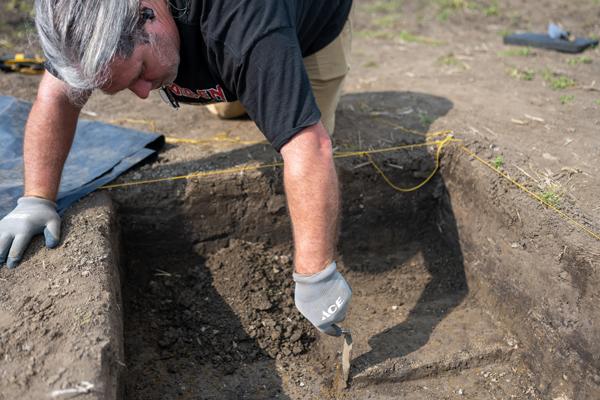
Lamp’s Voinovich School journey included a master’s thesis on Paleoindian use of wetlands as well as direct experience with OHIO’s Sociology and Anthropology Department doing field work for a wetland restoration compliance project required under state law.
That project, he said, included input from his master’s advisor, Associate Professor of Anthropology Joseph Gingerich, and Director of Environmental Programs Jennifer Bowman.
“It was one of those serendipitous things but was a direct result of the Voinovich School. It allowed us to better train students in archeology and do what they’re going to do in the real world,” Lamp said.
While that work was rewarding and educational, getting his MSES “was the key” to launching his career, he said.
“That frees you up to do all the things – writing and submitting the reports, running the field work. It really makes you more useful to a company," Lamp said.
His work at EMH&T has included advanced research and investigative reports on whether sites eyed for development qualify for inclusion in the National Register of Historic Places – work he described as a rare opportunity for archeologists in the field.
“That eligibility is really what drives all of our work in contract archeology,” Lamp said. “We get to do that and it’s super rare.”
He cited those opportunities and the company’s culture as reasons EMH&T is a great place to work.
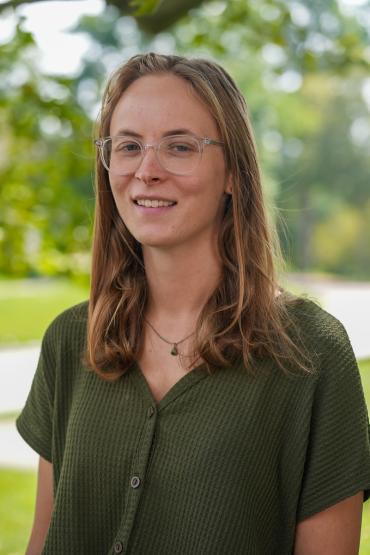
Riddiford landed a position with EMH&T last year after obtaining her MSES degree. She works in the firm’s Water Resources Division.
“My experience at Ohio University working with engineers as a graduate assistant in the Office of Sustainability Infrastructure Hub helped me a lot with my current job, as I work mostly with engineers on a day-to-day basis,” she said.
Riddiford said the Geographic Information Science certificate she earned at OHIO “opened the door to many opportunities and was one of the key reasons that I am in the position I am now as a water resource specialist.”
Mastering the ArcGIS Pro program helped her learn other complex computer programs such Civil3D, which she frequently uses at her job.
“My foundation in ArcGIS has made it easier for me to pick up on using Civil3D much more quickly than I could have without the background in GIS,” she said.
Riddiford said two OHIO advisors in particular helper her along her OHIO journey: Associate Professor and Curriculum Chair Gaurav Sinha and Director of Sustainability Sam Crowl.
Sinha, her GIS professor for two courses, “taught me a lot about spatial analysis and critical thinking in general,” she said.
For her graduate practicum, Riddiford developed a Nine-Element Nonpoint Source Implementation Strategy, which is published on the Ohio EPA website, for a watershed close to campus.
“This gave me a lot of report writing and consulting experience, which has been very useful at EMH&T,” she said.
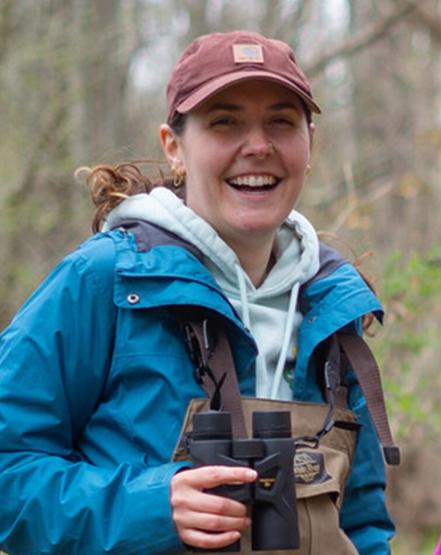
Mollick also found her way to the firm last year following her graduation with an MSES degree.
The environmental scientist’s time with the Voinovich School included taking on a leadership practicum, she said. Among her noted advisors was Professor Natalie Kruse Daniels, director of the Environmental Studies Program.
“I leaned toward the leadership practicum because I’m someone who likes the hands-on stuff. It was an opportunity where you could basically search out an organization or agency that you want to work with – kind of like an internship,” Mollick said.
The organization she targeted for the practicum was the Wayne National Forest.
“It was really cool they give you that freedom to choose what you really want to focus on during your studies. I liked that a lot because I knew I wanted to go back to grad school, but I didn’t necessarily want to go into research,” she said.
Other hands-on experiences she gained during her time at OHIO included a variety of jobs such as remote sensing to map out a wetland area, doing chemical and water sampling, stream restoration work for a Pennsylvania state park, and partnering with the Ohio Department of Natural Resources Division of Mineral Resources Management. The latter work resulted in a Little Short Creek watershed Acid Mine Drainage and Abatement Treatment plan published on OHIO’s AMDAT Reports website.
The MSES graduate said those duties dovetailed nicely with her job in the private sector. Her work at EMH&T has included wetland mitigation, monitoring and permitting.
Mollick said the Voinovich School also played a key role in preparing her for the transition from college by helping with networking skills and job searches.
“They are really good at connecting us with the people who could help further our careers,” she said.
“I had a great time during my time with the MSES program and the Voinovich School and all the people I got to meet and work with,” Mollick said. “So I would happily recommend this program to anybody looking for a graduate program in environmental science.”