The future of media is virtual: OHIO students experience revolutionary LED Wall
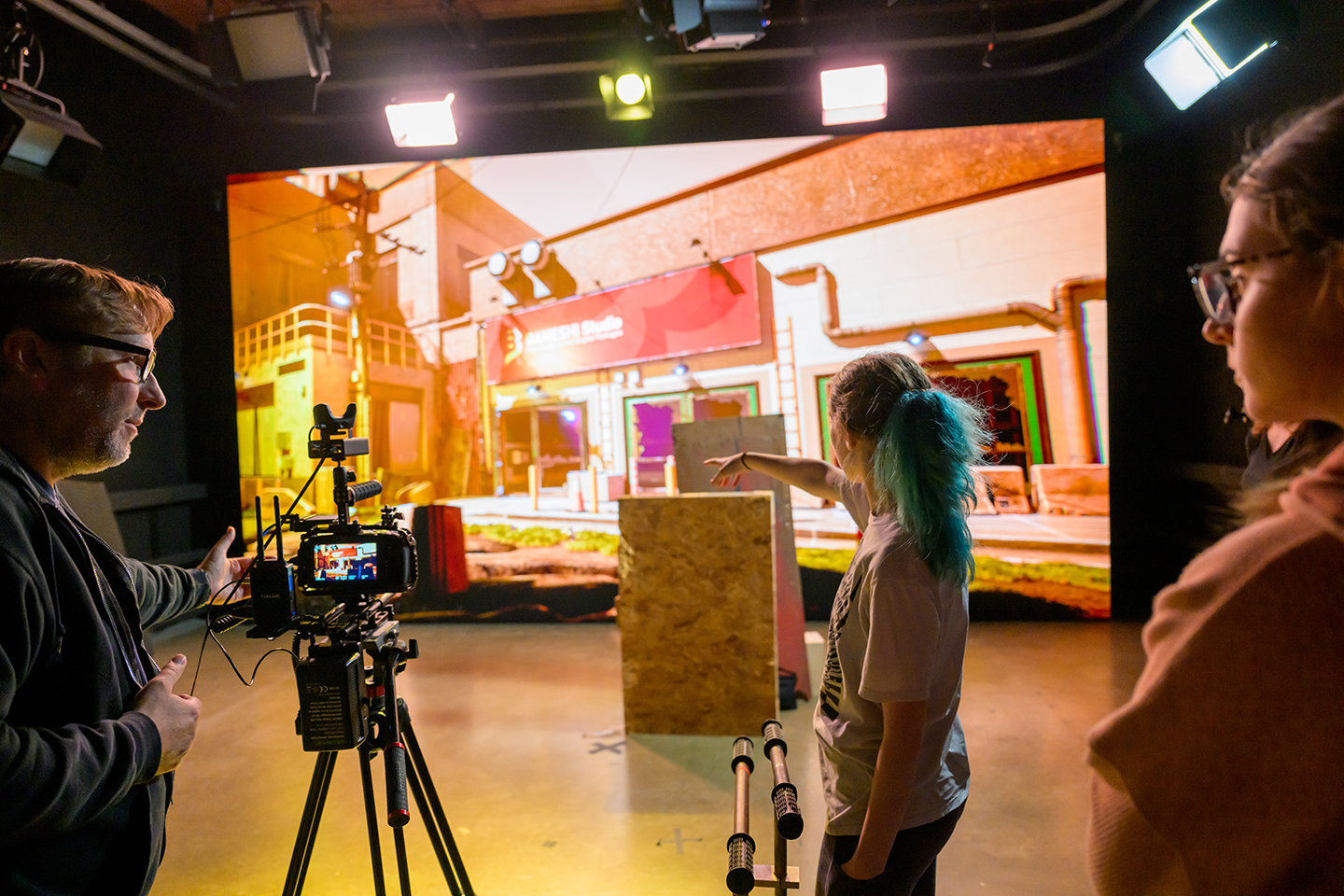
Ohio University students have recently gained access to an impressive 21-foot-wide by 12-foot-tall LED Wall. This acquisition gives students the ability to travel the streets of a bustling metropolis, a picturesque landscape and a sci-fi wasteland all within OHIO’s Radio-Television Communications Building.
Alex Semancik | January 14, 2026
Share:
Ohio University students have unlocked the ability to travel the streets of a bustling metropolis, a picturesque landscape and a sci-fi wasteland all within OHIO’s Radio-Television Communications Building (RTV Building). The LED Wall in the Lyon Studio expands virtual production at OHIO and allows students to experience some of the newest technologies being used in Hollywood and beyond.
Virtual production involves the broader use of technology, including real-time rendering, computing software and hardware, to create photorealistic cinematic worlds. These worlds can be used to shoot content and tell stories in a range of different applications from making movies, to creating advertising and promotional material.
Hollywood has had access to similar technology for more than a decade, where they’ve used it to create immersive, cost-effective virtual sets for shows like “The Mandalorian.” As time has gone on, this technology has become cheaper and more accessible and now it’s OHIO’s turn to harness it.
Inside the world of virtual production at OHIO
Ohio University’s virtual production journey started more than three years ago with Media Arts and Studies Associate Professor Brian Plow and his students collaborating with OHIO’s Game Research and Immersive Design (GRID) Lab. The GRID Lab provides the resources to create interactive digital media and technologies, and it was the perfect incubator for Plow and his students to begin working in Unreal Game Engine—a powerful real-time 3D creation tool—and identifying other common tools being used in virtual cinema.
“We just progressed from there, adopting new technology over time, and integrating it into the production pipeline,” Plow said of the origins of virtual production at OHIO. “After securing funding, in late 2024, we got the green light to go ahead and purchase the LED Wall, and this summer of 2025 was a watershed moment for us in which we were able to install the wall, which is really the most visual and striking part of the virtual production pipeline.”
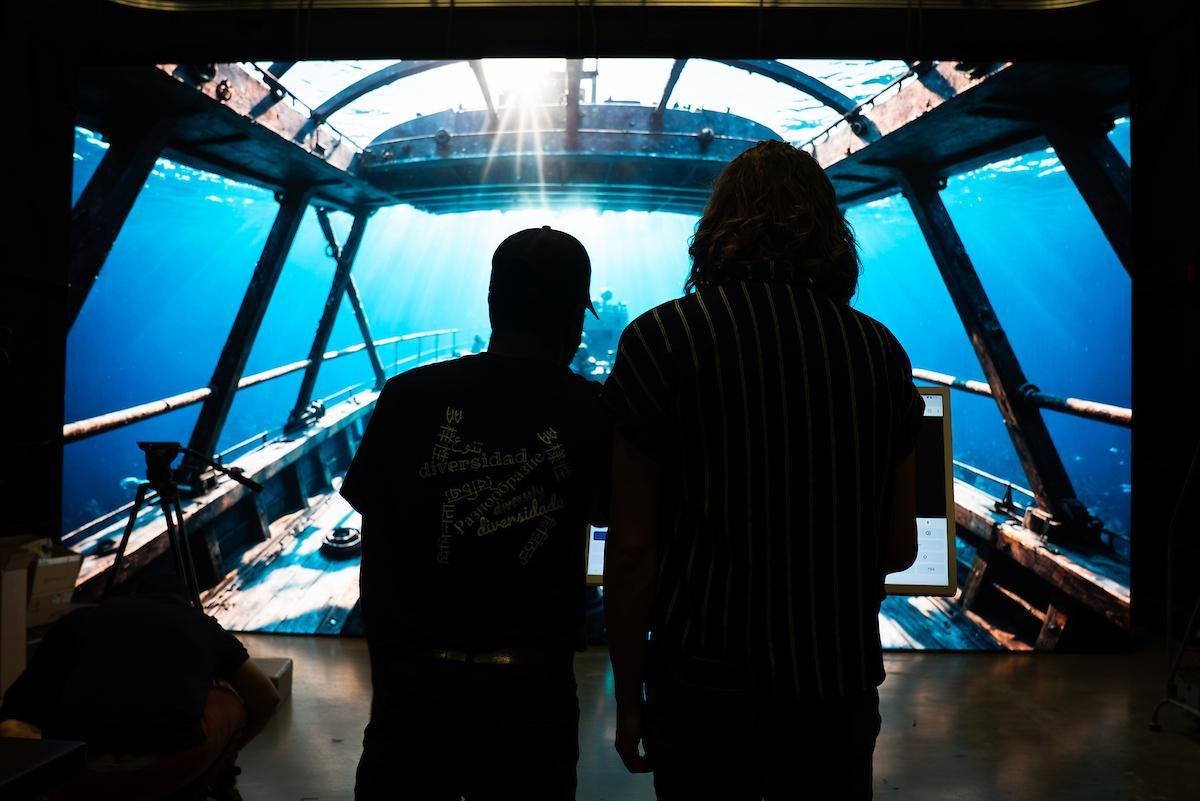
The Wall is an impressive 21-foot-wide by 12-foot-tall structure made up of 364 high-resolution LED panels. Three CPUs and an NVIDIA A6000 graphics card power the wall and allow students to use game-developer technology to create realistic 3D environments blended with live action actors and props. Plow says that as soon as the wall arrived, his approach was to quickly get students involved to get as much use out of it as fast as possible. Students in MDIA 4904, LED Wall Production, have swiftly matched Plow’s enthusiasm.
“I've never seen technology like that. I'm still in awe that we have technology of that magnitude,” emphasized Scott Caudill, a senior media arts production major. “Being able to take a camera and connect it to the wall and have the wall’s picture move every time the camera moves. That's just wild to me.”
Caudill is referring to using Unreal Engine to blend virtual environments with live action filming via a 3D tracker that sits atop the camera. When following actors and shooting a scene, the background moves with the camera simulating a real space. For students who are newer to virtual production, the LED wall can also simply be used as a background using Vū studio.
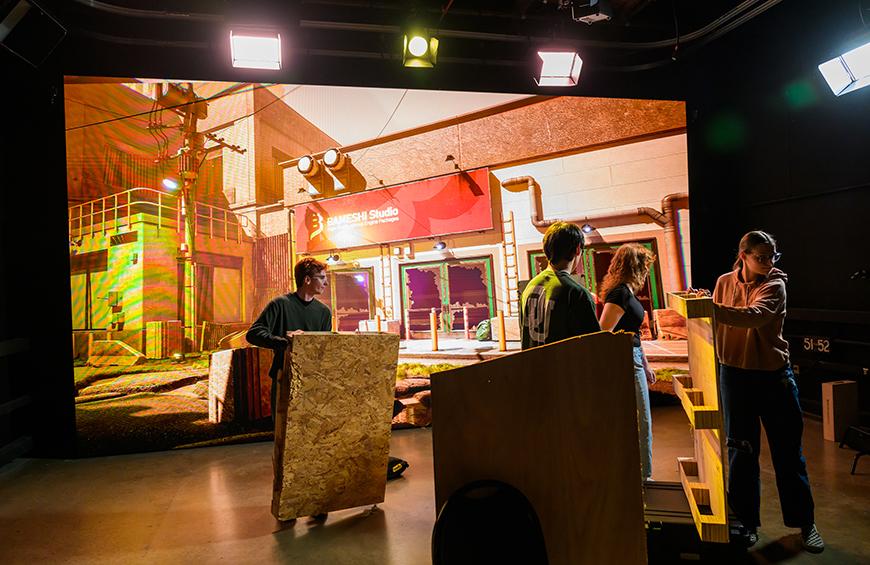
“The LED wall is like the new blue screen, green screen,” said Salem Fullenkamp, a junior media arts production student. “I think working with Unreal Engine is pretty freaking sick. There’s something so fun about taking an environment that is intended for game use and creating a scene where it looks like a real space that people are standing in, but it’s really just the wall.”
All the LED Wall Production students feel as though the wall opens their creativity and perspectives with being able to “film anywhere.” With this past fall semester being the first time to utilize the wall, Plow and his students are just getting started with taking audiences to places they normally wouldn’t have access to in Athens, Ohio.
“When we bring students into this type of environment, it's really amazing to see the immediate and productive cross-pollination of ideas,” said Plow. “There are things that they're thinking of that I would never think of. I love being in an educational environment where we're working on something together. That excites me, and it empowers the students.”
Partnerships that encourage experiential learning
Beyond learning the basics of virtual production and using an LED wall, students are also immediately applying what they’ve learned through work with clients. Plow says that working with clients and modeling that relationship incorporates important soft skills that go beyond a standard media production classroom environment.
“One of the strategies behind the LED Wall was using it to develop as many collaborative partnerships on and off campus as we could,” he said “We knew this was going to be an exciting resource that had a number of different applications, so we wanted to use this as a catalyst to really build bridges between the School of Media Arts and Studies and Scripps College to different entities on campus to enable our students to have opportunities to produce content that was meaningful, useful and valuable.”
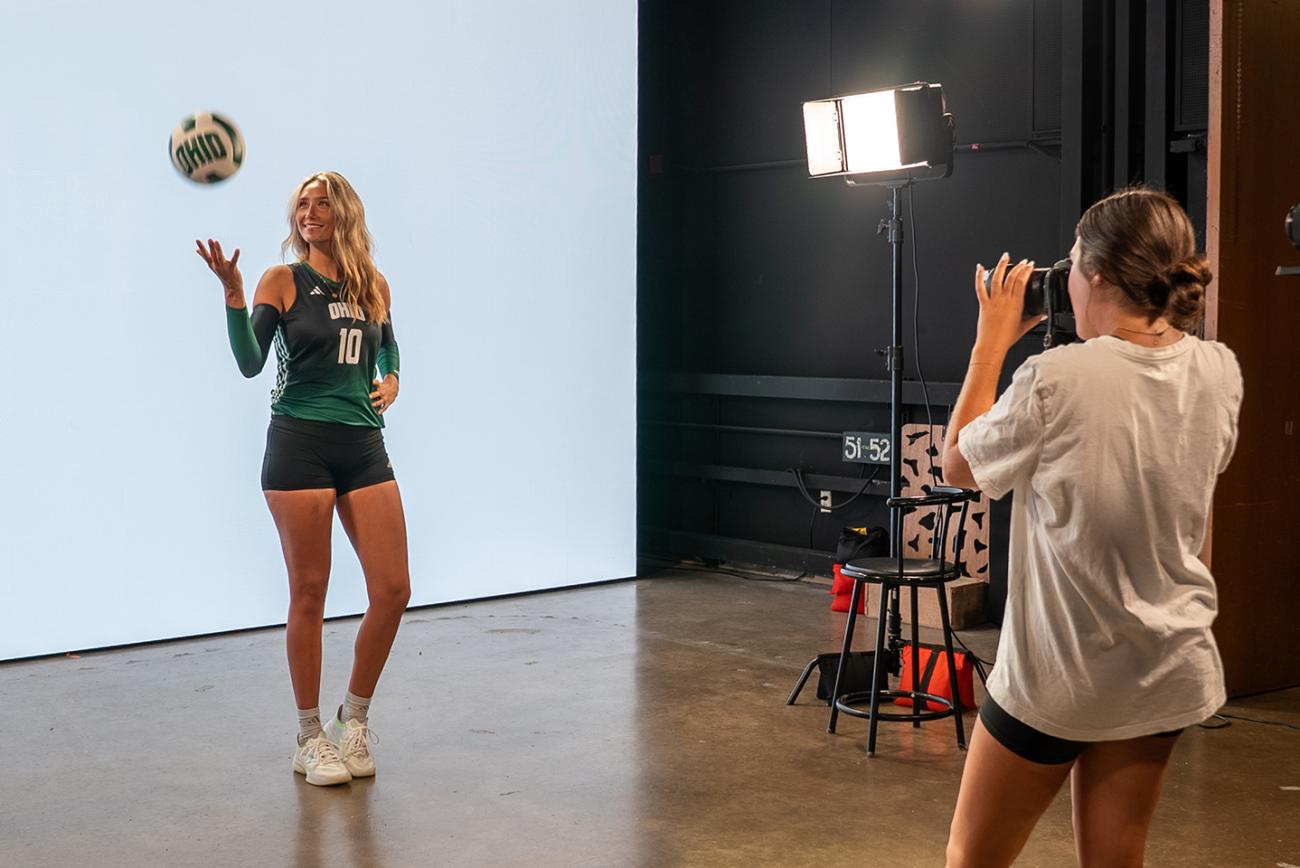
For Ohio University Athletics, Plow and his students bring in teams to shoot content such as player cards, walk-on videos and hype videos for social media. Creating this content was a relatively simple use of the wall that was a comfortable entry point for students but also provided them experience working with a real client.
Advantages and opportunities for graduates
Familiarization with any new technology typically comes with a slew of benefits and virtual production is no different. Going back to the pandemic, Scripps College leadership has been thinking about the future of media education and the new technology that comes with it through the Digital Cinema Initiative. The LED Wall is the latest iteration of experiential education and opportunity for students.
“I think this technology affords our students with a number of advantages and opportunities after graduation,” said Plow. “We always know that our students that have a rich knowledge of technology and technical parts of the media production process are always at an advantage in their job searches.”
Students who are actively working with the wall already share a similar confidence in their experience with the wall paying off when it comes time to look for a first job.
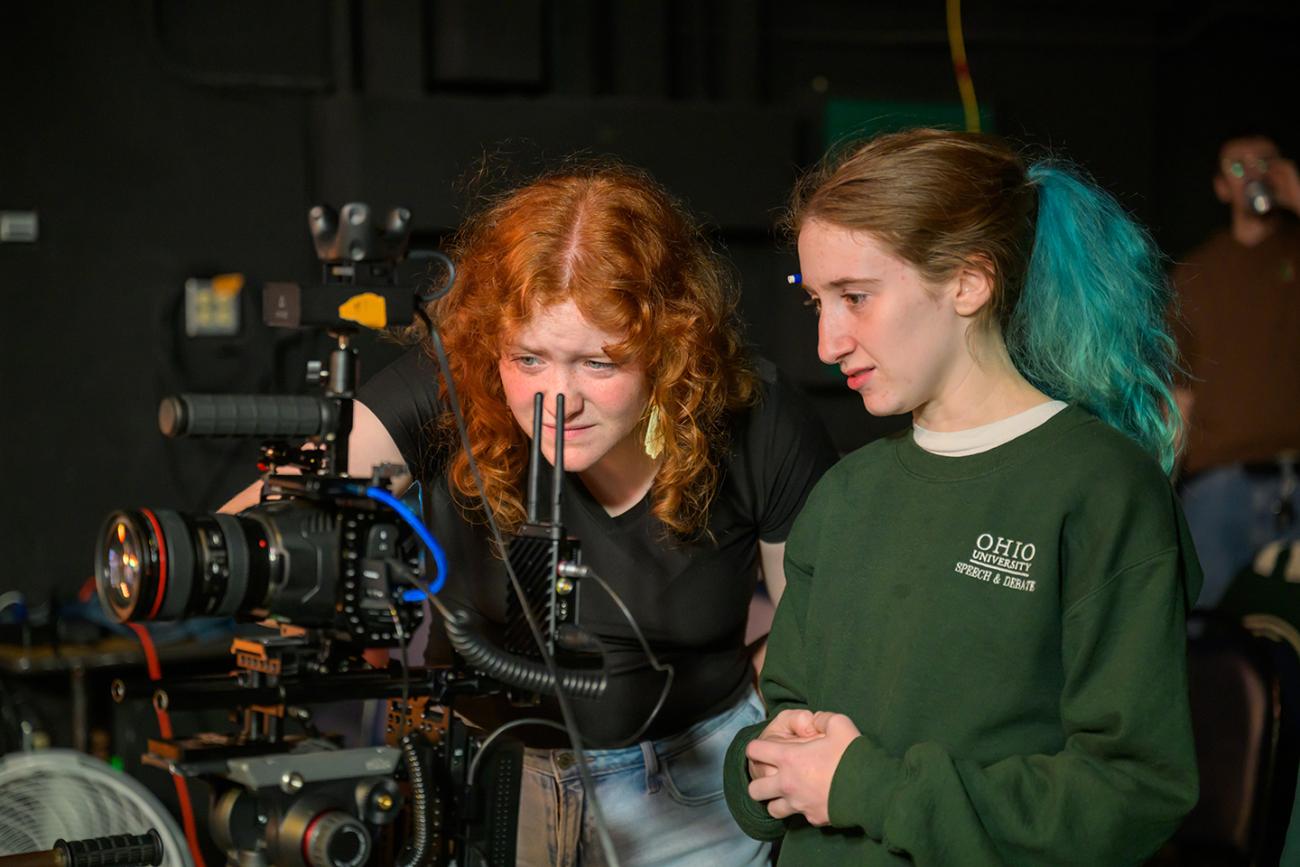
“I really like that I’m getting experience with something that will help me down the line, honestly, that’s a big thing,” said Samantha Fanger, a second-year Media Arts Production major. “It’s a very competitive market so finding a way to make yourself stand out is really important, but the wall is also just really cool. It’s getting so big in the industry, everyone’s using this new technology, so it will definitely help me stand out.”
Plow added that not just the experience itself, but the work that students create with the LED Wall will also lead them to success.
“We’re able to start experimenting with the same pipeline, the same tools, same software that these large Hollywood studios have been working in,” he said. “That affords our students the opportunity to create content that makes their work distinct and it gives them a chance to learn the software and pipeline that professionals are moving toward in the industry.”