A compact system designed to avoid unnecessary hardware components.


Our interdisciplinary engineering research team is developing a low-cost, flexible, user-friendly, and secure solution to help manufacturing firms detect defects using artificial intelligence techniques.
Small and medium-sized manufacturers often face barriers, including affordability, that make traditional automation and inspection upgrades difficult to justify. The challenges include:
Our prototype combines production simulation, image acquisition, AI inference, and operator feedback in one integrated architecture.
A compact system designed to avoid unnecessary hardware components.
The AI inspection program is hosted on an NVIDIA edge-computing platform with integrated control circuits.
Motion and production sequences are controlled through a programmable logic controller.
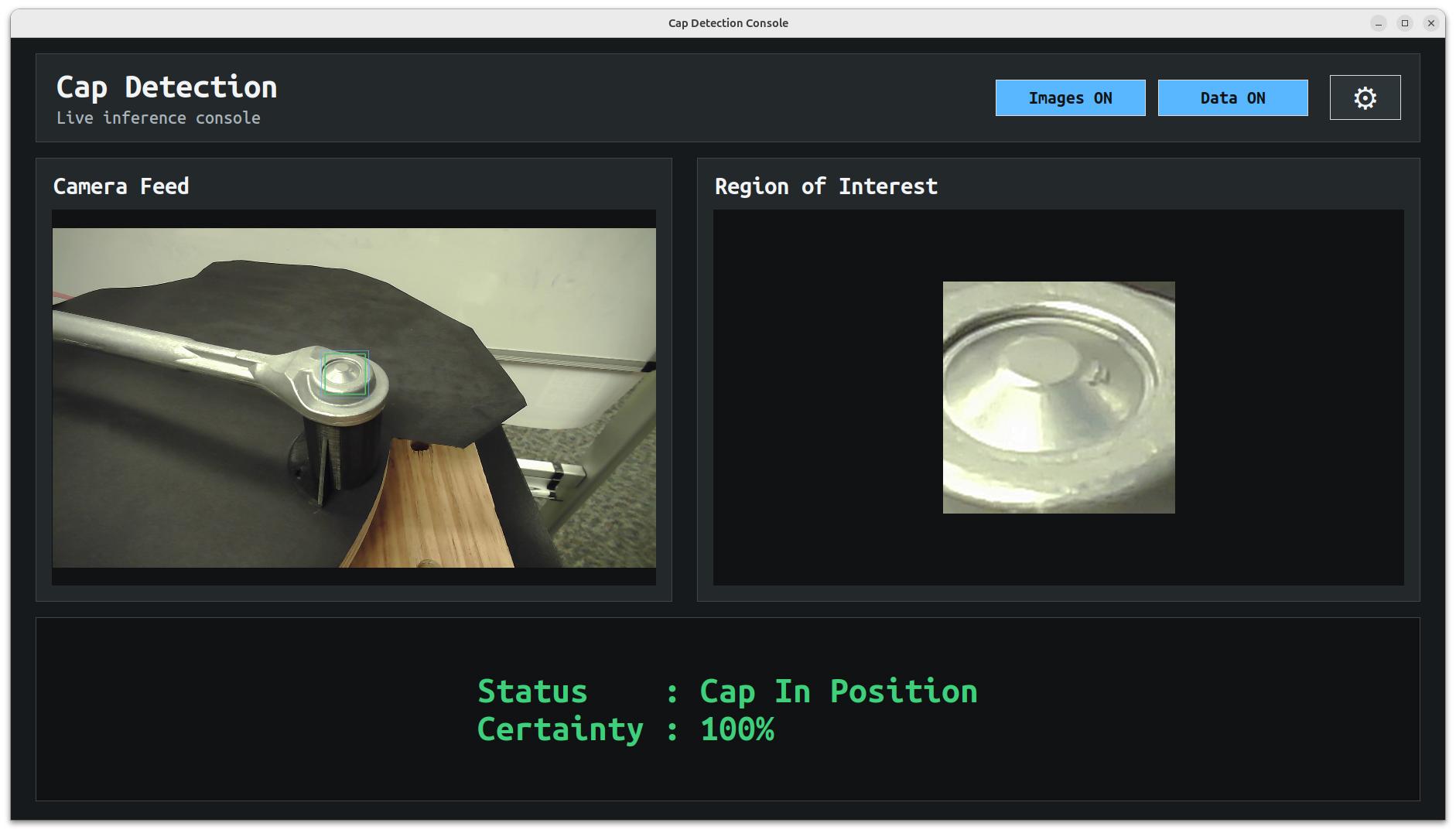
Operators receive clear inspection feedback through a practical interface.
Our demonstration project applies computer vision by using convolutional neural networks (CNNs) to distinguish between acceptable and defective joint-cap conditions.
A convolutional neural network is the kind of deep learning that makes self-driving cars possible or helps find abnormalities in medical scans. It begins with three-dimensional visual images and applies a convolutional layer of filters (called kernels) that detect edges and create a 3-D matrix that can be analyzed. Where other computations are algorithm-based, CNNs depend on pattern-based deep learning. Deep learning requires less computing power and data storage, which is why self-driving cars are possible without relying on supercomputers the size of a basketball court.
Our demonstration uses an open-source deep learning platform called PyTorch to inspect a joint cap. Here's how it works:
Our project considers security at the facility, during transmission, and at the receiving endpoint.
A cellular connection can separate data transfer from the facility network and reduce exposure to internal cyber threats.
Password-protected 7z encryption with metadata protection is paired with HTTPS/TLS during cloud transfer.
A WireGuard VPN tunnel can hide transfer activity from the cellular provider and support firewall protection through a static endpoint.
Zero-Trust Payload Isolation: Encrypting data directly on the local device ensures sensitive operational files are fully protected before leaving the local device.
Open Lightweight Encryption: AES-256 header encryption (-mhe=on) provides robust metadata protection without requiring proprietary software or paid platform licenses.
Encrypted Transit Channels: End-to-end transport is secured via standard HTTPS/TLS protocols integrated into modern cloud infrastructure.
Flexible Network Architecture: Designed to support segmented cellular connections (SIM) or static IP endpoint tunnels for air-gapped facility safety.
We welcome conversations with manufacturers, industry advisors, research partners, and students interested in practical AI inspection, system integration, cybersecurity, and workforce development. Contact Dr. Yuqiu You at youy@ohio.edu.

Dr. You is Professor & Assistant Department Chair of the Engineering Technology and Management Department in the Russ College of Engineering and Technology.

Miguel Sempertegui is a Visiting Assistant Professor of Instruction in the Engineering Technology and Management Department in the Russ College of Engineering and Technology.

Garrett is a graduate student, pursuing a Master of Science in the Industrial and Systems Engineering Department.

Kirumira is pursuing a Bachelor of Science degree in computer science in the School of Electrical Engineering and Computer Science.

Gill is pursuing a Bachelor of Science degree in the the Engineering Technology and Management Department.

Mackey is a senior with an Electrical Engineering major.