
Early Curriculum and the Humanist Mission
The University Rises Up
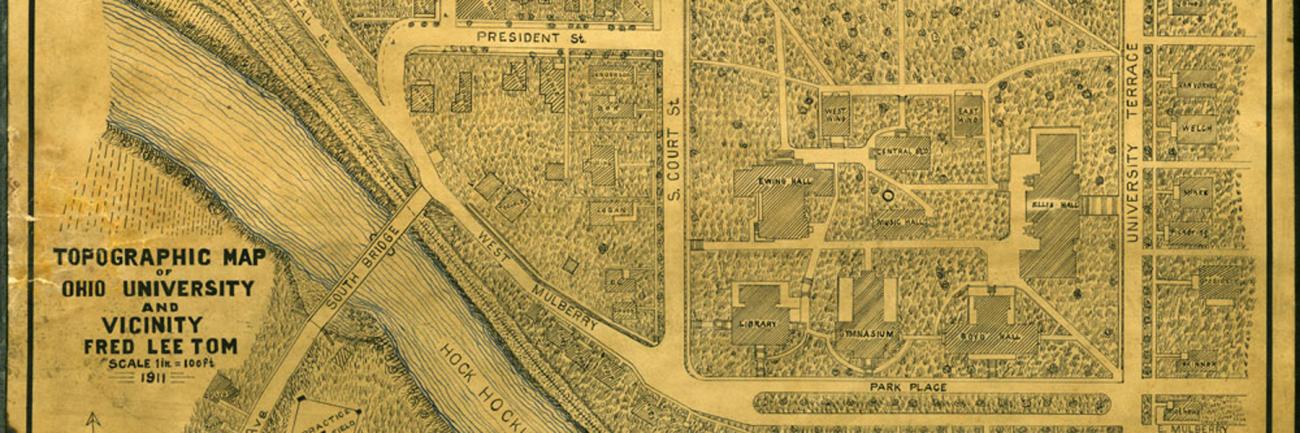
Classes at Ohio University were originally held in the two-story brick building known as the Athens Academy Building, which stood on the College Green near Galbreath Chapel from 1806-1841. Cutler Hall was completed in 1818 and was originally called the College Edifice and later the Center Building before being named for Manasseh Cutler in 1914. Wilson Hall was completed in 1837 and McGuffey Hall in 1839.
The log cabin that currently sits at the intersection of Richland Ave. and South Shafer Street dates to this first phase of construction of the university in the early 1800s. It originally stood on College Street as the home of Silas Bingham and later was used as a residence for the university’s third president, Robert Wilson, and also for John Templeton, the university’s first Black American graduate. The house was moved to its current site in 1987.
Higher Education in Humanistic Disciplines Sharpens Minds
The Rev. Jacob Lindley was the university’s only professor when it opened in 1808 with three students, who were taught a classical curriculum of Latin, Greek, mathematics, natural philosophy, and moral philosophy. Lindley was a Princeton graduate, and modeled his curriculum after eastern schools such as Harvard and Yale.
In 1815, the university gave its first baccalaureate degrees
Thomas Ewing and John Hunter both received a Bachelor of Arts and a Bachelor of Science degree. Tuition was $2 when the university was opened, and raised to $6 in 1818 when the university board developed a college-level curriculum focused on studying English, Latin and Greek languages, mathematics, rhetoric, logic, geography, natural and moral philosophy.
As the population of Ohio grew and enrollment at the university expanded, additional professors were added. By 1824, the university had professors of rhetoric and moral philosophy, Greek and Latin, mathematics, and natural sciences. In 1824 Robert Wilson became the university’s first president, by which time the university was attracting students from every part of the state and had acquired a high reputation despite its youth.