Image
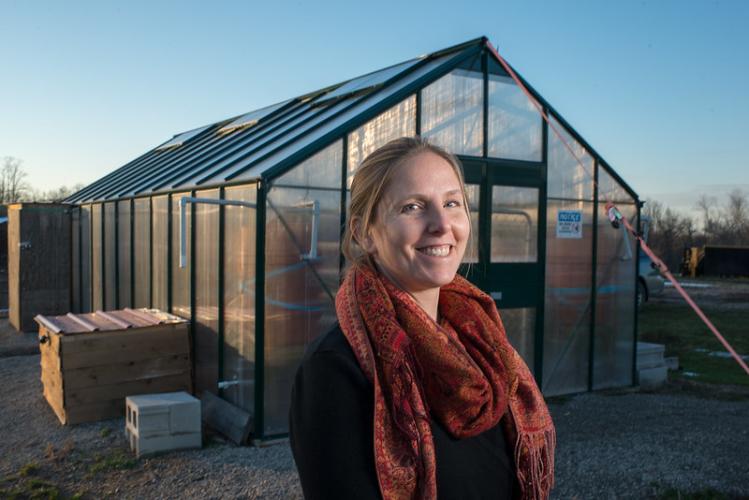
Dr. Sarah C. Davis
Follow the career path of Dr. Sarah C. Davis and it’s easy to see how her expertise has grown with the many ecosystems she has researched over the years.
As a professor at OHIO’s George V. Voinovich School of Leadership and Public Service, the ecologist has put that experience to good use with an extensive portfolio of work and involvements covering a wide range of subject areas including bioenergy, biofuel, carbon cycling and photosynthesis.
Her efforts to impart that knowledge to her students led to the creation of the Davis Research Group, which partners with other organizations on a variety of studies. The group’s mantra in a way sums up Davis’s career arc.
“Our research is all about working toward more sustainable solutions for energy and land management,” Davis said. “We train leaders in environmental science to resolve models and demonstrate technologies that have positive environmental, social and economic impacts. We look forward to a future with resilient agriculture and energy systems that are built on ecological knowledge.”
Davis earned her Ph.D. in biology from West Virginia University in 2007. She followed up a research associate stint by becoming a bioenergy analyst and adjunct professor at the University of Illinois at Urbana-Champaign until 2012. She joined the Voinovich School in January 2013.
Along the way, Davis has refined her research to fit the biome she inhabits. She has published research on forest management, perennial grasses and drought-adapted crops, but most recently has investigated solutions for organic waste and nutrient pollution in southeast Ohio.
“So in the beginning, I was just concerned with sustainable land management practices and what the impacts were for our changing environment essentially. Forests are one of the largest carbon sinks and the way we manage them can have a big feedback to our climate system,” she said. “As my career progressed, I started to become more interested in agricultural systems because a lot of the pressures on our forests are related to our resource demands for agricultural products and for energy products.”
Since arriving at the Voinovich School, Davis has expanded her research focus on smaller-scale farms, maintaining forests while cultivating high-value products such as ginseng and white oak, and studying nutrient cycling and companion technologies that can accomplish a circular economy of nutrients.
Part of her research on high-value agricultural products, which also include goldenseal, walnuts and chanterelles that can be harvested in the wild, is to quantify their value in an agricultural economy dominated by row crops.
“The quantity of each product is small, but there's a wide diversity of them, and so in aggregate they have high value,” Davis explained. “This is kind of a new approach for articulating the value of biodiversity in central Appalachian forest ecosystems.”
The ecologist’s interests also naturally extend to sustainability, such as turning waste into biofuel and other uses.
“I've transitioned more to looking at efficient management of organic waste and how we can work within a more circular economy of materials,” she said. “How can we capture nutrients from our waste streams that we can use to support our agricultural systems, thereby reducing the energy requirements and manufacturing costs of making new fertilizer?”
Davis’s ecological expertise is reflected in the courses she teaches.
“I'm teaching Environmental Science and Public Policy, which introduces students to scientific information that relates to environmental issues as well as the policy processes that are required in order to address our biggest environmental challenges,” she said. Her courses also include Strategies for Resilient Agriculture, Ecology and Environmental Issues, and Bioenergy.
Through her research group, Davis has students working on phytoremediation, or how plants take up heavy metals that can contaminate soil and water in places where there's been mining, organic waste processing technologies, and other cutting-edge research. The work is often done in collaboration with local landowners and community organizations such as Rural Action, the Athens Hocking Solid Waste District and Southeast Ohio Recycling Terminal.
“Ongoing research involves students at every step. I have several graduate students and a few undergrads that work as research assistants, and scholars,” she said. “All of the research helps to inform the material I cover in classes and keeps me up to date on current advances.”
“The Research Group is a natural part of my job to engage with and mentor graduate students,” Davis adds. “Helping students develop knowledge and skills for their future careers is the most rewarding part of being a professor.”
Another natural extension of her work is helping to obtain funding for various research projects by writing grants. She also serves on the advisory board for Rising Appalachia and the research board for Crane Hollow Nature Preserve.
Aside from her work at OHIO, Davis still finds time to pursue some personal interests, which mainly revolve around her family and taking advantage of “living in the middle of a forest” in southeastern Ohio. She also gardens, loves to cook and dabbles in painting. You might spot her cheering at Bobcat football games in the fall or cross-country skiing on The Ridges in the winter.