
Fall 2026 Edition
Alumni & Friends Magazine
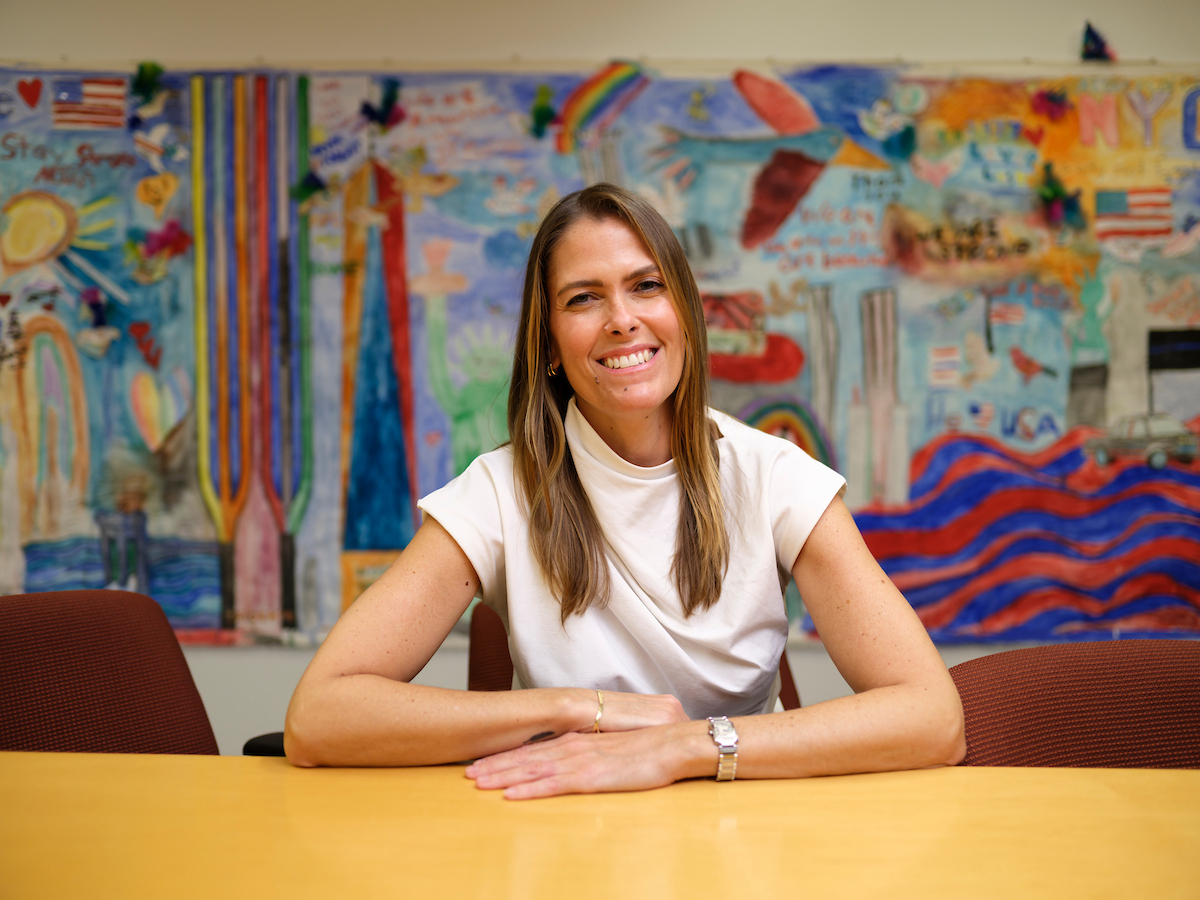
From Athens to Ground Zero: How OHIO alum Megan Jones educates the world about 9/11 through storytelling
What does it really mean to “Never Forget?” Does it mean remembering the date? The act of terrorism? The nearly 3,000 lives lost? The smoke, the sirens and the images that have become etched into history? For Megan Jones, BS ’01, it means remembering the people.
Samantha Pelham Kunz, BSJ, BA ’17; MAA ’21 | November 16, 2026
Share:
As Vice President for Education Programs at the 9/11 Memorial & Museum, Jones spends her days helping millions of students, teachers, families and visitors understand one of the darkest days in American history. But she believes the most effective way to teach the story of Sept. 11 isn’t through statistics, timelines or casualty figures, but through the people whose lives were forever changed and the humanity that emerged in the aftermath.
“For me, above anything else, the story of 9/11 is a human story,” Jones says. “It’s about humanity. It’s about, yes, the darkest of humanity, but it’s also about the best of humanity.”
That philosophy comes to life inside the museum’s education center, where vibrant artwork created by children lines the walls below the ground where the Twin Towers once stood. Crayon drawings of firefighters sit alongside paintings of the memorial pools and handwritten messages of hope.
It is an unexpectedly colorful space in a place so closely tied to tragedy. Just beyond the classroom space are preserved artifacts that show the impacts of the day but, more importantly, tell the stories of the people who were there, including firefighters, office workers, survivors and families. Through those experiences, students and visitors learn about Sept. 11 through the people who lived it.
“You can say that 2,977 people were killed on 9/11, and that’s a very large number,” Jones says. “But when you tell the story of a 24-year-old young man who was just at work at his first real office job in New York and decided to help evacuate people and get them to safety and then run back up the stairs to help strangers, then it becomes more real.”
For Jones, storytelling is at the heart of her work. It is how she helps people from around the world, including generations who were not yet born when the attacks occurred, understand not just what happened on that day, but who was affected, how people responded and the impacts still felt today.
Embarking on Curiosity
Jones’ path to educating the world on one of the toughest topics to consider was not straightforward. Her curiosity about teaching history and exploring new perspectives, however, laid the foundation for her career.
Jones graduated from Ohio University in 2001. Although initially reluctant to attend her parents’ alma mater — they met at OHIO and often spoke about Athens and the University — she quickly changed her mind.
“I did the college tour with one of my friends from high school — my mom took us down, and I knew immediately that it was going to be the place for me. And so that was it, and it really was some of the most special years of my life.”
Jones fondly remembers living in Brown Hall, joining Chi Omega and forming friendships that continue today.
She studied political science and sociology, expecting to attend law school. But while interning in Cleveland, she organized a courthouse visit for her younger siblings and their classmates and discovered she preferred introducing young people to complex ideas.
“I had so much fun talking to them about the process and organizing their field trip,” she says. “I thought, ‘What about education?’”
After earning a master’s degree in educational leadership and teaching, Jones moved to Washington, D.C., hoping to work on Capitol Hill. Instead, volunteering at the National Archives led to a job as an education specialist, where she discovered how primary sources could transform history education.
“I loved that job — working with primary sources and thinking about how to integrate those sources into the classroom,” she explains.
She later managed visitor programs at the U.S. Supreme Court, where navigating difficult conversations required neutrality and care.
“We always did this thing where you would wear your Megan Jones hat, and then you had to wear your government hat,” Jones adds. “You had to be so neutral and thoughtful about everything you said.”
During that time, she began considering what might be the most difficult history lesson in America to teach, and how to approach it. Her thoughts returned to 9/11.
The attacks had touched Jones’ own family. Her cousin worked across the street from the World Trade Center and witnessed the first plane strike the North Tower. Trapped in the dust cloud, he disappeared for several days before his family learned he had survived.
He rarely discussed the experience until one day he unexpectedly shared his story with Jones, leaving a lasting impression.
Her cousin died in 2012, around the time Jones began wondering how future generations would learn about Sept. 11. Then she saw a job posting for the museum, which had not yet opened.
“We had just bought a house in Virginia,” she says. “I thought, ‘That would be absolutely crazy.’”
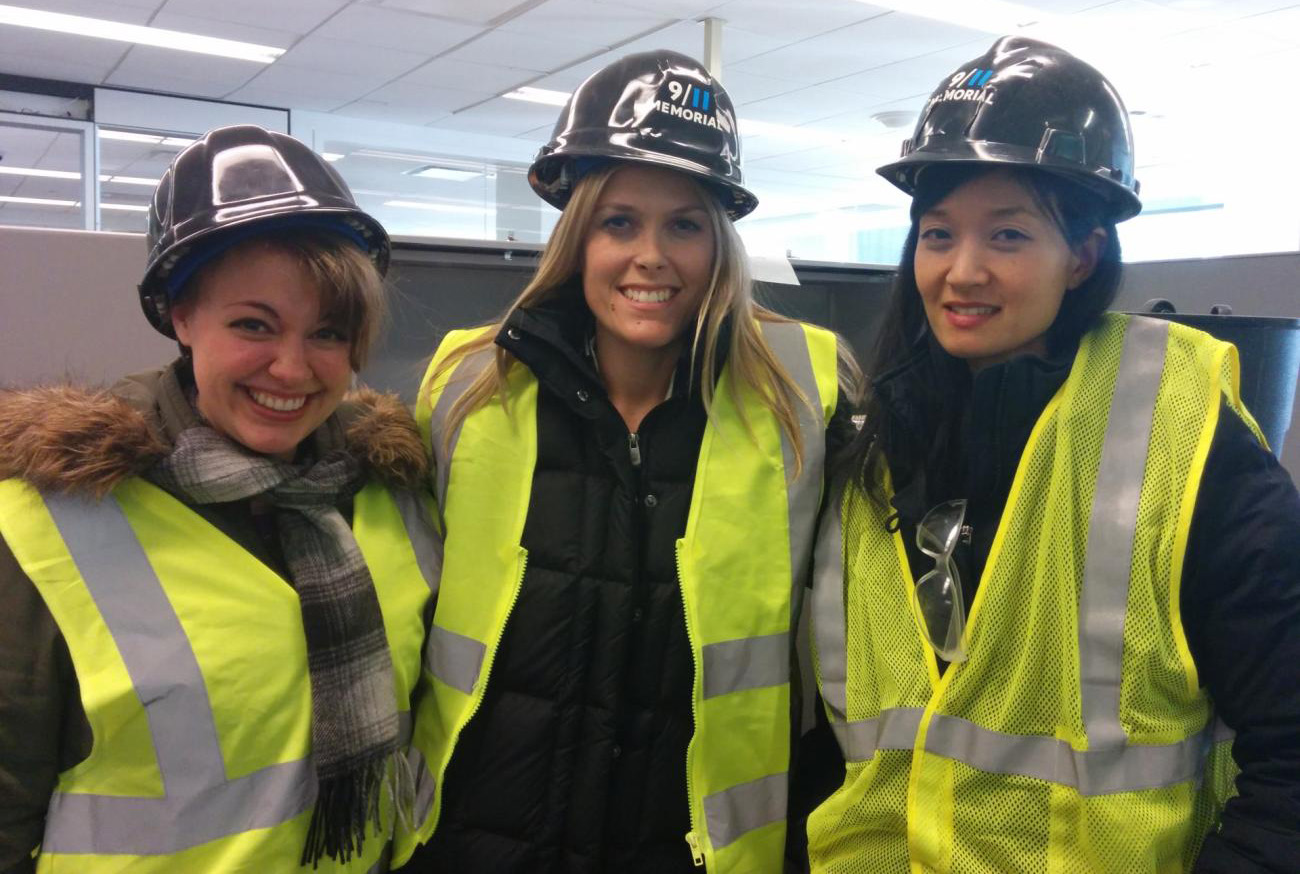
Megan (center) and colleagues ahead of the opening of the Museum.
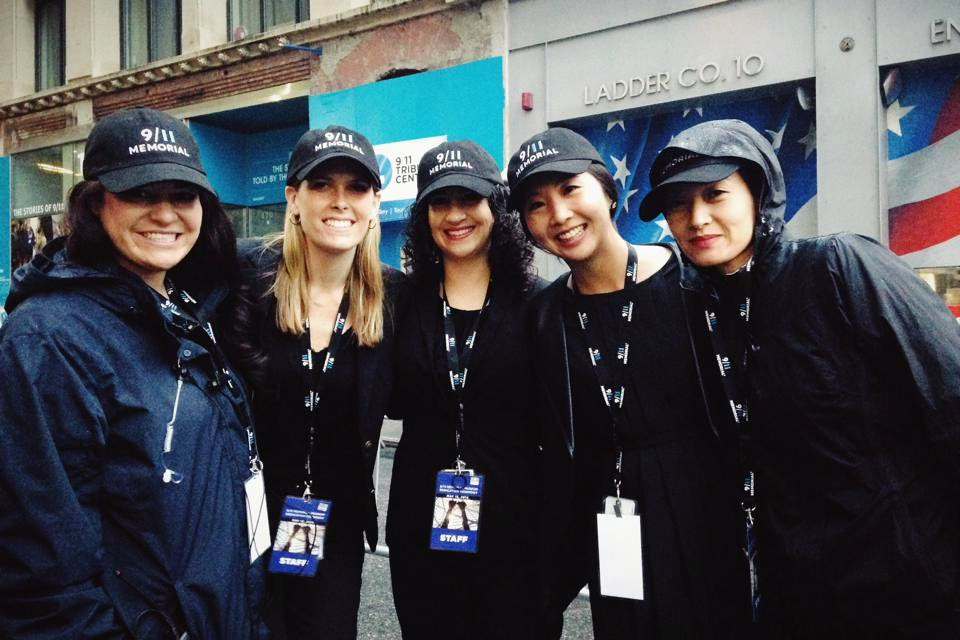
The day the 9/11 Museum opened to the public.
She Applied Anyway
Jones became one of the first education employees hired before the museum opened in spring 2014. On her first day in January 2014, she walked into the makings of a museum with borrowed construction boots on, staring at an education space that at the time was nothing more than white walls.
“There was nothing in here,” she explains. “That’s really when it hit me — the awesome responsibility that we had in creating every education program for this institution from the beginning.”
Tangible Storytelling
At the start of her role, much like the museum itself, Jones and her team had to build an educational program from the ground up. They knew they needed field trips for students, programs for New York City public schools, professional development for teachers and programs for teenagers, in addition to finding ways to educate global populations and, perhaps most challenging, students visiting the museum who would have no personal memory of that day.
Jones quickly understood that at the heart of educating all those different types of people was one thing in common: tangible storytelling.
“They need to understand what happened that day first and foremost,” she says. “How can you remember something that you didn’t live through? We always say, ‘Never forget.’ They don’t know what they’re not supposed to forget.”
According to Jones, museum tours are inquiry-based rather than simply didactic. Rather than beginning with lectures, museum educators ask students to observe and ask them, “What do you notice?”
Standing in front of Fire Truck Ladder 3, students might point out the damage or burned portions of the vehicle. Those observations become an opening into the story of Ladder Company 3 and the firefighters who were on that truck that day, including their captain, Patrick “Paddy” Brown.
“We start with an observation,” Jones says. “Then we tell the story of a particular person or group of people connected directly to that artifact.”
The same process happens throughout the museum. An artifact becomes a story. The story becomes a person. The person becomes a way for students to understand the larger events of Sept. 11.
“It’s not just something that happened and then time moved on,” she says. “It’s something that continues to affect the world that we live in today.”
But Jones’ goal isn’t simply to help students understand what happened. She wants them to make their own meaning from it.
“What’s really important to me is not to tell why 9/11 is important or why it matters, my goal is for students to discover for themselves why it’s important. Because when you can make meaning for yourself, that’s more impactful than someone just standing in front of you and saying, ‘Well, this was an important day because...”
The museum’s approach to tangible storytelling extends to its volunteers, who help bring history to life through the artifacts and personal stories they share with visitors.
Longtime University supporter Mark Morrow has spent 13 years working in New York City with the team that leads tours and helps visitors understand the museum. As a volunteer, he guides visitors through the museum, giving brief talks about key artifacts that convey the story of 9/11 and the World Trade Center.
He shares a particularly meaningful experience from this 25th anniversary year.
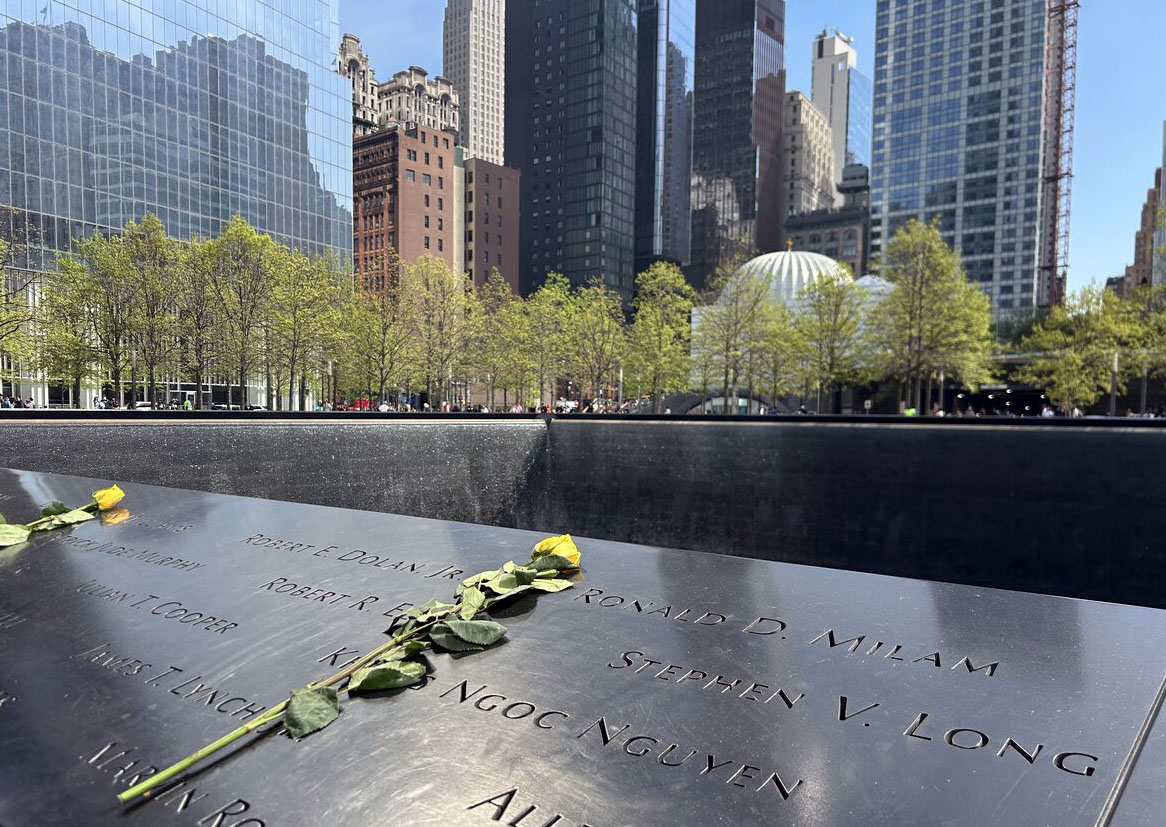
The names of those who died on 9/11 are on bronze parapets around the pools, arranged using a system of “meaningful adjacencies”—by relational and shared location versus alphabetically. Recently, Morrow assisted a woman who was looking for her sister’s name.
“She said, ‘This was my sister, and I’ve never been able to come here.’” Morrow escorted the woman to the area where her sister’s name is, then offered to step back and escort her to the family seating area when she was ready. “I said, ‘I’ll give you a moment, but I’ll be right back there.’ And she said, ‘No, please stand beside me if you’re okay with that.’ I said, ‘Absolutely.’”
“She stood there, and you could hear her fighting back the tears, and she finally looked at me and she said, ‘I’m ready,’” Morrow recalls, referring to the reading of the names in the family area.
He reflects on his experience of being selected to serve at the museum’s family desk for five out of the 13 years he has been there. “This year’s anniversary, because it was 25, I’m honored.”
Educating a Generation with No Memory of the Attacks
As time moves further from Sept. 11, teaching about it becomes more challenging. For students born after the attacks, 9/11 is not a memory — it’s history. Jones believes educators must acknowledge that difference rather than assume students understand the day’s significance.
Students must understand both the events of Sept. 11 and their lasting effects.
“9/11 didn’t exist in a vacuum,” Jones says. “It’s not just something that happened and then time moved on. It’s something that continues to affect the world that we live in today.”
The museum’s education programs help students explore those effects, while encouraging them to confront difficult questions rather than avoid them.
“I’ve always been someone who has tried to address the most uncomfortable things because I think, you know, even as a teacher, if you don’t address the hard history, you’re going to have students who still want to have answers and will find them,” she says.
That is especially important when students can turn to social media for answers.
“If they don’t come to the classroom with curiosity, they’re going to go find it somewhere else,” Jones says. “And that can be very frightening with how much misinformation and disinformation is out there.”
The museum also works with educators through professional development programs and its annual Summer Institute, which brings teachers from across the country together to study 9/11 history, explore museum pedagogy and consider how storytelling can foster classroom conversations.
Teachers hear from museum experts and people with firsthand connections to 9/11, including first responders, survivors and family members.
The institute is designed to multiply that impact: Teachers equipped with the knowledge and resources to tackle difficult history can bring those lessons to dozens or hundreds of students.
“Because they’re the ones on the front lines that are going to be asked the questions and are going to, you know, are really a part of our charge as educators is to pass this history to the next generation,” Jones says.
Jones also relies on teachers to help the museum understand classroom needs. Their feedback informs lesson plans and professional development because, as she puts it, she can guess what is happening in classrooms — but doesn’t necessarily know.
That relationship keeps the museum connected to the realities of teaching difficult history nearly 25 years after the attacks.
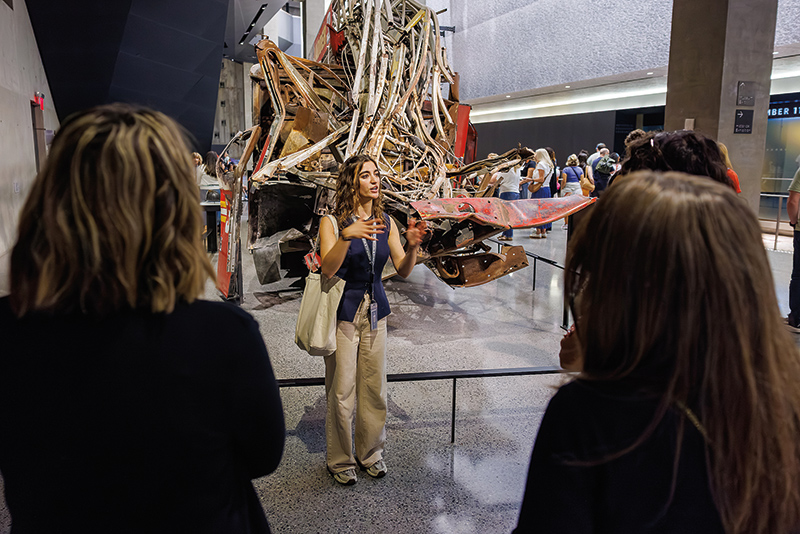
Tours gather in front of Fire Truck Ladder 3, where they learn about the members of FDNY Ladder Company 3 who bravely responded to the World Trade Center on Sept. 11. The truck was damaged beyond repair when the North Tower collapsed. Photo by David E. Starke
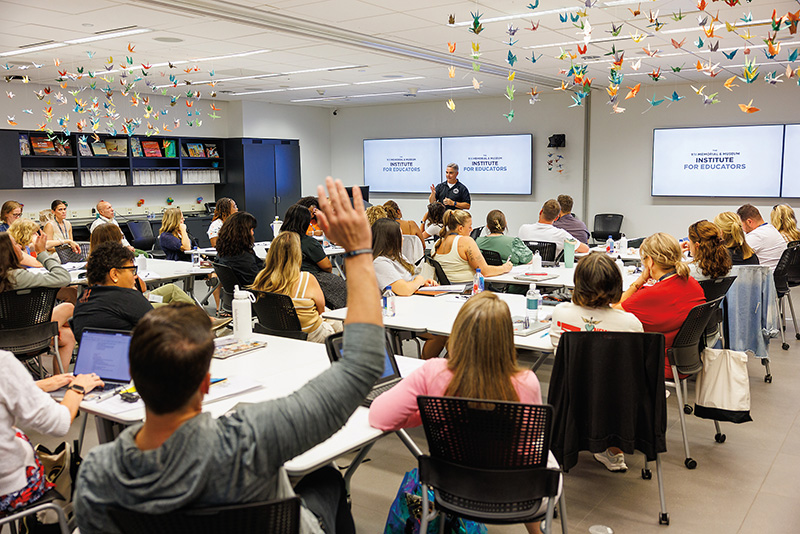
9/11 Memorial and Museum Institute for Educators. Photo by David E. Starke
Bringing the Museum to the World
Jones knew that not every student or visitor could travel to New York and stand among the artifacts of the museum. So she began looking for ways to bring the stories out to the public in a more accessible way.
It began modestly in 2016 with a single webinar featuring Ada Dolch, a principal whose school sat just one block from the World Trade Center. On Sept. 11, Dolch evacuated hundreds of students through the dust cloud while her own sister remained trapped inside the North Tower. Afterward, instead of turning inward, she helped inspire the creation of a school for girls in Afghanistan, even naming the garden there in memory of her sister.
“Ada is so incredibly inspiring because she always talks about how she could be angry or mad but instead tries to educate,” Jones says.
That first program drew about 30,000 participants.
The next year, prerecorded stories allowed more schools to participate while educators answered questions live online. According to Jones, attendance climbed to 100,000.
Today, the museum’s annual program features survivors, first responders, family members and people who were themselves children or students when the attacks occurred. Their stories are filmed professionally and made available for free through the museum’s website around the anniversary of 9/11.
Students can watch the stories wherever they are and submit questions through a live chat, connecting them with Jones and her colleagues at the museum. More than 5 million students have participated in the program, reaching more than 65 countries.
“The idea was to connect students with people who were there,” Jones says.
The program has also found audiences far beyond traditional classrooms. Libraries have screened the films for the public, as well as movie theaters and communities across the globe.
This year’s speakers included sons of a firefighter killed in the attacks — one who followed in his father’s footsteps, joining the New York Fire Department (FDNY) and eventually earning the same rank on what would have been his father’s 70th birthday — and daughters who lost their fathers before choosing careers in public service themselves.
Their stories illustrate what Jones hopes students remember: not simply how people died, but how others chose to live afterward.
The museum has also expanded its virtual offerings, including live virtual tours for students in grades three through 12 who cannot travel to New York. The tours use cameras to bring students into the museum and follow the same storytelling approach as an in-person visit.
The goal is to ensure geography does not determine who gets to learn from the museum’s stories.
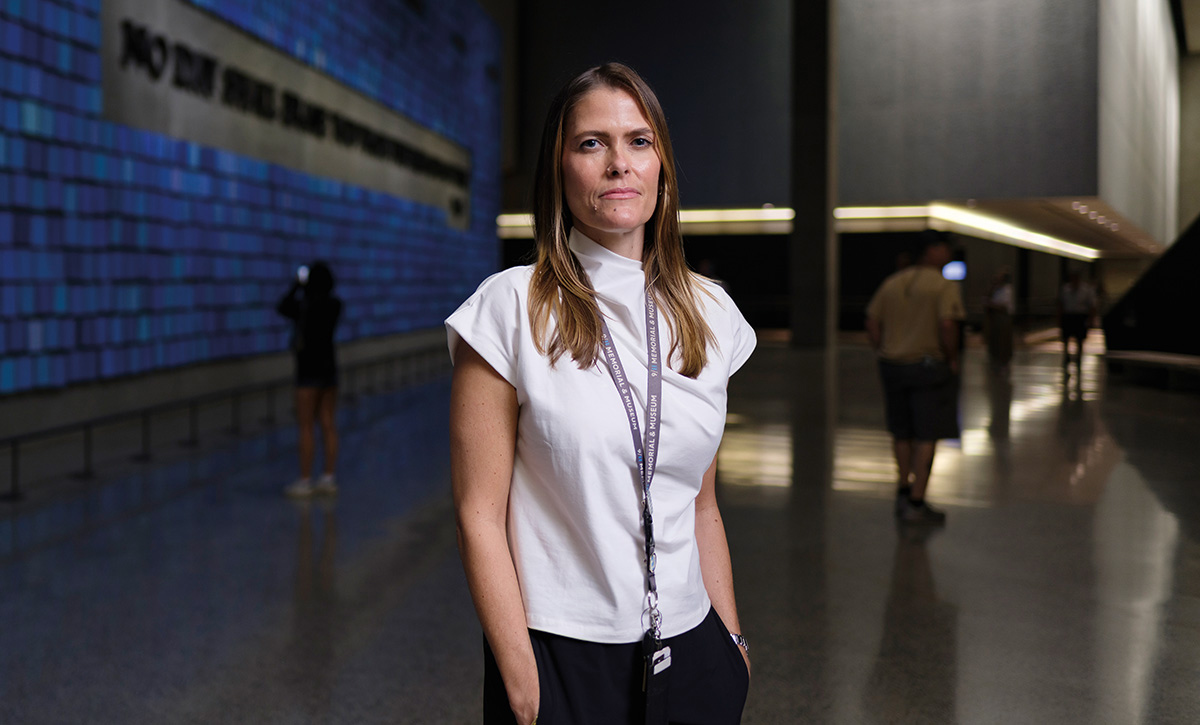
Megan Jones, BS ’01, in front of artist Spencer Finch’s piece “Trying to Remember the Color of the Sky on That September Morning” inside the museum. Photo by Karsten Moran
Discovering the Why
After years spent helping millions understand one of history’s darkest days, Jones still returns to the question she asks students: Why does it matter?
“I used to start always with, ‘Why are we even here? Why are we in history class?’” she says. “The ‘why’ is the most important question.”
She believes each student must discover their own answer, and her role is to create opportunities for that discovery.
For Jones, remembering Sept. 11 is about more than tragedy. It’s about recognizing our shared humanity.
“I often think about the people who were trapped in the towers and faced with a ‘choiceless choice,’ circumstances no person should ever have to experience. The attacks were an attack on humanity. Yet within that horror, people also demonstrated extraordinary courage, compassion and selflessness and I think that these stories can inspire us to be the best versions of who we are — I think everyone’s capable of that.”
Jones believes these stories remain relevant even to those who were not alive when the attacks occurred.
“I think 9/11 gives us an opportunity to explore our inner humanity and how really we are all more connected than we are different,” she says.
At the museum, artifacts offer a tangible connection to the past, while educators help bring those stories forward.
“I’m just here to help bring out the story,” Jones says. “But they are the story. They’re the tangible story.”
Now 25 years after the attacks, Jones hopes these stories help a new generation recognize what connects us.
“You hope it doesn’t take something like this to see it,” she says. “But I think remembering 9/11 and telling these stories and sharing these stories can help us see that at our core, despite all differences, we’re all human and we are all connected.”
For a generation with no firsthand memory of Sept. 11, that may be one of the most important things to remember.