Image
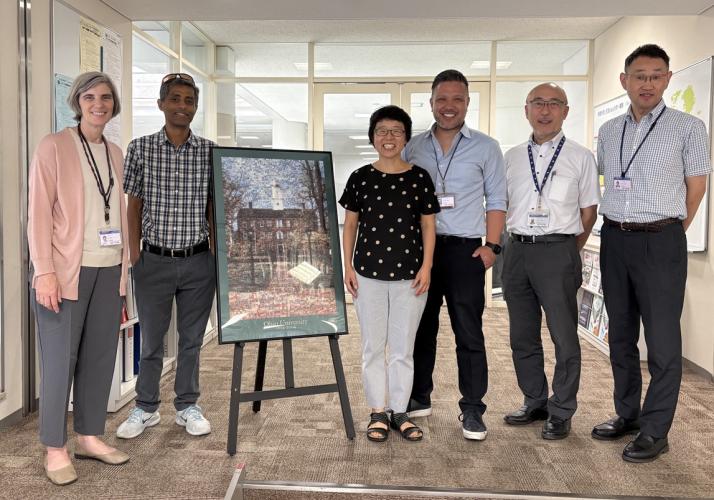
Ohio University and Chubu University are expanding their long-standing partnership through new investments in collaborative international research.
Two OHIO faculty research teams, one in geography and one in electrical engineering and computer science, will each receive $18,000 per year for three years to develop joint research with colleagues at Chubu University in Japan. The awards are the first made through a new faculty research collaboration program designed to support sustained research partnerships between the two institutions.
The initiative advances Ohio University’s broader commitment to international research and creative activity by connecting faculty with researchers at strategic partner institutions whose expertise, facilities and regional knowledge complement strengths at OHIO. Multi-year support is intended to give faculty teams time to develop shared research agendas, produce collaborative scholarship, engage students and pursue opportunities for additional external funding.
The new projects build on more than five decades of academic engagement between OHIO and Chubu, the University’s longest-standing international partnership.
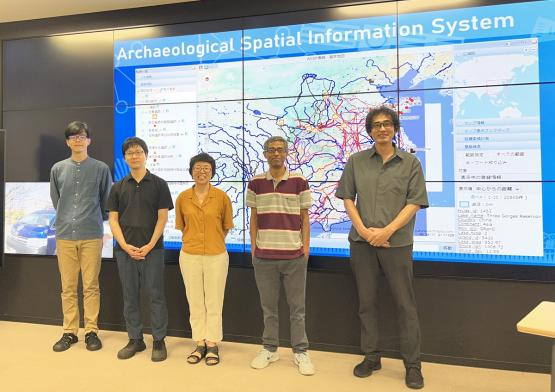
Yeong Kim and Gaurav Sinha, faculty in the Department of Geography in the College of Arts and Sciences, are developing a collaborative research team linking OHIO geographers with Geographic Information Science specialists at Chubu University’s International Digital Earth Applied Science (IDEAS) Research Center.
The project has three areas of focus: developing shared research capacity in Geospatial AI; assessing natural hazards and disaster risk across developing Asia; and conducting comparative research on industrial restructuring in Ohio and Aichi Prefecture.
“Chubu has built genuine depth in digital earth science and geoinfomatics, and we bring complementary strengths in critical urban geographical analysis. Neither group could do this work alone at the scale we’re proposing,” said Kim.
The Chubu members of the collaborative team include Nobuya Watanabe, faculty in History and Geography, and Satoru Sugita, faculty in Astronautics and Aeronautics. Both are affiliated with the IDEAS Research Center and have conducted GIS and remote-sensing research in Middle Eastern and Southeast Asian countries.
Watanabe said the partnership creates opportunities to combine the institutions’ different areas of expertise, including the use of AI-assisted drone mapping in geographical and environmental research.
Six members of the collaborative research team met at Chubu University this summer to present their work and identify areas for joint research. The group also discussed ways to connect research collaboration with student learning.
Kim said the teams “also exchanged ideas about how our students, both undergraduate and graduate, could benefit from the shared expertise and resources like virtual seminars and other academic events and joint courses.”
Chang Liu, faculty in the School of Electrical Engineering and Computer Science in the Russ College of Engineering and Technology, will work with Chubu researchers on a second three-year project focused on large language models and reinforcement learning.
The team will develop and test a framework that uses large language models to generate reward signals for reinforcement-learning systems. Researchers will evaluate the approach in complex real-time strategy environments, where the difficulty of specifying effective reward functions has long constrained system performance.
"The grant gives us a way to work with Chubu University on something engaging: using game AI techniques to improve how agents learn to play games,” Liu said. “We are now organizing a competition for our own students, and once we have our results we will invite Chubu students to join and compete. Working with colleagues at Chubu on an international competition would give our students a real audience and real peers abroad, which is what this program is for."
Together, the two funded projects demonstrate the range of research that can emerge from an institutional partnership spanning disciplines, colleges and national research contexts. The three-year structure also allows the teams to move beyond individual visits toward sustained research programs, publications, student engagement and future funding proposals.
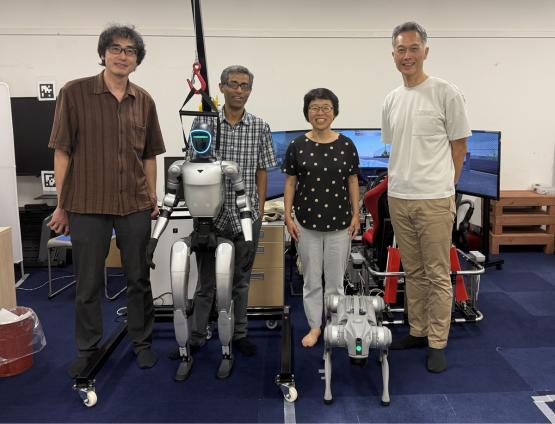
The new research collaboration program builds on a faculty exchange that has connected Ohio University and Chubu University since the partnership was established in 1973.
Through the Kohei Miura Visiting Professorship, an OHIO faculty member spends an extended period at Chubu University engaging in scholarship that can include collaborative research, seminars, presentations and work with Chubu faculty and students. The reciprocal Robert Glidden Visiting Professorship brings Chubu faculty members to Athens for scholarly activity that can include research, teaching, workshops and collaboration with OHIO faculty.
Over five decades, these programs have created repeated opportunities for faculty members from the two universities to work together in person and develop relationships across academic fields. Those exchanges now provide an important foundation for expanding the partnership’s research activity.
Kim, for example, served as a Kohei Miura Visiting Professor in 2022. Faculty from Chubu University have likewise worked with OHIO colleagues across fields including engineering, chemistry and biochemistry, biological sciences, international studies, business, health sciences and the humanities.
The partnership began when Chubu Institute of Technology President Kohei Miura and OHIO President Claude Sowle established the faculty exchange in 1973. The reciprocal programs continue today alongside other forms of academic and institutional collaboration.
The relationship has also produced several lasting connections between the campuses, including the Chubu University Japanese Collection in Alden Library, Yamada International House, which was renovated with support from Chubu University in 2004, and Friendship Park and its cherry trees.
The faculty research collaboration grants represent a further development of the OHIO-Chubu relationship by providing dedicated, multi-year support for joint research.
The program is intended to help faculty move from initial scholarly connections to sustained collaboration such as developing shared research questions, combining institutional expertise and resources, programs for students, producing joint scholarship and positioning teams to pursue additional research opportunities.
For Ohio University, the initiative also demonstrates how long-term international partnerships can contribute directly to the University’s research and creative activity mission. Rather than treating international engagement as separate from research, the Chubu collaboration connects global partnerships with faculty scholarship, interdisciplinary collaboration and opportunities for students to participate in internationally connected academic work.