Image

When hospital staff put a wristband on Matt Jeffers and asked for his name and date of birth, the question caught him off guard. As an intensive care nurse, he had asked it of patient after patient. This time, he was the one answering.
"That was kind of weird," he said. "I asked a lot of people that question before it ever happened to me."
Jeffers, a 2019 graduate of Ohio University Southern's nursing program, tells that story and others in "Heartbeats of Hope: A Nurse's Journey Through COVID, Cancer, and Chaos," a memoir he published in September. The book follows him from intensive care units during the COVID-19 pandemic through a stage 3C colon cancer diagnosis and the years of recovery that followed.
That path started at OHIO Southern, where he said the program's size was part of what made it work for him.
"I liked that it was a little bit smaller and really close-knit," he said. "It was a good program. It prepared me to pass my boards and my exit exams."
Two instructors stand out to him: Nicole Stumbo and Mashawna Hamilton, who taught his mental health nursing course and was associate director of nursing during his time in the Associate of Applied Science in Nursing program.
Hamilton remembers him, too.
"Even as a student, Matthew stood out for his compassion, professionalism and genuine commitment to the nursing profession and his patients," said Hamilton, now an associate professor and associate director of the RN to BSN program in the Ohio University School of Nursing. "He graduated and stepped directly into the workforce during the COVID-19 pandemic, one of the most demanding times our profession has ever faced, and he met that challenge with courage and grace."
Jeffers started his career at Southern Ohio Medical Center in Portsmouth, a place he said was good for learning the trade and getting his feet under him.
Not long after, the pandemic arrived. He began travel nursing, working in intensive care units in West Virginia, Missouri, New Mexico and eventually Las Vegas.
"It was a pretty difficult time for nurses, especially ICU nurses," he said.
In the middle of the pandemic, Jeffers was diagnosed with stage 3C colon cancer, and the prognosis was poor. As a nurse, he understood what that meant right away.
"A lot of people, when they get a cancer diagnosis, have a little bit of a buffer, a little time to process things," he said. "For me, it was immediate. I understood everything as it was happening in real time. They say ignorance is bliss, and I think that's especially true when you're dealing with something like that."
He needed emergency surgery, followed by 12 rounds of chemotherapy, and he tried to keep working as a nurse as he recovered.
Through it all, Hamilton said, he "has continued to serve his patients with the same dedication he showed in the classroom."
He has now been in remission for four and a half years.
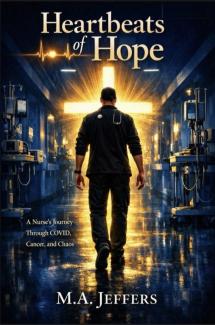
He spent more than a year thinking about how to tell that story before he started writing in February. He finished the manuscript in early summer and worked with an editor in Las Vegas through August. Going back through those memories wasn't easy.
"Some of the stories I cover in the book were traumatic," he said. "I'd shared them in some form with people I was close to, but a lot of it I hadn't shared with many people."
The back cover asks a question that stayed with him long after the danger passed: Why am I still here? He'd rather readers find his full answer in the book, but he offered part of it.
"Being here for my kids is one of the main reasons," he said. "My faith has helped me a lot. After going through some truly horrific things and not having a good prognosis, I'm just grateful to be here for my kids."
Children are also who the book's proceeds are meant to help. Jeffers is donating 50% of them to St. Jude Children's Research Hospital.
"It was awful enough going through that as an adult," he said. "I couldn't imagine going through it as a kid. Whatever I can do to help those kids and their families."
Family changed his career plans, too. Jeffers had an application ready for nurse anesthesia school when, a couple of days before he submitted it, he learned his son was on the way. His son just turned one.
"Fatherhood's the best job at the end of the day," he said.
Today, Jeffers works as a critical care educator for HCA Healthcare's Far West Division, supporting nurses at six hospitals in Las Vegas and California who are either new to the profession or moving into critical care from another specialty. He tries to set aside the student-and-instructor hierarchy of nursing school and teach new nurses as co-workers, so they feel safe to learn.
"Transitioning into critical care can be intimidating for a lot of people," he said. "I remember when I started. You can be faced with a situation you may not feel equipped for. I'm there to help shape them into critical care nurses and hopefully build some confidence along the way."
The advice he gives those new nurses is the same advice he'd give OHIO Southern nursing students today: be patient with yourself, and protect your time away from work.
"Nursing is a job that we do. A lot of it is a calling, but it's not who we are as people," he said. "You still have family. You still have hobbies and things you like to do. If you see really stressful things at work and then go home and don't take care of yourself, it becomes a cycle where you never escape the stress."
As for the book, he hopes it finds the people who need it.
"It's important to me to get my message out to people who may be struggling and could use a lifeline to get them through difficult times," he said. "Hopefully this book will be able to do that."
"Heartbeats of Hope" is available on Amazon in Kindle, paperback, and hardcover editions.