Image

Anders Saling
More than two-thirds of Ohio University students say emotional or mental health struggles have hurt their academic performance.
That's exactly the problem JED Campus was built to solve, and this fall marks year three of the work.
JED Campus is a multiyear partnership with The Jed Foundation that gives colleges a structured way to build a real mental health safety net, through assessment tools, feedback reports and ongoing strategic support. Student voices drive it at every step, from the Healthy Minds Study survey to focus groups to seats on OHIO's own JED Campus Team.
“Being a JED Campus means a connection with experts, campus communities and resources to guide efforts to support students,” said Interim Provost John McCarthy. “We mobilize everything to understand OHIO's students and their needs and to connect and expand our own assets to provide support.”
The model has real numbers behind it. The Jed Foundation's decade-long analysis, “A Decade of Improving College Mental Health Systems: JED Campus Impact Report,” found students at schools that completed JED Campus were 25% less likely to report a suicide attempt, 13% less likely to report suicide planning and 10% less likely to report suicidal ideation.
Suicide prevention training saw a 32% increase in participation last year, and OHIO is building on that momentum this fall by extending Mental Health First Aid training to the Nursing Learning Communities, giving future health care providers the same skills to recognize and respond to a mental health crisis.
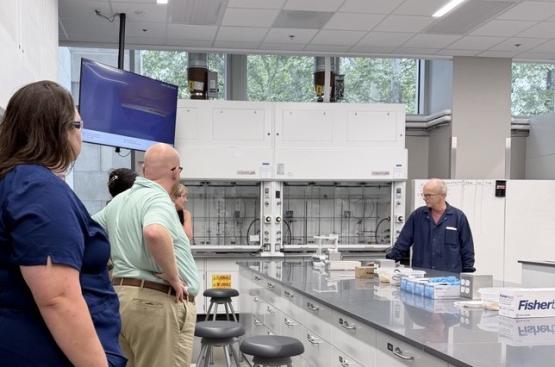
On the environmental safety side, the JED Campus Team completed five building scans this year, including a scan of the Chemistry Building, looking at each space through the lens of someone in crisis and identifying ways to apply CALM principles.
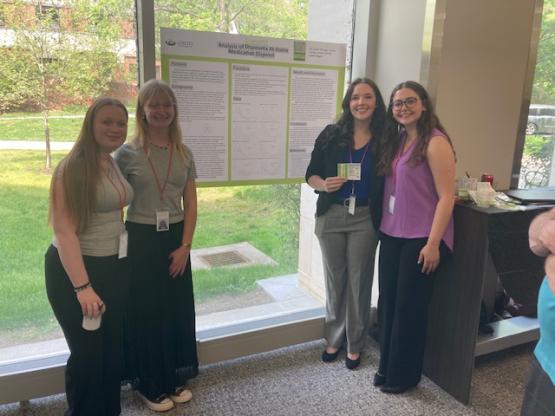
The team also hosted two medication disposal days, teaching students how safe disposal protects both people and the environment. That work continues this year, including a new pilot with Housing and Residence Life to put disposal packets directly into students' hands.
The connection between mental health and academic performance is not abstract on this campus. In the OHIO Healthy Minds Study, 69% of students said emotional or mental difficulties had hurt their academic performance on one or more days in the past four weeks.
The campaign’s subcommittee spent last year turning that number into action. After running focus groups with students, faculty and staff, the team added the tagline “Live Well. Learn Well.” to the THRiVE campaign and is now building messaging and imagery that make the link between well-being and academic success impossible to miss.
JED Campus work extends to OHIO's regional campuses as well. Each is updating its website this year to make it easier for students to find and connect with the resources already available to them. This fall, a photo project piloted at OHIO Southern is expanding to all regional campuses, with students documenting how mental and physical health show up in their academic lives.
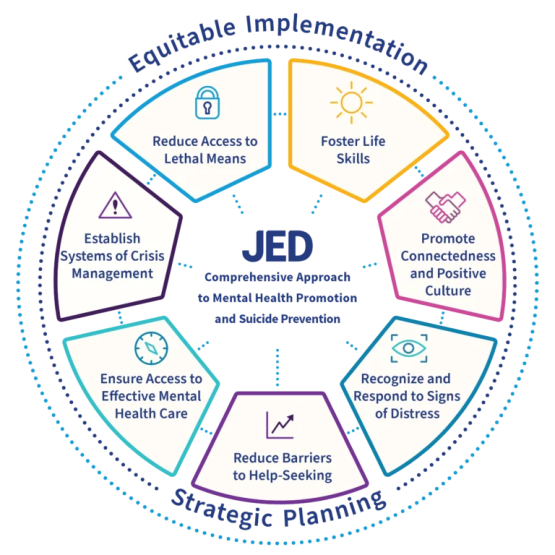
OHIO's approach runs on seven interlocking focus areas, from identifying students at risk to promoting social connectedness, all grounded in equitable implementation and strategic planning.
“In year three, the OHIO JED Campus Team wants to keep building on the work we accomplished last year. We hope to train more students, faculty and staff to recognize and respond to students in crisis, continue to conduct building scans and educate on environmental safety and CALM principles, normalize safe medication disposal and decrease the number of students who save unused and expired medications, promote help-seeking specifically among students who might be reluctant to ask, and continue to explore ways to decrease social isolation and loneliness,” said Hali Burleson, MPH, senior project planner and manager of JED and Well-Being.
Burleson, McCarthy and Mark Ferguson, assistant vice president for Well-Being, co-chair the JED Campus Initiative. Anyone on campus who wants to learn more, ask a question or get involved is welcome to reach out to any of them. Progress on OHIO's JED Campus work is available at ohio.edu/well-being/jed-campus.