Hornitos and Tonnara: Food in Sicily Students Search for the Soul of the Island on Land and Sea
Food in Sicily students studying hornitos and tonnara on Mount Etna revealed some of the forces that have shaped the island of Sicily, its peoples and its food system.
August 27, 2026
Share:
This year, Food in Sicily students hiked on Mount Etna to see examples of the geological phenomenon called hornitos, a term derived from the Spanish word for "little ovens" and popularized by Alexander von Humboldt in his descriptions of his expedition to the Jorullo volcano in Mexico. The term describes small, oven-shaped conical mounds on lava flows that emit smoke and vapors when active. Students also visited the Sirmuma Museum of the Sea in Ortigia to learn about the tonnara, a traditional, fixed coastal net system used until 2007 to trap and harvest migrating bluefin tuna.
Hiking on Etna
Mount Etna, derived from the Greek verb aíthō meaning “burn,” is a stratovolcano similar to Mount Fuji and Mount St. Helens. At 11,165 feet, Etna is the highest volcano in Europe and the most active stratovolcano in the world, with eruptions dating back 500,000 years and documented for at least 2,700 years. In Greek mythology, Hephaestus (Vulcan in Roman mythology) was the god of fire and blacksmithing, and Mount Etna was his forge. Another story described one-eyed giants or Cyclopes working alongside Hephaestus to forge thunderbolts for Zeus, king of the Greek gods. In another myth, Zeus imprisoned Typhon, a monstrous giant with 100 heads, beneath Mount Etna. In "The Odyssey," Odysseus and his men were terrified by the rumblings and booms they heard as they sailed past eastern Sicily, sounds they attributed to giants and gods below Etna. Etna was also considered to be a portal to the underworld ruled over by Hades, the god of the dead.
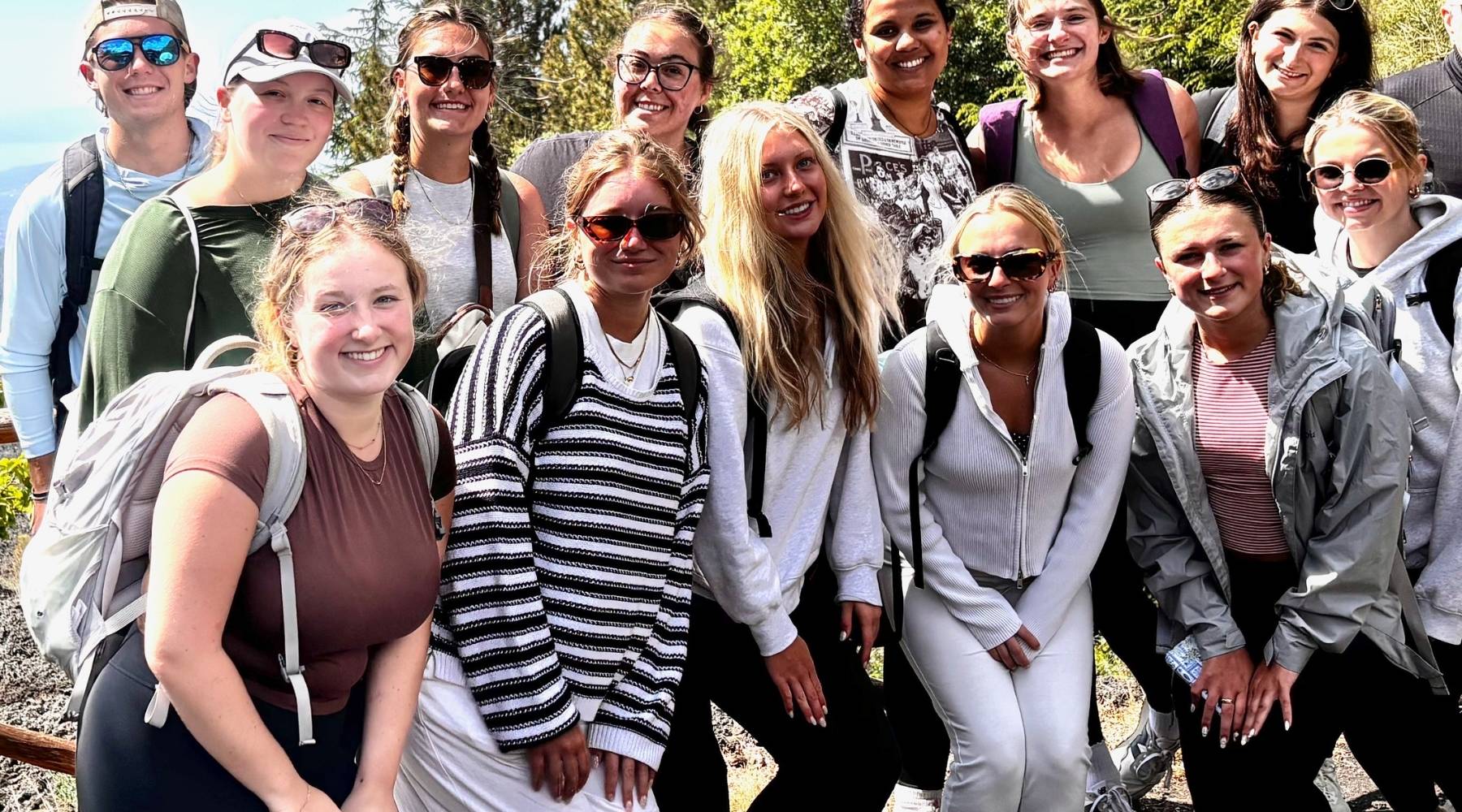
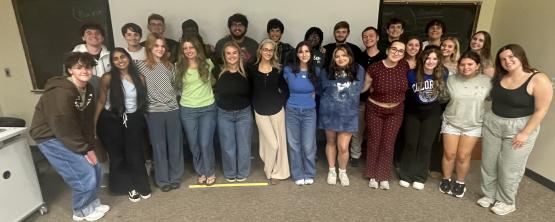
(top row: left-to-right): Jackson Stratham, Lauren Elliott, Kate Nolette, Sadie Sincak, India Dyer, Julia Drazga, Bianca Fant. (bottom row: left-to-right): Josie Brubaker, Lauren Faulhaber, Olivia Jeras, Izzy Caruso, Meena Kraus, Sammy Reitz.
Locals refer to Etna as "La Montagna" or "A Muntagna" in Sicilian. The gendered pronoun reflects the Sicilian view of Etna as a female entity, a mother or a grand, unpredictable "signora," wielding destructive power but also creating fertile terrestrial ecosystems of vineyards and orchards on its lower slopes. Historically, Etna is also known as "Mongibeddu" in Sicilian, from the Latin "mons" and the Arabic "jabal," both meaning "mountain," which produces a tautological toponym "mountain mountain" (similar to other tautological toponyms such as Lake Tahoe, Mississippi River and Sahara Desert). Despite the destruction of towns it has caused and the regular closing of Catania Airport due to volcanic ash clouds, Etna in Sicilian culture is seen as a symbol of resilience and vitality.
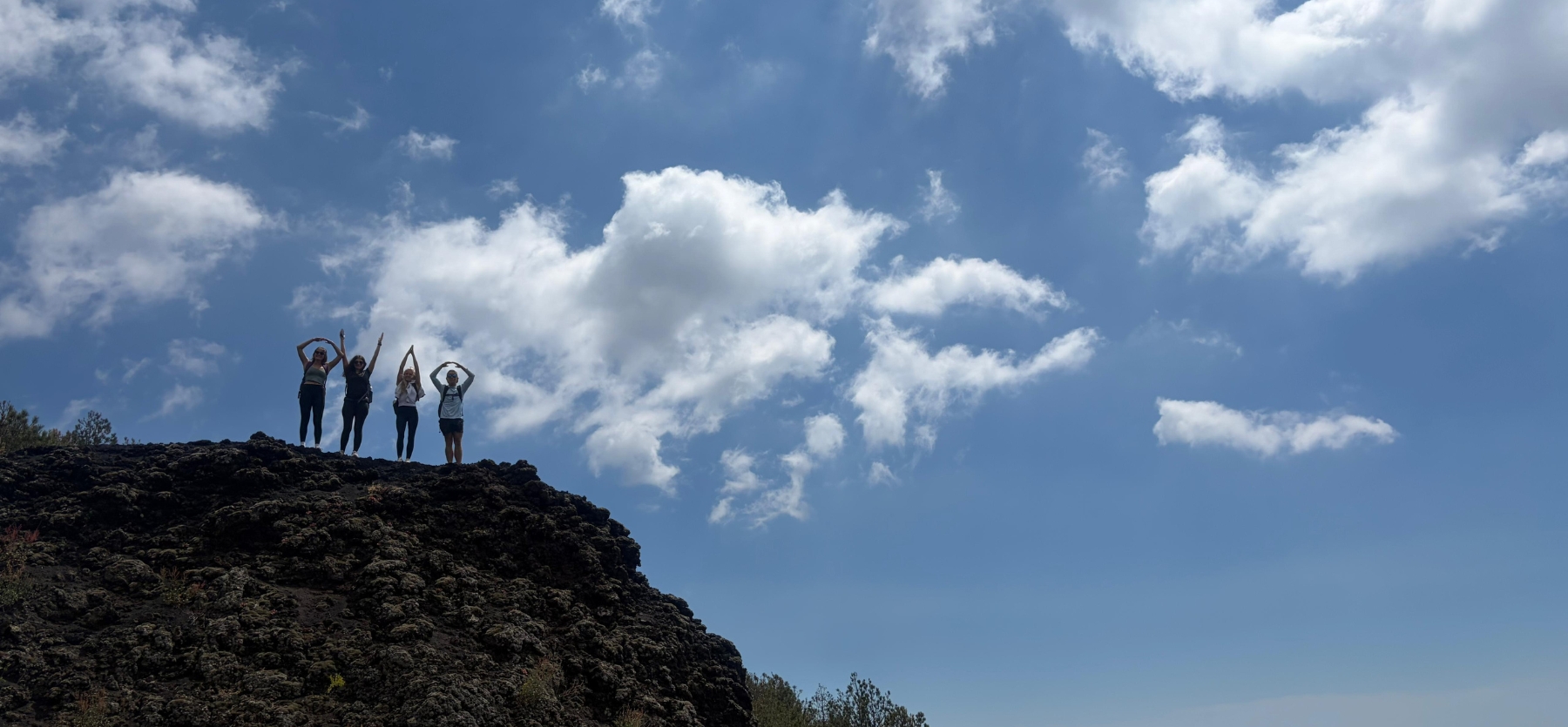
Starting at 6,000 feet, our Food in Sicily five-mile round-trip hike, led by vulcanologist Francesco Ciancitto, ascends gently through woodlands of chestnut, oak, pine, birch and beech trees. Higher up, we encounter wildflowers, including the intensely bright yellow Etna broom, wild orchids, and endemic violets blooming directly out of the dark volcanic ash. We then travel through lava fields of varying colors, from the newer black lava flows to the older grey flows colonized by lichen, until we finally reach our destination, the hornitos.
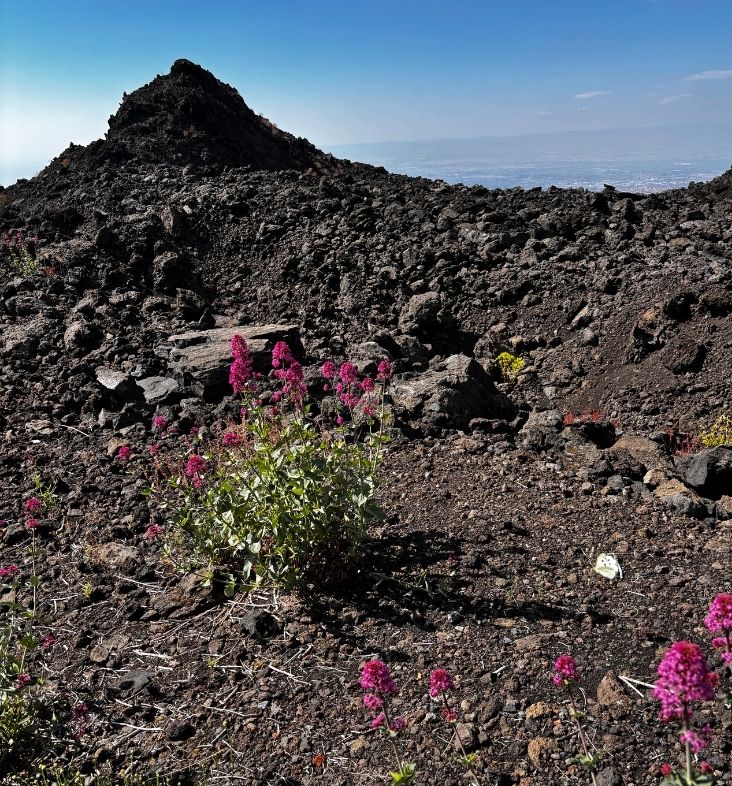
An example of a hornito structure on Etna.
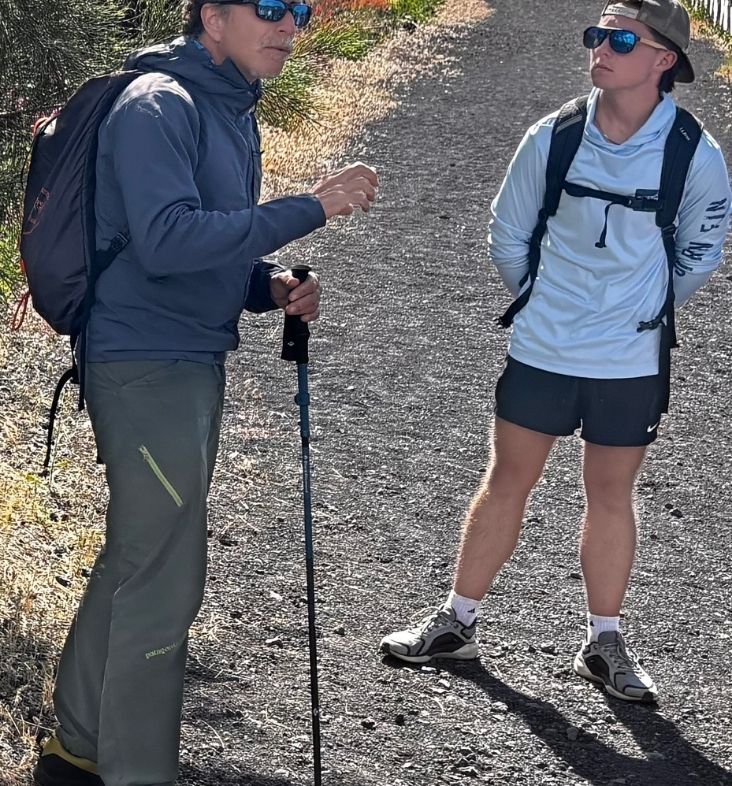
Vulcanologist Ciccio Ciancitto with Jackson Stratham.
Francesco, or Ciccio, as he is more commonly known, explained how hornitos are formed. When a volcano erupts, flowing streams of fluid lava cool on top, forming a solid crust and creating an underground lava tube system similar to cannoli. Rising volcanic gases push small amounts of trapped molten lava, or ricotta, to extend the cannoli metaphor, upward through weak spots in the roof of the tube, where the hot rock quickly cools and solidifies in the air. As the lava solidifies, it builds up on the surface, creating structures as high as 30 feet. The hornito that the students explored was, of course, inactive. But one could imagine that when it was active, it would resemble a portal to Hades. And maybe it still is traveled by souls entering the underworld and exiting to wander the island.
The Museum of the Sea and the Story of Tuna Fishing
The Museum of the Sea was originally the idea of brothers Daniele and Sebastiano Aliffi, descendants of one of Siracusa’s historic carpentry and shipbuilding families. The aim was to preserve the vanishing heritage of local fishermen and boatbuilders as traditional shipyards closed down. The collection, however, is not just tools and models but also an oral history archive of the stories of those who worked on the port, built boats for generations and participated in the tuna harvesting, or "mattanza."
The Sicilian tonnara is a system of fixed coastal net traps originally developed 2,500 years ago by the Phoenicians to intercept migrating tuna. The Arabs refined and expanded the intricate network of underwater chambers and introduced the terminology of the tonnara, including the word "rais," or “chief,” to describe the master fisherman in charge. Atlantic bluefin tuna migrate thousands of miles to their spawning grounds in the Mediterranean. As the large schools of tunas come closer to the coast (usually around April and May), a wall of nets forces them to enter a labyrinth of nine chambers that stretches up to two miles long. As the fish fill the chambers, the tuna are moved into the next chamber until they all end up in the final chamber, or "camera della morte" (the chamber of death). This kill chamber is the only one that has a net floor. At a signal from the rais, the fishermen positioned in boats around the kill chamber start hauling up the nets, singing traditional work songs, or "cialome," until the tuna appear thrashing around at the water’s surface. Now the mattanza or "killing," begins. The tuna are harpooned and hauled into compartments behind the fishermen. Atlantic bluefin tuna can weigh up to 1400 pounds and measure up to 12 feet long. You can watch actual footage of the mattanza taken from Roberto Rosselini’s 1950 movie "Stromboli (Terra di Dio)" starring Ingrid Bergman.
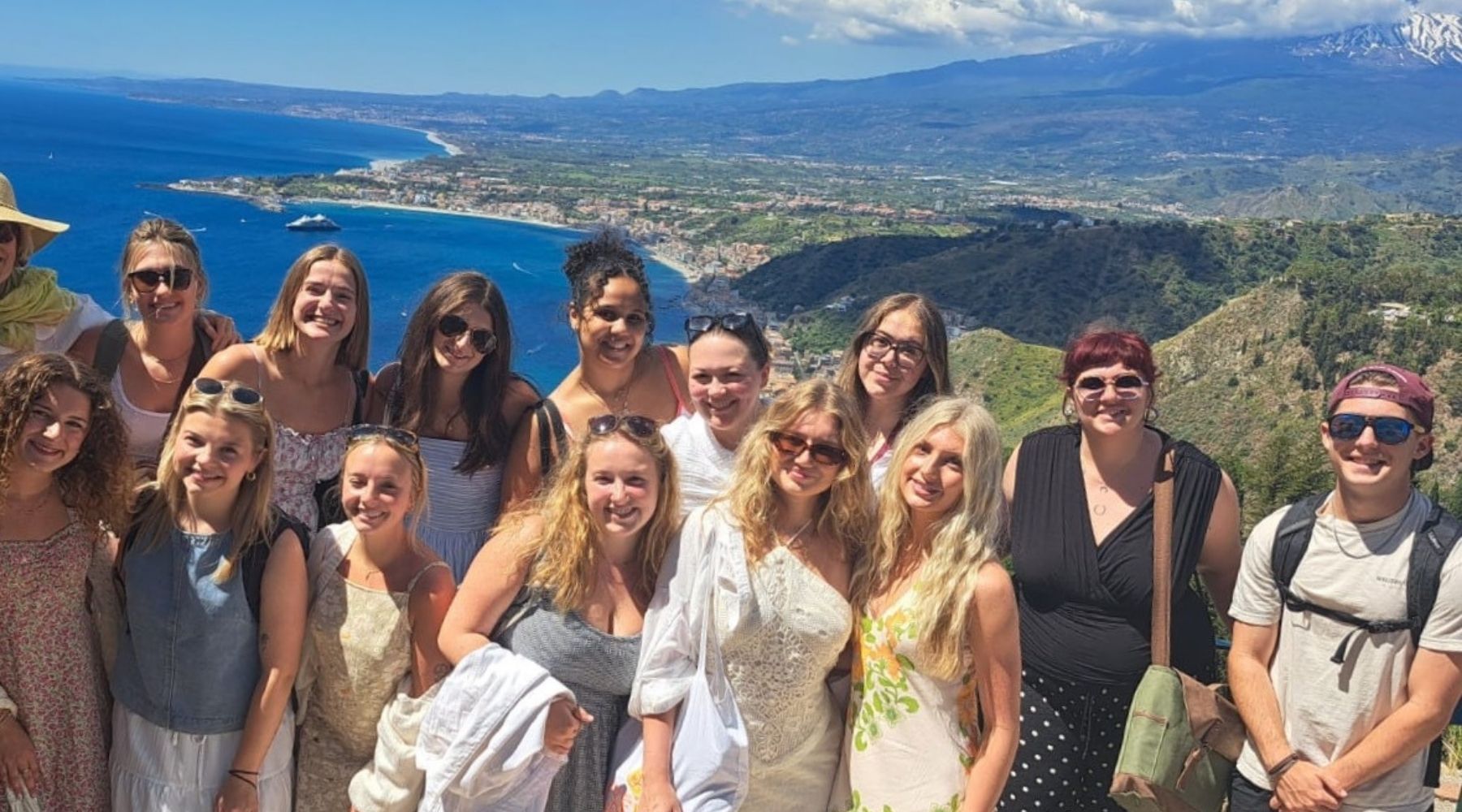
View from the Greek Theater at Taormina of the peak of Mount Etna and the coastline down to Siracusa (top row: left-to-right): Kate Nolette. Julia Drazga, Bianca Fant, India Dyer, Lauren Elliott, Sadie Sinchak, Gaia Pintaldi (Exedra faculty), Jackson Stratham; (bottom row: left-to-right): Meena Kraus, Sammy Reitz, Izzy Caruso, Josie Brubaker, Lauren Faulhaber, Olivia Jeras.
Tonnara is also used to refer to the canneries that were developed along the coast of Sicily, mainly by the Florio family in the 1800s. With the rise of industrial overfishing and European Union quotas, Sicily's traditional coastal fishing economy has been devastated, closing canneries and bankrupting small-scale fishermen. The last mattanza was held in 2007. Many of the canneries have now been repurposed as tourist attractions. The most famous of these is the tonnara on the island of Favignana, now a museum telling the story of the mattanza and recently a filming location for the 2026 movie "The Odyssey."
Food in Sicily Study Away Program
Food in Sicily is a faculty-led program for Ohio University credit. In OHIO study away programs, students earn OHIO credit, take courses with other OHIO students and are taught by OHIO faculty. A student's financial aid package applies the same as it would for on-campus courses.
Food in Sicily is open to undergraduate and graduate students, and students can earn six credit hours while learning how to make mozzarella, practicing Italian with "Table and Market" dialogues, meeting with local social enterprises, volunteering at a local soup kitchen, taking cooking classes, and visiting farms, olive oil makers, and wineries.
The Food in Sicily program is based in Ortigia, a neighborhood in the Sicilian city of Syracuse. Additional program activities include market tours and cultural visits to Noto and Taormina. Students also hike on Mt. Etna and enjoy time on Sicilian beaches.
For more information, visit the Food in Sicily webpage or contact Dr. David Bell.