Image

An ongoing partnership between the state and the George V. Voinovich School of Leadership and Public Service at Ohio University is setting students on the path to success in the business world.
The Ohio Procurement Internship Program (OPIP), administered by the Ohio Department of Development in conjunction with state universities, links students and businesses with the joint goal of enhancing their knowledge and expertise in the realm of government contracting.
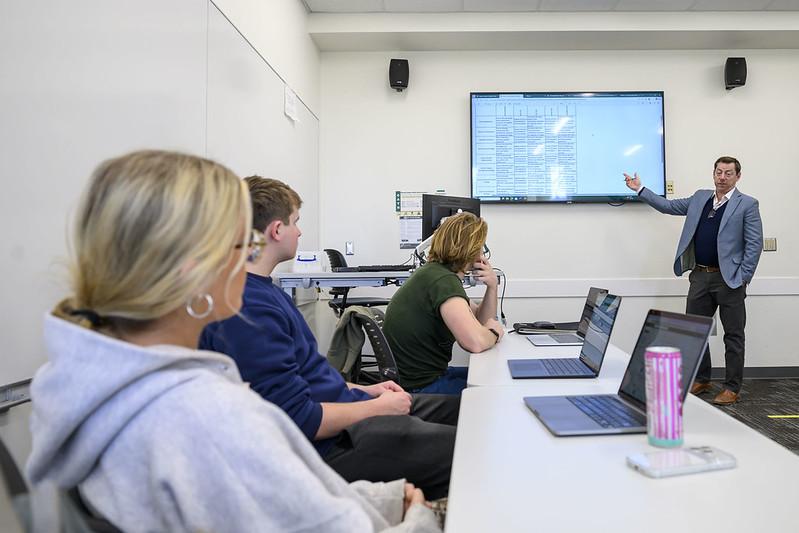
The course within OHIO’s College of Business is taught by Billy Grill, Southwest Ohio associate director for the APEX Accelerator at Ohio University, which helps Ohio businesses navigate the complexities involved in obtaining government contracts.
Grill said he brings that business focus to a class that aims to teach students “the basic acquisition life cycle and the tools that you could use to build out a plan and start helping small businesses” in the procurement space.
“The most valuable thing about that class for the students is I run it like a business, so there’s a lot of teamwork," he said.
Students are given a project to work on together and develop a procurement plan for a theoretical company, and then they present the plan to instructors toward the end of the course.
Along the way, they learn how to develop requests-for-proposals, navigate SAM.gov and other government contracting websites, and develop a range of other skills tied to the procurement process. In addition, students hear presentations from professionals in the field.
At the completion of the course, OPIP students are ready to begin their summer internships.
“For their upcoming internships, knowing how to utilize those tools and digest that data gives them such an advantage over a lot of other students coming out and this is a very niche space,” Grill said. “So once you know it, you tend to stick to it and create those relationships, because there's just so much need, especially here in Dayton, with our small businesses. They're hungry for that talent.”
Grill keeps in touch with the students during the internships and provides guidance as needed.
Matthew Fischer, who is interning this summer with a company in northeast Ohio, said that ongoing support has been especially helpful. His work with Madison-based Great Lakes Power has included monitoring SAM.gov and USASpending.gov for procurement opportunities for the company, a distributor and manufacturer of power transmission products for heavy-duty marine and off-highway applications.
“The class really helped to get comfortable with that, and going back to Billy whenever I need to helps me out with whatever I’ve got going on here,” Fischer said.
Under the OPIP program, at least half of the work done during the internship has to be procurement-focused and the remainder of the time is flexible. As a marketing major expected to graduate next year, Fischer said the company has him producing online videos and marketing surplus inventory.
Fischer, whose mother went to OHIO and his sister is expected to follow suit, recommended OPIP for business majors looking for internship opportunities. He said the program was especially helpful to him in landing an internship, which is a requirement for graduating with a business degree at OHIO.
“This is a great way to find an internship,” he said. Fischer had been undecided about his internship before discovering the program.
Spencer Johnson, who is currently seeking his Master of Public Administration degree from the Voinovich School, also spoke highly of Grill’s course even though he’s meeting the internship requirement in a roundabout way.
Due to timing conflicts with his MPA work, Johnson took an internship related to his graduate degree pursuit in Washington, D.C. with the National League of Cities, which dovetailed nicely with his OPIP class.
Johnson, who is working on NLC’s Legacy Forward Initiative to support second-stage businesses in 10 cities, plans to pursue a career in state or federal government. He saw the OPIP program as a fit to help achieve those goals.
“I was drawn to the program because I’m someone who has spent a lot of time over the past year working on a lot of economic development and sustainability work. What drew me to procurement was being able to have small and legacy businesses or even larger sized businesses be able to procure and kind of anchor their local economy,” he said.
“That was extremely interesting to me – especially as someone who is interested in government – that intersection of economic policy, procurement and government. That’s why I decided to take the course, and they did a very good job being able to connect all three of those things throughout the entire course,” Johnson said. “It made us realize how important procurement is as a tool for local economies as well.”
During the OPIP course, Johnson said students developed a request-for-proposals (RFPs) plan and created a theoretical company called Veteran’s Electric, a disabled veteran-owned small business. A final presentation outlined a strategy to enter the market as a subcontractor and piggyback off the relationships that the company built, he said.
Johnson, who holds a social studies education degree from Kent State University, said various presenters during the course were extremely helpful.
“We brought in a lot of procurement practitioners, a contracting officer, people who are able to work in and around Wright-Patterson Air Force Base. We talked to a lot of people who have obviously spent a lot of time in procurement, so it was really interesting to get their perspective on things and different insights.,” he said.
While he ended up immediately taking an internship related to his MPA degree, Johnson said the OPIP course has been very relevant to his current work.
“It really is a lot of practical information and implementation of the things you are learning. It’s helpful for me right now in this internship,” he said. “We are talking a lot about how to help local economies with aging businesses. I’m actually writing a blog right now about how procurement can be used as a tool to secure and sustain legacy businesses.”
Grill said participating businesses have given OHIO interns and the OPIP program high marks, and some have ended up being repeat hosts for the university’s students.

Among those is D’Angelo Technologies, LLC, which so far has hosted four OPIP interns. The Beavercreek firm is primarily a U.S. Department of Defense contractor offering a range of services including engineering, research and development supports, rapid prototyping and modernization.
“We’ve really enjoyed the program,” said CEO Maurissa D’Angelo, who also serves as an adjunct professor at Wright State University.
OHIO student Jonathan Kashou is among six interns currently working at the firm.
Interns at the company get started reviewing information about its workings and are asked for feedback on how to improve the presentations.
Moving forward, D’Angelo said, “We do a lot with having them look into government opportunities” through bid searches.
“If they see one that fits within our wheelhouse they’ll send them to us and we also try to have them all at least support writing one proposal so they get a flavor of how a proposal is written for the government and the intricacies,” she said. “We try to get them a flavor of everything they would see in the government world.”
Kashou is currently creating a product website for the company, D’Angelo said.
“We really threw him into the fire,” she said. “He’s also diving into a NATO request-for-proposal that we wrote last year and didn’t win, and he’s going to rewrite it for this year.”
D’Angelo said OPIP interns come to the firm well-prepared to do procurement work.
“It’s been a great program, and the instructors set these guys up very well for hitting the ground running,” she said.
The OPIP program is made possible by the Appalachian New Economy Workforce Partnership (ANEP). Administered through the Ohio Department of Higher Education and appropriated to Ohio University’s Voinovich School, ANEP supports a suite of business and economic development programs. Since 2001, ANEP has invested millions in economic development initiatives across the 32-county Appalachian region.