Image


Researchers at Ohio University have filed a patent after using advanced molecular simulations to uncover, for the first time, how a pioneering growth hormone drug works at the atomic level—a discovery that could pave the way for a new generation of more potent treatments for growth hormone disorders.
July 22, 2026
Share:
A newly filed patent from researchers at Ohio University could help develop more effective treatments for disorders related to growth hormone, thanks to a discovery that reveals exactly how a groundbreaking drug works at the molecular level.
The patent, filed by researchers in the Heritage College of Osteopathic Medicine and the Russ College of Engineering and Technology, stems from a collaboration between Dr. John Kopchick, whose research led to the development of a growth hormone antagonist currently used to treat acromegaly, and Dr. Sumit Sharma, a computational scientist whose team specializes in molecular simulations.
Together, the researchers, alongside Russ College Ph.D. student Hemant Nagar, used advanced computer modeling to uncover a previously unseen molecular interaction that could lead to a new generation of more potent growth hormone drugs. Nagar led many of the simulations and calculations behind the discovery, helping translate a decades-old scientific question into a patentable discovery.
"We figured out the mechanism of how this drug is working," Sharma said. "That also gives us ideas about what we can change further in the molecule so we can have a more effective drug."
The discovery builds on a question Kopchick has been asking for more than two decades.
Nearly 25 years ago, Kopchick and collaborators developed a modified form of human growth hormone that inhibits excessive growth hormone activity rather than promoting growth. The drug ultimately became an FDA-approved treatment for acromegaly, a rare disorder caused by excessive production of growth hormone.
But despite years of successful clinical use, scientists never fully understood why a single amino acid change in the molecule transformed it from a growth-promoting hormone into a growth-blocking therapy.
"When we were talking with FDA officials years ago, everyone had to explain how they thought the compound worked," Kopchick explained. "The explanation was that we changed one amino acid and now the growth hormone doesn't fit correctly to the growth hormone receptor. But I always wondered, 'Is that all?'"
That question led Kopchick to seek out Sharma several years ago after learning he taught a graduate course in molecular simulations.
"I sat in on his class because I wanted to dig deeper," Kopchick said. "I wanted to understand what was actually happening at the atomic level."
Using high-performance computing and molecular simulations, Sharma's team recreated the interaction between growth hormone and its receptor (over 600 amino acids each with several atoms). Starting with experimentally determined protein structures, the researchers surrounded the complex with nearly 5,000 water molecules and simulated how every atom moved and interacted over time.
"We have the growth hormone and growth hormone receptor structures, and we can locate each atom in those proteins," Sharma explained. "Then we place water molecules around them and simulate how the atoms move at body temperature and how they influence each other."
By comparing the natural growth hormone with the modified therapeutic version, the researchers observed something no one had previously seen.
"We found that one amino acid in the receptor changes its orientation and completely flips out of its original position," Sharma said.
That seemingly small movement has major consequences.
Normally, growth hormone forms three strong ionic and hydrogen-bond interactions with its receptor. Sharma's simulations revealed that when the amino acid flips, one of those interactions breaks, reducing the total number of stabilizing bonds from three to two.
"When this flip happens, it breaks one of those bonds," Sharma explained. "It's not only flipping, it's breaking an interaction that is critical for how the hormone binds. We figured out the mechanism of how this drug is working, and that also gives us ideas about what we can change further in the molecule so we can have a more effective drug."
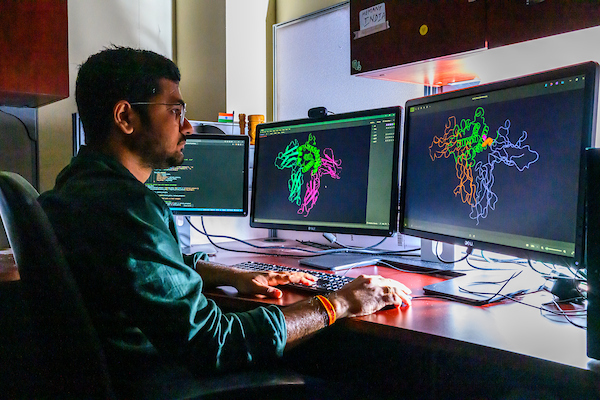
For Nagar, who came to Ohio University from India after earning bachelor's and master's degrees in chemical engineering, the project combined two passions he had been pursuing for years: pharmaceutical research and computational modeling.
"I was looking for a Ph.D. where I could work in pharma and understand how drugs are designed and how they work," Nagar said. "Then I came across Dr. Sharma's work on proteins and drug development, and it aligned perfectly with what I wanted to do."
Nagar said the project challenged him to look beyond what could be observed in laboratory experiments.
"We wanted to know what was actually going on when the drug was working, what interactions were happening and how molecules were interacting with different parts of the system," he said.
The discovery does more than solve a longstanding scientific mystery; it also reveals new opportunities for designing future therapies.
By identifying the precise molecular interactions responsible for growth hormone activity, researchers can begin engineering drugs that either strengthen or weaken those interactions depending on the condition being treated.
The implications could benefit two very different groups of patients – those with growth hormone deficiency and those with acromegaly, a condition caused by excess growth hormone that can lead to enlargement of bones, organs and soft tissues.
For children with growth hormone deficiency, researchers could potentially develop more effective growth hormone therapies that stimulate growth with fewer doses. For patients with acromegaly and related disorders, scientists could create more potent antagonists that better suppress excessive hormone activity. One of the most well-known examples of someone living with acromegaly was professional wrestler Andre the Giant.
"Potency is the key word," Kopchick said. "Now that we understand these interactions, we can start designing molecules that are even more effective."
The patent application outlines potential modifications that could be made to growth hormone-based therapeutics, creating opportunities for future drug development and commercialization.
"The results are startling, and the implications are even more startling," Kopchick said.
The research also demonstrates the growing role of computational science in biomedical discovery.
Rather than relying solely on laboratory experiments, researchers can now use simulations to test ideas and predict molecular behavior before synthesizing compounds in the lab.
"This allows us to design with much more information ahead of time," Sharma said. "We can understand what's happening at the molecular level and make better decisions about what compounds to pursue."
To conduct the research, Nagar performed simulations that tracked molecular movement in increments of femtoseconds — quadrillionths of a second. Determining the energetics behind the receptor's structural changes required 72 separate simulations, each generating 15 million molecular configurations. Altogether, the project required analyzing millions of molecular snapshots.
"To understand the dynamics of these interactions, we are essentially looking at millions of snapshots of how the system behaves," Sharma said. "That level of detail helps us understand the physics behind what the molecules are doing."
For Sharma, one of the most rewarding aspects of the project has been seeing doctoral student Hemant Nagar lead many of the simulations and calculations behind the discovery.
"He is the first author on the manuscript and first name on the patent," Sharma said. "He has done all the simulations and the calculations. He's very smart and very enthusiastic."
Nagar credits both Sharma and Kopchick for helping guide the research.
They are an encyclopedia of knowledge. Dr. Sharma's expertise in computational modeling and Dr. Kopchick's knowledge of drug development helped pave my research. The information and help they gave me was invaluable.
The project also gave Nagar an opportunity to see how discoveries made in a university laboratory can ultimately improve patient care.
"Seeing what happens in the pharmaceutical industry and then coming back to research, I knew I wanted to understand how drugs are designed and how they work," Nagar said. "Being part of a project like this has been a unique experience because you're not just learning science — you're helping create new knowledge."
Sharma said the possibility that the research may improve peoples’ lives is deeply meaningful, and that mentoring students through discoveries of this kind is one of the satisfying aspects of academic research.
"John’s discovery has had an extraordinary impact, likely saving thousands of lives. Our goal now is to build on that legacy and extend its benefits even further," Sharma said.
The team is continuing to build on the findings, conducting additional simulations and preparing a scientific manuscript detailing the discovery. The researchers hope the patent will eventually attract industry partners interested in licensing the technology and advancing the next generation of growth hormone therapeutics.
"We already know through these simulations that what we initially built is working," Nagar said. "Now we're exploring whether there are other hidden interactions that can help us design even better treatments."
For Kopchick, the ultimate goal remains improving the lives of patients.
"If we're going to do something in our lives, we might as well do something that benefits people with diseases,” he said.