Image
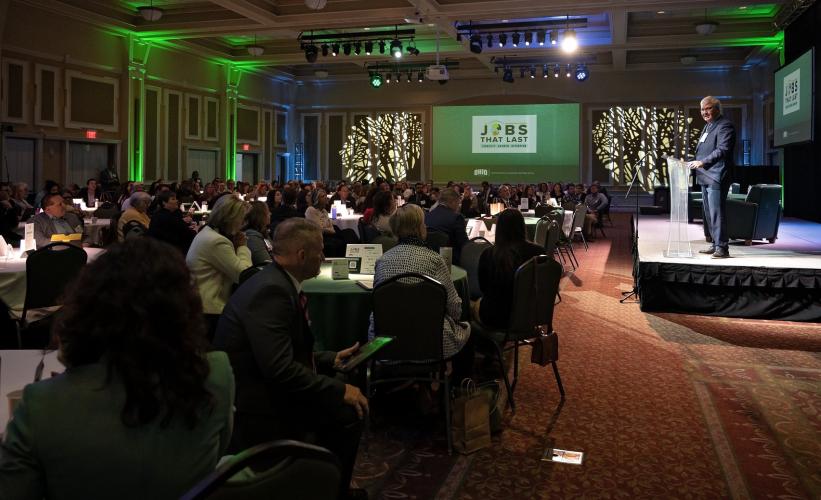
The 14th Annual Appalachian Ohio State of the Region Conference held May 12 underscored key contributions to the economic and social fabric of southeast Ohio by the George V. Voinovich School of Leadership and Public Service.
Held on the scenic Ohio University campus, the conference’s theme of “Jobs that last; Stability. Growth. Retention.” provided valuable insights on workforce, education, development, energy and other regional initiatives for attendees to take back to and benefit their communities.
Hosted by the Voinovich School, the event, characterized by Dean Tracy Plouck as an opportunity to “learn about what is working well in the region,” drew more than 350 attendees in person and online.
OHIO President Lori Stewart Gonzalez kicked off the conference by welcoming attendees to “the most beautiful campus in Ohio” and acknowledging the efforts of the Voinovich School to improve Appalachian Ohio.
“They do every day what a university is supposed to do: reaching out to the community to partner and work together to make our region strong,” she said. “It shows what Ohio University strives to be all the time: a university that listens, that we partner and we try to transfer knowledge in a way that would improve the region and the lives of our citizens.”
“At OHIO, our commitment to Appalachian Ohio is not just in words it’s actually in deeds, and we make sure we do that in health care, in education, in so many areas,” Gonzalez added, stressing the importance of the many partnerships forged between the university and the community.
Dr. Vicki King-Maple, executive director of the Ohio Mid-Eastern Governments Association, emceed the event, which included comments from Miss Ohio Olivia Fosson, a Lawrence County native who discussed the Miss Ohio Scholarship Program.
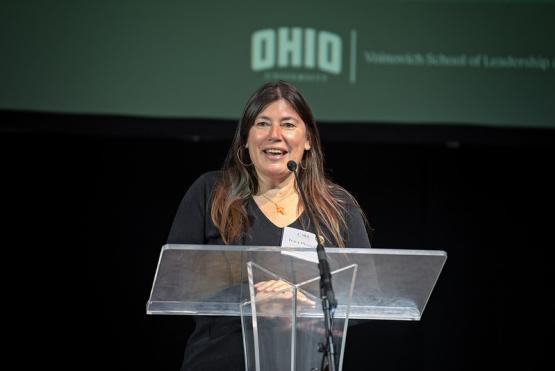
Other welcoming remarks were shared by John Carey, an OHIO graduate who served many years in the state legislature and is currently director of the Governor's Office of Appalachia, and Matt Abbott, president and CEO of Ohio Southeast Economic Development (OhioSE).
Carey cited the importance of partnerships between his office, the university and other entities, including local development districts.
“I can’t tell you how important they are. We basically wouldn’t be able to do what we do” without the help of the districts and local governments, he said, citing the work of the Mayors’ Partnership for Progress and others.
While noting that some $2.2 billion has been invested in Appalachia by the Ohio Department of Development in the last eight years, Carey urged attendees to look to the future and think about how to capitalize on those investments.
“With opportunities come challenges. I think we’ve all been stretched as we do everything we can to promote our region,” Carey said, stressing the importance of local planning for the future. “We have to be ready to seize the opportunity when it becomes available.”
Abbott, a Muskingum County resident, said there’s a lot of optimism in the 25-county southeastern Ohio territory, which serves as a network partner to JobsOhio.
“There’s a lot of good things happening in our region,” he said. “We must continue to celebrate it, lock arms and work together in the success that we’re seeing now and the success I think is in the future.”
Abbott listed some statistics underscoring those successes: last year OhioSE worked on 25 projects entailing 825 new jobs and $1.6 billion in new investments, he said.
“That’s collective with people in this group we were able to work with to get those projects done,” he said.
Since 2011, the region has seen more than 450 projects, over 13,000 new jobs created and close to $16 billion in new capital investments, he said. More than $50 million has been put into site development, and over the last five years, 12 spec buildings were developed and only three are still available.
Abbott also cited the area’s strength in energy production.
“That’s what sets us apart,” he said. Including other sources in Western Pennsylvania and West Virginia, he added, “If we were a country…we’d be the third-highest natural gas country in the world.”
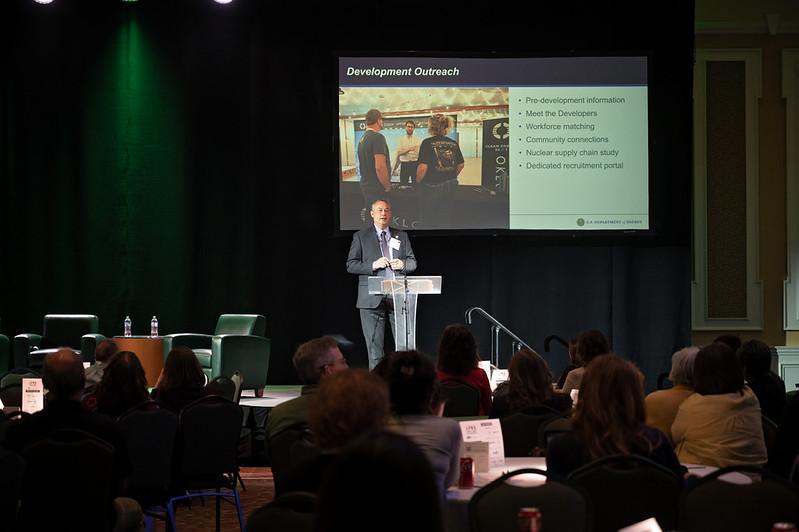
Energy and job creation took center stage at the conference with a keynote speech from Joel Bradburne, principal deputy assistant secretary for the Department of Energy's Office of Environmental Management. Bradburne focused his remarks on the Voinovich School’s integral involvement in the redevelopment of the former Portsmouth Gaseous Diffusion Plant in Pike County.
The school’s PORTSfuture initiative, led by the Voinovich School’s Director of Energy Programs Stephanie Howe, has connected federal, state, and local entities and immense resources in the multi-year effort to rejuvenate and repurpose the 3,700-acre site.
In the last several months, the project has attracted huge investments, including an October announcement by Centrus Energy Corp. for a multi-billion-dollar expansion to its uranium enrichment facility, and further announcements regarding U.S. Department of Energy backing of the Centrus plans, an agreement between Oklo Inc. and Meta Platforms, Inc., and a public-private partnership with SoftBank/SB Energy and AEP Ohio to launch the PORTS Technology Campus at the site.
The latter initiative will accelerate site cleanup and redevelopment, modernize the regional energy infrastructure, and develop advanced computing projects in Southern Ohio. SB Energy announced an initial investment of over $37 billion, combining a $33 billion 10 GW power plant with $4.2 billion in AEP Ohio grid upgrades to support a new Artificial Intelligence data center.
Howe joined Bradburne’s presentation via a video link to detail the significant job-creating developments, which the DOE official described as mindboggling.
Lauding Howe’s years-long efforts on the projects, including critical data collection to help guide them, and the related work of the Southern Ohio Diversification Initiative, Bradburne said the recent announcements underscore the Voinovich School’s focus on public-private partnerships.
“This is the big catch,” he said. “It’s a huge economic impact.”
Bradburne nonetheless urged conference attendees to keep moving the ball forward toward continued revitalization of the site.
“The future is incredibly bright,” he said. But advancing the project “will need some help pulling this off.”
“It’s going to take you in the room to pick it up and drive it where it needs to go,” he added.
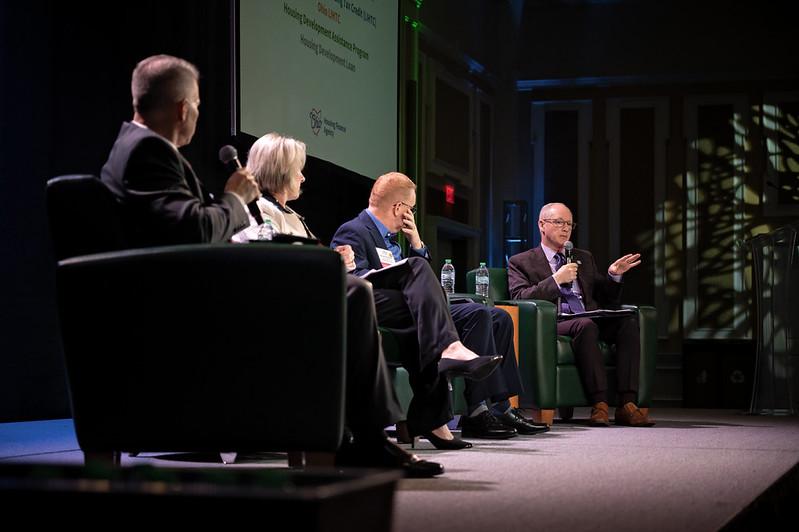
The all-day conference also featured panels discussing housing, development and education issues.
The Building Stability: Housing Solutions that Strengthen Regional Economies Panel included: Bill Beagle, executive director of the Ohio Housing Finance Agency (OHFA); Julie Needs, executive director of the Sustainable Opportunity Development Center in Salem; Brian Wagner, CEO of the Muskingum County Community Foundation; and moderator Mike Jacoby, managing director of economic development for Bricker Graydon Wyatt.
Jacoby said housing is a key to economic development, and that challenges in the region include rent increases, an affordability gap and shortage of units for low-income residents. The age of housing stock and energy costs are more unique to the area, leading to a shrinkage of stock that falls apart and needs to be demolished, he said.
Beagle outlined the various OHFA programs, noting there are more applications than available assistance. Responding to a question about the agency’s proactive efforts to support housing in underserved areas of the state, he said OHFA has opened up the rulemaking process and is working harder to make sure more interested parties are involved.
He also noted that OHFA has set-asides for strategic initiatives in certain areas and for “transformative economic development mega-sites.” In addition, Department of Tourism areas are identified to make sure they all get one or two projects, and Ohio Housing Trust Fund dollars are targeted to rural projects in conjunction with the Low Income Tax Credit Program.
Needs discussed how Salem took the initiative to address local development with Elevate Building Solutions. At issue was low housing development not keeping up with high business development due to permitting delays and other issues, she said. Elevate Building Solutions, which has helped build “housing momentum,” has grown into a shared services partnership between Salem, Columbiana, Leetonia and East Palestine.
Wagner detailed the foundation’s work in supporting economic development and discussed plans to develop 100 new market-rate housing units at the 74.5-acre property former Leasure Family Farm site. He told a conference attendee that partnering with a local developer was a key in moving forward with the development.
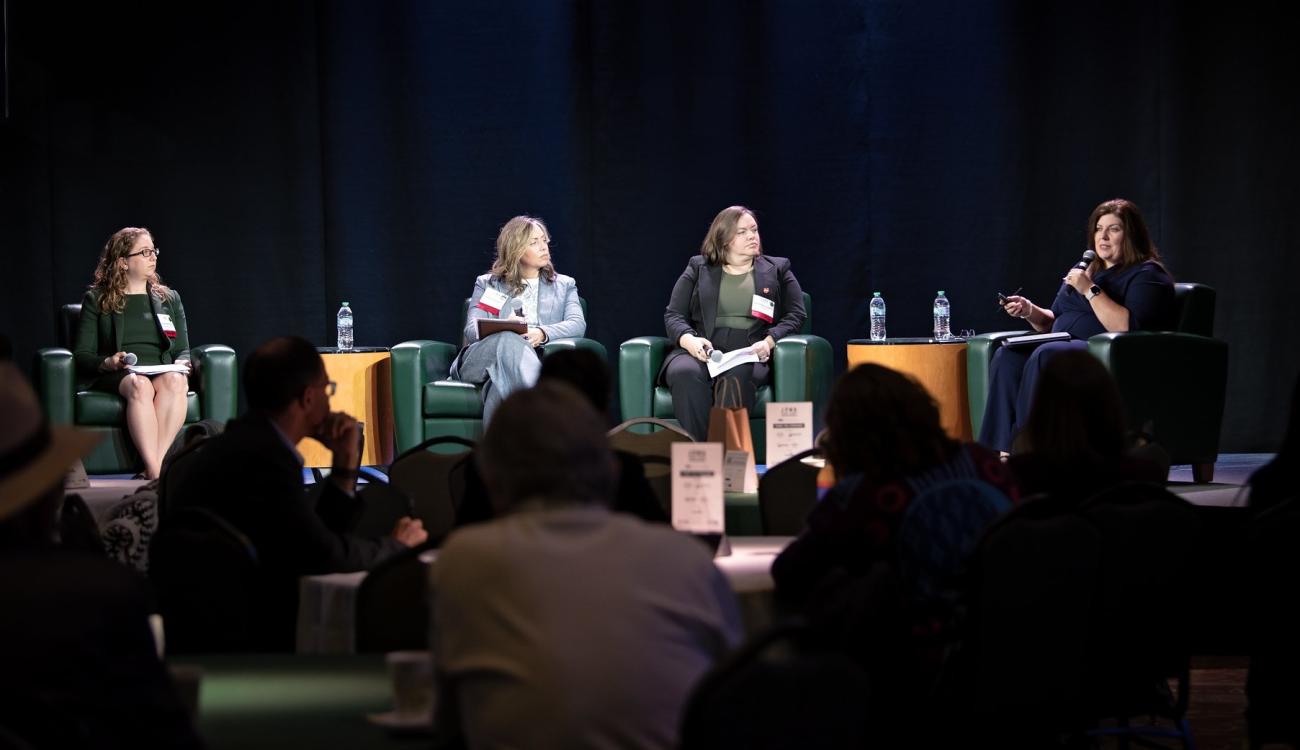
The Fueling Growth: Innovative Financing for Regional Expansion Panel included: Hannah Baumgartel, senior program manager, Small Business and Community at JobsOhio; Tiffany Swigert, executive director of the Coshocton Port Authority; Lisa Eisenberg, senior director of Debt Management in the State Treasurer’s Office; and moderator Chasity Schmelzenbach, executive director of the Buckeye Hills Regional Council.
Schmelzenbach pointed out that most Joint Economic Development Districts and Tax Increment Finance Districts are in other regions of the state, and that Appalachia also lags behind in infrastructure development. The state’s Opportunity Zone program is expanding in coming years, but funding remains spotty across designated areas.
“We’re starting to proliferate with some of those items, but it is taking time,” she said.
Eisenberg outlined how the TOS Ohio Market Access Program helps local communities leverage the state’s financial resources to get lower debt costs for local projects. The credit enhancement program for local governments covers debt issuances for a variety of projects, she said.
Baumgartel, who holds two degrees from OHIO, said JobsOhio has spent the last several years trying to reach more areas of the state. Initiatives on that front include the Small Business Grant Program, partnering with other entities to reach more areas, a Pre-project planning grant and the Vibrant Community Grant Program, she said.
Swigert discussed the development of the Coshocton Collaborative, 24,000-square-foot facility turned into business incubator that was supported by JobsOhio grant funds, and the redevelopment of a former coal-fired plant in Conesville on 2,400 acres, of which 850 are developable, including an industrial park.
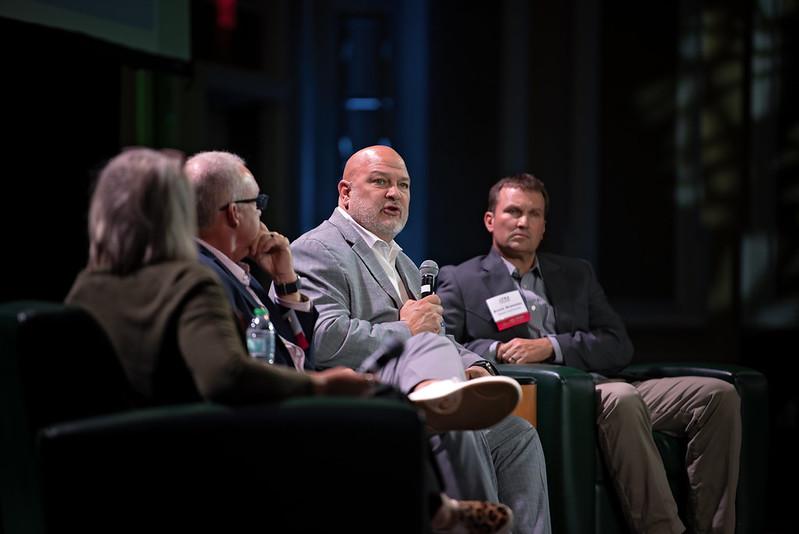
The Retention by Design: Connecting Education, Industry, and Opportunity Panel included: Brock Brewster, superintendent of Western Local Schools; Dan Leffingwell, director of GRIT Program/Future Plans; John Zehentbauer, superintendent of Mahoning County Career Technical Center; and moderator Laurie McKnight, senior research manager for 5G Broadband at the Voinovich School.
Leffingwell, a retired superintendent, explained the GRIT Program’s aims to deploy Science Technology Engineering and Math (STEM) curricula to “bridge the gap” between educational approaches and future jobs by helping communities and schools reach their goals to connect students to the jobs of the future, most of which are STEM-related.
Zehentbauer discussed the Mahoning County Career Technical Center in Canfield’s efforts toward offering STEM-related courses and workforce development, which bolstered its manufacturing and aviation programs. Those efforts resulted in the center growing its attendance while other schools have seen declines.
Brewster, a lifelong Pike County resident, shared how the 2023 overdose death of a student spurred him to seek changes in the school’s approach to learning and adopt the GRIT program. Saying the area has an “exposure gap” versus a “talent gap,” his district has adopted GRIT assessments toward personalized education plans, created a Western BUILT marketing initiative and started more career-focused learning at its Western Career Exploration and Development Center, he said.