
Examining environmental politics, polarization, and hope
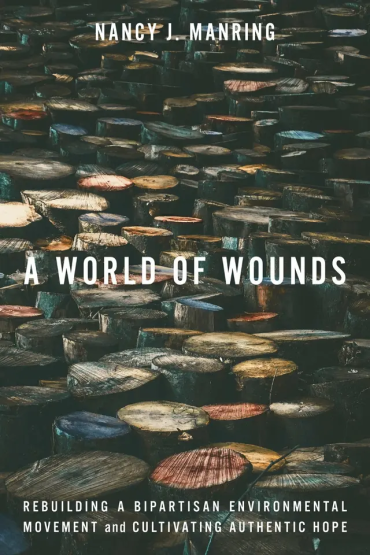
Ohio University faculty member Nancy Manring reflects on the ideas behind her new book, “A World of Wounds,” and what our dialogue around environmental issues reveals about conflict and cooperation.
February 12, 2026
Share:
At a time when environmental politics often feel exhausting, combative, or difficult to move forward, Nancy Manring has spent her career asking a novel question: what if we reframe the problem?
As a political science professor in the College of Arts and Sciences at Ohio University, Manring has brought an unusually broad lens to environmental politics, shaped by her background in the natural sciences, environmental policy, and public dispute resolution. This perspective anchors her new book, “A World of Wounds,” which explores how environmental issues became so deeply polarized in the United States.
The book reflects the kinds of questions Manring regularly encounters in the classroom, like how misinformation can sometimes occur, why emotions like fear and grief matter, and what can help people remain engaged when issues feel overwhelming.
Drawing on research across disciplines, Manring points to shared interests in land, wildlife, and public spaces as areas in the political debate where cooperation is still possible. In the edited Q&A below, Manring reflects on the ideas behind the book, the path that shapes her work at Ohio University, and what it means to stay engaged when the stakes feel overwhelming.
Worldviews vs. ideologies: A different framework for environmental politics
Q: It might be tempting for someone to feel overwhelmed or stuck when they think about climate politics. What do you hope this book helps them see differently?
A: People rarely talk about climate change with family and friends due to many misperceptions about the breadth of concern.
As a result, people often feel overwhelmed and hopeless because they think others don’t care. My book helps people understand that large majorities of Americans are worried about climate change and other environmental issues such as biodiversity loss, plastic pollution, “forever chemicals” and the like, and they want to see their concerns addressed effectively and legislatively. My book offers suggestions for cultivating authentic hope, and concrete strategies for communicating about environmental issues across the partisan divide.
Q: You came to environmental politics through the natural sciences and dispute resolution rather than traditional political science training. How has that path shaped the way you approach political questions in this book?
A: Most analyses of U.S. environmental politics focus on actors, institutions, and the role of competing political ideologies; the earth typically is ignored. Based on my background in the natural sciences and environmental dispute resolution, my work employs the framework of competing worldviews (also known as paradigms, deep-seated beliefs about the way humans relate to nature and one another) rather than traditional political models. By explicitly incorporating the earth and attitudes toward nature, the model of competing worldviews provides a more accurate and nuanced examination of the dynamics of environmental politics. Environmental politics is primarily a contest among actors with competing worldviews rather than competing political ideologies. This approach helps to diffuse partisanship and illustrates that many people across the political spectrum care about the environment.
From natural sciences to political science: An interdisciplinary approach
Q: Your path into environmental politics wasn’t a straight line. What parts of your background have been most valuable in your career at Ohio University?
A: My background in the natural sciences enables me to teach environmental politics grounded in the earth and the realities of our contemporary environmental problems. This grounding in the sciences mirrors the reality of environmental issues, adds richness to my teaching, and enables me to discuss the ecological and global stakes of domestic environmental policy decisions. My research in the environmental, ecological, sustainability, and Earth System sciences also is what led me to the framework of authentic hope which informs the writing of my book, how I teach, and helps to sustain my students as they face the realities of accelerating global warming and ecological loss. My background in dispute resolution paired with my multi-disciplinary background enables me to synthesize and navigate competing perspectives and has facilitated my work with faculty members from many diverse departments.
Teaching environmental politics through the lens of hope
Q: In what ways did your experiences in the classroom shape how you approached writing "A World of Wounds"?
A: My book is built upon and expands upon my teaching pedagogy. I have always taught environmental politics through the lens of competing paradigms rather than traditional ideological conflict. Several of the book chapters expand upon material I present in class. My book and courses are grounded in the concept of authentic hope. Authentic hope, unlike optimism, involves staring reality in the face then choosing hope and action.
Authentic hope, unlike optimism, involves staring reality in the face then choosing hope and action.
Q: You bring up emotions like fear, grief, and anxiety next to a field that’s often very data-driven. Why do you think emotions belong in political science, particularly when we talk about climate and the environment?
A: The role of emotion in politics, political communication, and policy support is a growing area of research in political science. Loss of valued ecosystems, ecological decline and climate change cause emotional and psychological distress for many people, especially young people. Research shows that ecological grief and eco-anxiety can cause depression and hopelessness that often lead to political inaction rather than political participation at a time when widespread political participation is essential to protect our planetary home.
Finding common ground: Interest-based solutions to climate debates
Q: A lot of environmental debates are framed as zero-sum fights. How did your experience with conflict resolution influence how you think about disagreement, negotiation, and compromise in this space?
A: Many zero-sum disputes occur when stakeholders with hardened positions conflict with each other. However, people have multiple interests that underlie even hardened positions. Focusing on underlying interests is the key to collaboration and agreement. For example, imagine someone who believes that global warming is not a serious, man-made problem; but this same person is a strong advocate of renewable energy. If someone’s interests are aligned with the goal of reducing our reliance on fossil fuels, does it really matter if their position is that global warming is not a serious issue? There are so many reasons not to burn fossil fuels for energy that do not involve challenging hardened positions about global warming. People care about many issues negatively affected by drilling, refining, transporting, and burning fossil fuels. The “collateral damages” of our reliance on fossil fuels provide multiple opportunities for collaboration around widely shared interests such as reducing air and plastic pollution, protecting public lands, wildlife, and outdoor recreation opportunities.
Building critical thinking skills around issues-driven complexity
Q: Environmental mediation involves reconciling competing perspectives on complex environmental issues. How have you helped students develop an appreciation for diverse perspectives and analytical thinking?
A: When I was teaching Public Dispute Resolution, I taught my students interest-based negotiation, the fundamentals of the mediation process, and consensus-building skills. I hope that my students develop the critical thinking skills that enable them to engage in more complex and nuanced analysis of environmental politics that transcends ideological conflict and other traditional political variables. In all my classes, I also provide information to help my students develop communication skills for addressing complex environmental issues. Lastly, I talk a lot about cultivating hope. Our students need authentic hope to foster resilience and better mental health as they navigate adulthood in a turbulent world.
Q: What kinds of assignments or activities have you found most effective in helping students engage with complex environmental issues?
A: Climate scientists say that the most important thing all of us can do to address global warming is talk about it. In my climate change politics course, over the Thanksgiving weekend, my students complete an assignment called “Ending Climate Silence” that requires them to talk about global warming with family or friends. It is impossible to effectively mobilize public support and political advocacy for an issue that people won't talk about. I share research on climate change communication strategies and dispute resolution skills to help them prepare for a conversation. This assignment enables them to dispel superficial stereotypes, investigate the complexity of climate change politics, and think critically about how to communicate about an issue that causes many of my students a great deal of worry and anxiety. Science-based issues like environmental issues pose challenges for democratic forms of government. Investigating the question, “Can democracy handle climate change?” provides an opportunity for my students to think deeply about the strengths and weaknesses of democratic processes in the larger context of bequeathing future generations a stable climate and democratic governance.
Public lands as common ground for bipartisan collaboration
Q: You argue that rebuilding a bipartisan environmental movement is still possible. Where do you see the most realistic chances for people across parties to work together?
A: The environmental movement is a broad movement with many areas of focus. People all across the political spectrum care very deeply about our public lands and wildlife. The most promising realm for bipartisan collaboration is the protection of our natural heritage, a traditional area of focus for many environmental organizations.