Image
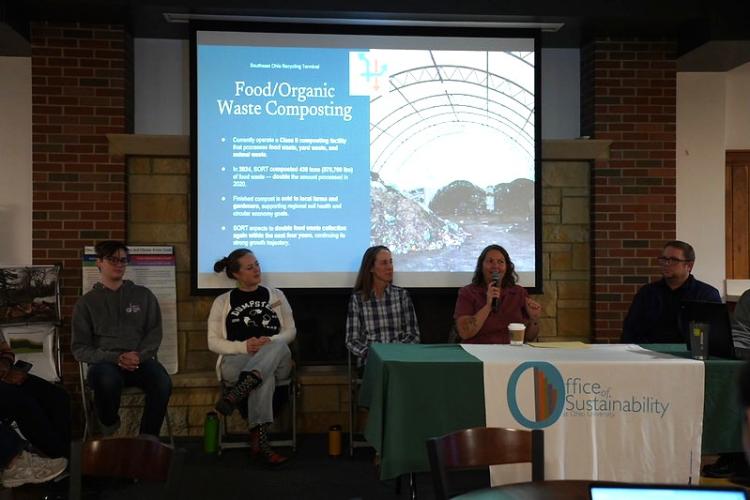
This article was written by Voinovich School of Leadership and Public Service student Avery Barker about Barker's experiences at the seminar.
It was a privilege to attend the Sustainable Infrastructure Hub Seminar on Nov. 24, focusing on "Organic Waste Management Strategies that Generate Value for Campus and Community."
As a student working with the Voinovich School of Leadership and Public Service, it was inspiring to see how closely our school is tied to these critical regional sustainability efforts, especially since the event was moderated Dr. Sara Davis, the Sustainability Infrastructure Hub coordinator. The seminar, which featured a diverse panel of experts, hammered home a key idea of sustainability is much more than just taking out the trash, it’s about leadership, policy, and creating true value from waste, specifically focusing on organic waste (food, agriculture waste, and bio solids).
The discussion centered on how local partnerships are making Athens a leader in the state.
Crissa Cummings from the Southeast Ohio Recycling Terminal (SORT) highlighted impressive progress, stating that in 2024, SORT composted 438 tons (876,700 lbs.) of food waste, more than three times the amount processed just four years ago. The finished compost is then sold to local farms and gardeners, supporting regional soil health.
Crucially, SORT is now assessing a Biosolids Feasibility Grant, collaborating with the Voinovich School, Rural Action, local wastewater plants, and regional food processors to expand capacity to process biosolids and food processing residuals.
It was also interesting to learn that Ohio University has been a long-time leader, with Steve Mack of Facilities Management noting that OHIO established the largest in-vessel composting system in the U.S. back in 2009.
Further complementing this, Dr. Jay Wilhelm is studying how inexpensive sensors can be used in compost bins to track decomposition and provide upstream processing data. He explained that tracking methane levels can indicate when composting is working well.
The session highlighted the critical role of collaboration. Nicole Kirchner, senior program manager for the Ohio Zero Waste Initiative at the Voinovich School, and Maria Bonner (Rural Action’s Zero Waste program manager) spoke about the successes driven by the Appalachia Ohio Zero Waste Initiative (AOZWI), funded by the Sugar Bush Foundation. This partnership has led to the Athens curbside compost program and, more recently, bringing composting to area schools. Kirchner stressed that the amount of food waste diverted from the landfill in the last 16 years is "tremendous,” demonstrating that universities have a responsibility to "lead the way and demonstrate change."
However, the panel was honest about the challenges. The panelists noted that 25% of the mass in landfills is just food waste, which has a massive environmental impact. Key barriers include funding, complex regulation surrounding biosolid composting, and the fact that since landfill costs in Ohio are currently so cheap, it’s hard to convince people to pay extra for composting. Panelists agreed that growth won't happen until there is a change in policy. Finally, the panel stressed, behavior change takes time.
It was inspiring to see that students are not just watching but actively searching for solutions. Ava Wood, a junior environmental studies major, shared her work on Greek Waste Life Management. For composting in Greek housing, she asked the pivotal question: "What is the most effective way to build a system that will last beyond one exec board?" The panel suggested putting policy and infrastructure in place and getting someone younger looped into the process early.
Pat Syar, a junior chemical engineering major, discussed how AI can make composting easier. His research looks at AI systems that tell people where to put their waste. This can be a game changer, as he noted that university deployments have seen sorting accuracy rates "soar to 96%, up from as low as 30% without intervention."
Finally, Esther Afryie, a graduate student in environmental studies, brought up the vital topic of international student engagement. She pointed out that differences in home country’s waste systems and language barriers make it difficult to adjust, suggesting the use of standardized international pictograms for sorting.
The greatest opportunities in the next few years, according to the panel, lie in developing a facility for biosolids, leveraging AI for efficiency, and the inevitable policy changes in Ohio that will force us to come up with other solutions as the landfills fill up.
Attending this seminar reinforced for me why the Voinovich School’s focus on applied leadership is so important. These are not abstract concepts, they are real problems being solved right here at Ohio University through collaboration between students, researchers, and community leaders.