Image
For Ohio University Lancaster engineering technology student Tyler Merritt, taking things apart as a child was more than a curiosity.
“Growing up, I used to take things apart to see how things worked and then put them back together,” he said. “I was also fascinated with automation, how you could program a process to complete a task repeatedly.”
That early fascination became the foundation of a journey that is now shaping his future in advanced manufacturing. Today, through his education at the Fairfield County Workforce Center and his hands-on experience at Mid-West Fabricating, Merritt is transforming his lifelong interest in how things work into a meaningful career defined by dedication, growth, and opportunity.
Merritt’s path to Mid-West Fabricating began during the challenges of the COVID-19 pandemic, when his previous employer was forced to reduce staff. In searching for a new opportunity, he applied at Mid-West and was hired onto a team that values hard work and internal advancement. As he settled into the company, he began to recognize the potential it offered.
“I realized they like to promote people from within, so there was a good opportunity for growth,” he said. His commitment quickly stood out, earning him recognition and awards for dedication. When he expressed interest in long-term opportunities, leadership pointed him toward the Engineering Technology program at OHIO Lancaster.
After two years as an operator, he was promoted to CMM technician and quality inspector, a role he considers highly important because “it’s my job to catch defects and make sure all the gauges are good for production.”
This year marked the five-year anniversary of the partnership between Ohio University and the Fairfield County Workforce Center, a collaboration launched in 2020 to strengthen the region’s pipeline of skilled workers in manufacturing, healthcare, and the trades.
The Workforce Center has grown into a state-of-the-art training hub equipped with industry-grade robotics, mechatronics systems, programmable logic controllers and advanced engineering lab tools. It offers an associate degree in engineering technology and stackable certificates in automation, mechatronics, and semiconductor manufacturing fundamentals, creating clear entry points and pathways for students entering high-demand careers.
The partnership provides students with direct access to industry-aligned curriculum and technology, helping them move seamlessly from classroom learning to hands-on application.
For Merritt, this partnership has played a direct role in his professional advancement.

“This program helped me get my new job in the quality department,” he said. Courses such as process control and engineering graphics have strengthened his technical abilities, which he uses daily, particularly in reading part drawings and understanding tolerances. He explained that what he learns in class often shows up at work the very same week, and that his experience on the production floor also makes classroom concepts easier to grasp.
“When I’m in class, I have real-world experience on a lot of the stuff we’re covering, and it just helps me understand the course easier,” he said. Working closely with engineers in his current role has given him an early understanding of the responsibilities he hopes to take on in the future.
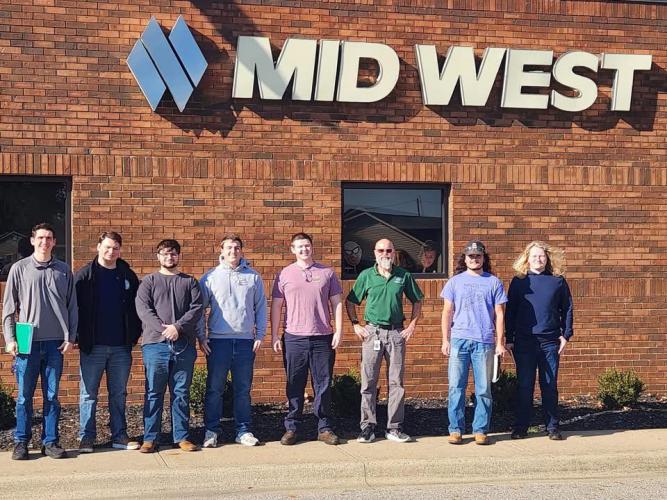
His dual roles as student and employee came together recently when he helped host an on-site class visit at Mid-West Fabricating. Mark Wile, assistant professor of instruction in engineering technology at Ohio University Lancaster, brought his Lean Enterprise course to the Amanda facility to observe manufacturing operations firsthand. Merritt led the tour, answered student questions and demonstrated several processes used daily in the plant.
The visit gave students valuable insight into how concepts like workflow analysis, quality control and process improvement play out in a real production environment. Merritt hoped the students understood how accessible these opportunities can be.
“I hope they realize that there are numerous opportunities available at various companies, and you can walk in without a degree and work your way up from the ground,” he said. “If you demonstrate dedication and a willingness to work, many places will assist you in achieving your goals.”
Looking ahead, Merritt hopes to transition into an engineering role and has been encouraged to pursue a bachelor’s degree in project management after completing his associate degree. His current position has allowed him to work closely with engineers, giving him firsthand insight into the problem-solving approaches and responsibilities associated with that field.
“My current goal is to hopefully get into the engineering field,” Merritt said. “They’ve also mentioned that I can potentially go for my bachelor’s in project management in the future.”
Reflecting on his journey so far, Merritt shared that the most rewarding part has been the steady progression of opportunities within a strong and reputable company. He has appreciated meeting people from diverse fields through both his job and his coursework, and he values the mentorship he has received from his instructors.
“I’ve had the privilege of meeting wonderful people at school, including helpful teachers who have been instrumental in my academic and professional journey,” he said.
Merritt encourages future engineering technology students to explore, ask questions and take time to discover what truly interests them. He believes that entering the workforce before or during school can offer clarity and valuable experience.
“You don’t have to complete your degree at the specified time; you can work while attending school,” he said. Merritt advises students to look for employers that support their goals and offer chances to advance, noting that many companies prefer to promote from within.
Merritt also sees the engineering technology field as essential to the future of Ohio’s workforce. He believes manufacturing will rely increasingly on automation to remain efficient and affordable, and that artificial intelligence and robotics will require highly skilled technicians and engineers capable of maintaining and improving complex systems.
“We will need skilled individuals who can work on robots and automated processes,” he said, emphasizing the growing demand for professionals who understand both the mechanical and digital aspects of modern manufacturing.
The partnership between Ohio University and the Fairfield County Workforce Center, now five years strong, is creating a strong foundation for students like Merritt and many more who will follow. It connects education with industry needs, opens doors to meaningful careers and strengthens the workforce of Fairfield County and beyond. Merritt’s success illustrates what becomes possible when opportunity, education and determination intersect, and his story represents just one example of how this partnership continues to shape the region’s manufacturing future.
For more information, visit ohio.edu/WorkforceCenter.