
Final Comprehensive Project | MS Exercise Physiology
Exercise Physiology Graduate Program Final Comprehensive Project (MS8089 & MS8090)
This project is intended as a means for students to demonstrate their comprehensive knowledge gained through Exercise Physiology academic and practical learning and is to be completed prior to starting the capstone experience (Internship).
The objective of this project is for students to complete a critically appraised topic (CAT) to answer a specific clinical question in order to enhance the evidence-based clinical practice of clinical exercise physiologists. A CAT paper is a synthesis of studies reviewing the same general topic and should lead to practical answers to a well-formed PICO(T) question.
The CAT paper will include the following 11 components and divided into 7 sections (see outline below): abstract; clinical scenario; clinical question (PICO(T)); search strategy & criteria; inclusion and exclusion criteria; best evidence/results; clinical bottom line; strength of the recommendation; implications for practice, education and future research, references, and figures & tables. There will be 1 required figure and 2 required tables.
Students are each other’s peers and, as a peer, students should be open and willing to review each other’s papers. Reviewing other students’ papers will help with your own writing and all students will benefit from the shared knowledge that is gained.
The project is completed as part of EXPH 6080 but may be worked on after this if a student wishes to publish the paper. If so, they may choose to register for Independent Study with an EXPH faculty mentor to complete this work.
Writing format
- APA Style (including citations and references) - recommend using Zotero.
- Double-spaced
- 12-point Times New Roman Font
- 1” left and right margins, and 1.25” top and bottom margins
Primary research journal articles should comprise the references for critical appraisal. This limitation does not extend to the introduction and background section.
- Primary research articles: Peer-reviewed original research articles and DO NOT include reviews, systematic reviews, clinical guidelines, position stands, clinical practice recommendations, opinion papers, or textbooks.
- Meta-Analysis: DO NOT use meta-analyses for critical appraisal.
- There are no reference list maximums or page number limitations. The student will continue to work on (re-write and refine with additional information) through the spring semester.
Cover Page
- Title of Paper
- Author
- Anticipated graduation date
Structured Abstract. Structured abstracts should provide the following key information in 300 words or less.
Clinical Scenario. A brief description of background information that demonstrates need and clinical relevance for the focused clinical question. This section should include epidemiology, pathophysiology, and current care and management of patients (this should be from clinical guidelines and recommendations both in the US and International) and be approximately 2-4 paragraphs.
Focused Clinical Question. The focused clinical question should be developed and presented using the PICO format
Search Strategy and Criteria. Clearly describe the process used to search for and include evidence to answer the focused clinical question.
- Search Strategy: Include the databases and sites searched, the search terms used, search limits, and timeframe of search. The search should ideally be conducted within 3 months of submission for publication and should seek to obtain the best available evidence.
- Inclusion and Exclusion Criteria: Describe the criteria for selection - the processes through which studies were selected for inclusion for further analysis.
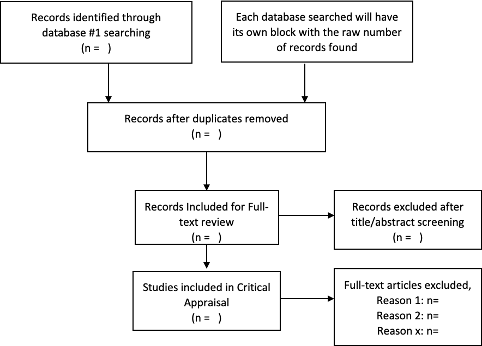
- Figure 1 in your paper should be a flow diagram of this process
Evidence of Quality Assessment. Describe the quality assessment scale used to appraise the quality of the evidence in the included studies
Summary of Search and Key Findings. In narrative form, describe the results of your search. Talk about implications for practice, education and future research.
Results of Quality Assessment from Best Available Evidence. Describe the sources of evidence used, including the reasons the studies were selected (level of evidence, strengths and weaknesses related to issues of validity, and quality assessment scale results). Please use the Center for Evidence-Based Medicine (2011) definitions for level of evidence (https://www.cebm.ox.ac.uk/) and the quality assessments provided on Canvas.
Summary of Best Evidence (Table). This summary of included evidence is a comparative presentation that must be presented in a table. The table headings/rows must include citation, study design, participants, inclusion/exclusion criteria, intervention investigated, outcome measures, results, level of evidence, quality assessment score, and contribution to CAT question. The contribution to CAT question should be the CAT authors’ rating of how the study answers the focused clinical question using as scale such that 1 is no contribution, 3 is an inconclusive contribution, and 5 is a conclusive contribution.
Clinical Bottom Line. This section includes the following:
- Strength of Recommendation: Provide the strength of recommendation based on the collective findings of the CAT by taking into account the individual studies’ level of evidence and the number, consistency, and coherence of the evidence as a whole. Authors must use the following text and insert the appropriate grade: “Collectively, the body of evidence included to answer the clinical question aligns with the strength of recommendation of [insert: A, B, C].”
- Answer to Clinical Question: Describe the clinical bottom line that answers the proposed clinical question using the appraised evidence.
Implications for Practice, Education, and Future Research. Include a practical discussion based on the information provided from the appraisal of current literature. Anecdotal comments regarding whether or not this intervention is commonly used clinically, the cost of this intervention, and so on are appropriate.
References (APA Format)
Flow Diagram of Inclusion Process of Reviewed Publications
Table 1: Search Strategy
| Date Searched | Database | Search Strategy | Filters/Limiters | Records Found |
|---|---|---|---|---|
| 6 July | PubMed | (Sedentary Behavior OR inactive OR “lack of physical activity”) AND (hypertension OR “High Blood Pressure”) AND (eating OR nutrition OR food intake OR dietary intake) AND (intermittent fasting OR “Time Restricted Feeding” OR fast*) | 2012-2022 RCT | 39 |
Table 2: Summary of Best Evidence
| citation | study design | participants | inclusion/exclusion criteria | intervention investigated | outcome measures | results | level of evidence | quality assessment score | contribution to CAT question |